Carlo Chiarappa - Antonio Vivaldi: "Il cimento dell'armonia e dell'invenzione," Op. 8, No. 1–6 (1993)
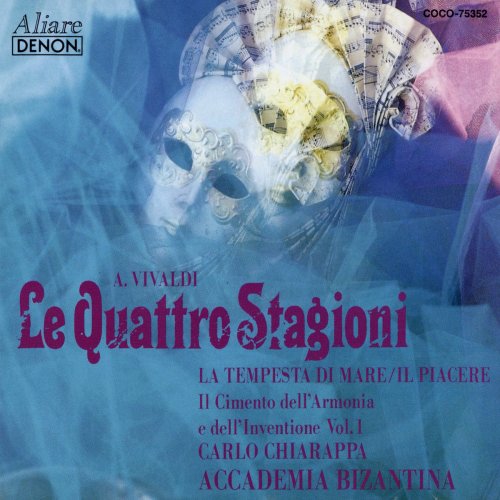
Artist: Carlo Chiarappa, Accademia Bizantina
Title: Antonio Vivaldi: "Il cimento dell'armonia e dell'invenzione," Op. 8, No. 1–6
Year Of Release: 1993
Label: Nippon Columbia Co., Ltd. / DENON
Genre: Classical
Quality: FLAC (tracks)
Total Time: 54:23 min
Total Size: 269 MB
WebSite: Album Preview
Tracklist:Title: Antonio Vivaldi: "Il cimento dell'armonia e dell'invenzione," Op. 8, No. 1–6
Year Of Release: 1993
Label: Nippon Columbia Co., Ltd. / DENON
Genre: Classical
Quality: FLAC (tracks)
Total Time: 54:23 min
Total Size: 269 MB
WebSite: Album Preview
01. Concerto No. 1 in E-Major, RV 269, F.I-22 "La Primavera": I. Allegro
02. Concerto No. 1 in E-Major, RV 269, F.I-22 "La Primavera": II. Largo
03. Concerto No. 1 in E-Major, RV 269, F.I-22 "La Primavera": III. Allegro; Danza Pastorale
04. Concerto No. 2 in G-Minor, RV 315, F.I-23 "L'estate": I. Allegro non molto
05. Concerto No. 2 in G-Minor, RV 315, F.I-23 "L'estate": II. Adagio
06. Concerto No. 2 in G-Minor, RV 315, F.I-23 "L'estate": III. Presto; Tempo impetuoso d'Estate
07. Concerto No. 3 in F-Major, RV 293, F.I-24 "L'autunno": I. Allegro; Ballo e Canto de'Villanelli
08. Concerto No. 3 in F-Major, RV 293, F.I-24 "L'autunno": II. Adagio molto; Dorminenti Ubriachi
09. Concerto No. 3 in F-Major, RV 293, F.I-24 "L'autunno": III. Allegro; La Caccia
10. Concerto No. 4 in F-Minor, RV 297, F.I-25 "L'inverno": I. Allegro non molto
11. Concerto No. 4 in F-Minor, RV 297, F.I-25 "L'inverno": II. Largo
12. Concerto No. 4 in F-Minor, RV 297, F.I-25 "L'inverno": III. Allegro
13. Concerto No. 5 in E-Flat Major, RV 253, F.I-26 "La tempesta di mare": I. Presto
14. Concerto No. 5 in E-Flat Major, RV 253, F.I-26 "La tempesta di mare": II. Largo
15. Concerto No. 5 in E-Flat Major, RV 253, F.I-26 "La tempesta di mare": III. Presto
16. Concerto No. 6 in C Major, RV 180, F.I-27 "Il Piacere": I. Allegro
17. Concerto No. 6 in C Major, RV 180, F.I-27 "Il Piacere": II. Largo E Cantabile
18. Concerto No. 6 in C Major, RV 180, F.I-27 "Il Piacere": III. Allegro
Accademia Bizantina has the stated intention of "making music like a large quartet"; the group is a Baroque orchestra specializing in choral music and opera.
A unique feature of the ensemble has been its cooperative structure; although keyboardist and conductor Ottavio Dantone has been musical and artistic director since 1996, Accademia Bizantina is managed by its collective membership, making for a sound and a management structure that mirror each other. The ensemble was founded in 1983 in Ravenna and was encouraged by, among others, the historically minded Austrian pianist Jörg Demus, the conductor Riccardo Muti, and the composer Luciano Berio, with whom it worked on a 1992 recording of his works. Among the figures who shaped its vigorous and brisk style were violinist Stefano Montanari and harpsichordist Dantone; the latter joined Accademia Bizantina in 1989 and has brought to the group a perspective that includes both musicological research and interpretive imagination. Beginning with Giuseppe Sarti's Giulio Sabino in 1999, the group has had a special focus on the rediscovery of neglected Baroque operas. It maintains a busy concert schedule across Italy and worldwide.
The Berio recording was Accademia Bizantina's debut, and its only recording to feature contemporary music. Mostly it has stayed within the core Baroque period, emphasizing equally well-trodden pieces like Vivaldi's Il Cimento dell'Armonia concertos and lesser-known works. In the 2010s it has ventured as far forward chronologically as Haydn, issuing a set of historically informed Haydn symphony performances on the Decca label in 2016. Its career on Decca began in 2004 with a recording of sinfonias and concertos of Alessandro Scarlatti, entitled Il giardino di rose, after an oratorio from which instrumental excerpts on the album were taken. It has also recorded for Arts Music, Naïve, Denon, and Alpha, for which they backed soprano Delphine Galou on a 2017 recording of Baroque arias, Agitata. ~ James Manheim
A unique feature of the ensemble has been its cooperative structure; although keyboardist and conductor Ottavio Dantone has been musical and artistic director since 1996, Accademia Bizantina is managed by its collective membership, making for a sound and a management structure that mirror each other. The ensemble was founded in 1983 in Ravenna and was encouraged by, among others, the historically minded Austrian pianist Jörg Demus, the conductor Riccardo Muti, and the composer Luciano Berio, with whom it worked on a 1992 recording of his works. Among the figures who shaped its vigorous and brisk style were violinist Stefano Montanari and harpsichordist Dantone; the latter joined Accademia Bizantina in 1989 and has brought to the group a perspective that includes both musicological research and interpretive imagination. Beginning with Giuseppe Sarti's Giulio Sabino in 1999, the group has had a special focus on the rediscovery of neglected Baroque operas. It maintains a busy concert schedule across Italy and worldwide.
The Berio recording was Accademia Bizantina's debut, and its only recording to feature contemporary music. Mostly it has stayed within the core Baroque period, emphasizing equally well-trodden pieces like Vivaldi's Il Cimento dell'Armonia concertos and lesser-known works. In the 2010s it has ventured as far forward chronologically as Haydn, issuing a set of historically informed Haydn symphony performances on the Decca label in 2016. Its career on Decca began in 2004 with a recording of sinfonias and concertos of Alessandro Scarlatti, entitled Il giardino di rose, after an oratorio from which instrumental excerpts on the album were taken. It has also recorded for Arts Music, Naïve, Denon, and Alpha, for which they backed soprano Delphine Galou on a 2017 recording of Baroque arias, Agitata. ~ James Manheim
![Isaiah Collier - JOY (2026) [Hi-Res]](https://www.dibpic.com/uploads/posts/2026-07/1785475369_pmwehr0rydwbv_600.jpg "Isaiah Collier - JOY (2026) [Hi-Res]")
![Dino Siani - Pianoforte e Orchestra / I Solisti e gli Archi (2026) [Hi-Res]](https://img.israbox.com/img/2026-07/30/w73w7u4gf9zujnwitnrytw81f.jpg "Dino Siani - Pianoforte e Orchestra / I Solisti e gli Archi (2026) [Hi-Res]")
![Erroll Garner - Plays All-Time Hits (1965) [Vinyl]](https://www.dibpic.com/uploads/posts/2026-07/1785260363_5.jpg "Erroll Garner - Plays All-Time Hits (1965) [Vinyl]")