Ottavio Dantone - Scarlatti: Il Giardino Di Rose (2004)
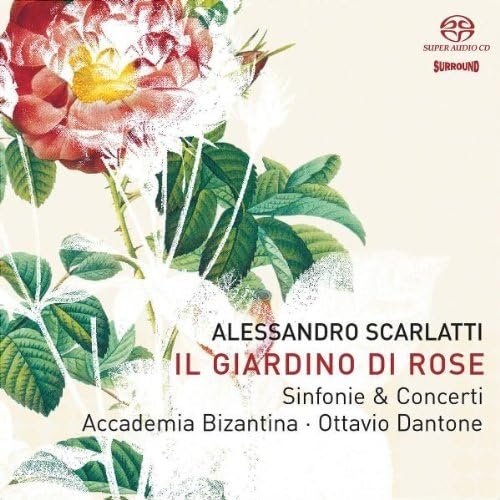
Artist: Ottavio Dantone
Title: Scarlatti: Il Giardino Di Rose
Year Of Release: 2004
Label: Decca
Genre: Classical
Quality: FLAC (image+.cue,log,scans)
Total Time: 01:15:13
Total Size: 404 MB
WebSite: Album Preview
Tracklist:Title: Scarlatti: Il Giardino Di Rose
Year Of Release: 2004
Label: Decca
Genre: Classical
Quality: FLAC (image+.cue,log,scans)
Total Time: 01:15:13
Total Size: 404 MB
WebSite: Album Preview
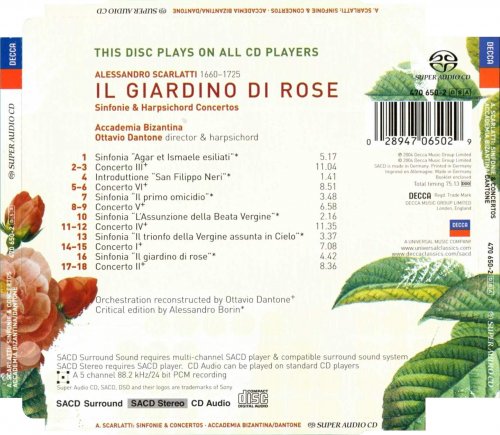
01. Sinfonia avanti l'oratorio "Agar et Ismaele esiliati"
Concerto III
02. I. Allegretto comodo
03. II. Andante con spirito
04. Introduttione "San Filippo Neri"
Concerto VI
05. I. Allegro moderato
06. II. Andante con espressione
07. Sinfonia "Il primo omicidio"
Concerto V
08. I. Allegro
09. II. [Presto]
10. Sinfonia "L'Assunzione della Beata Vergine"
Concerto IV
11. I. Andante
12. II. Allegretto moderato
13. Sinfonia "Il trionfo della Vergine assunta in Cielo"
Concerto I
14. I. Allegro
15. II. Allegretto
16. Sinfonia "Il Giardino di Rose"
Concerto II
17. I. Andantino
18. II. Andante con moto
Things are seldom what they seem,’ Little Buttercup remarks in HMS Pinafore, and this disc is certainly sailing under some strange colours. The straightforward part first: some 20 minutes are taken up with six of Scarlatti’s oratorio sinfonias. All but one are miniature concertos, pitting a solo violin or a concertino group against ripieno strings.
The predominant mood is one of jollity – rather surprising in the case of the murder of Abel by Cain – with plenty of chains of thirds for the solo violins. Among many deft touches are the end of Il trionfo della Virgine, which fades away like the heavenly host in Messiah. The expressive suspensions in Il giardino di rose are also to be heard in the earliest piece, Agar et Ismaele esiliati (1691), the final presto of which lasts all of 14 seconds.
The harpsichord concertos survive in an 18th-century manuscript in the British Library, dating from well after Scarlatti’s death. They are laid out on two staves, with passages marked solo and tutti, but in his booklet-note Alessandro Borin argues that the material needs to be fleshed out. Each concerto is in two movements, the first being fugal and the second a dance, generally in the form of a gigue. In the former, Ottavio Dantone has not simply scored the tutti sections but added fugal entries and composed introductions. According to his own detailed booklet-note, the binary form of the dance movements presented less of a problem.
The results are enjoyable, and beautifully played by Dantone and the lean strings of Accademia Bizantina. Whether the concertos are early examples of what Borin calls the emancipation of the harpsichord as a concertante instrument begs a number of questions, the principal one being whether the attribution to Scarlatti is correct in the first place. As for the elaboration, the copyright notice calls them ‘6 Harpsichord Concertos on themes by Scarlatti’, which must be nearer the mark. As an exact contemporary of Scarlatti said in another context: ‘It is a pretty poem, Mr Pope, but you must not call it Homer.’
–Richard Lawrence
The predominant mood is one of jollity – rather surprising in the case of the murder of Abel by Cain – with plenty of chains of thirds for the solo violins. Among many deft touches are the end of Il trionfo della Virgine, which fades away like the heavenly host in Messiah. The expressive suspensions in Il giardino di rose are also to be heard in the earliest piece, Agar et Ismaele esiliati (1691), the final presto of which lasts all of 14 seconds.
The harpsichord concertos survive in an 18th-century manuscript in the British Library, dating from well after Scarlatti’s death. They are laid out on two staves, with passages marked solo and tutti, but in his booklet-note Alessandro Borin argues that the material needs to be fleshed out. Each concerto is in two movements, the first being fugal and the second a dance, generally in the form of a gigue. In the former, Ottavio Dantone has not simply scored the tutti sections but added fugal entries and composed introductions. According to his own detailed booklet-note, the binary form of the dance movements presented less of a problem.
The results are enjoyable, and beautifully played by Dantone and the lean strings of Accademia Bizantina. Whether the concertos are early examples of what Borin calls the emancipation of the harpsichord as a concertante instrument begs a number of questions, the principal one being whether the attribution to Scarlatti is correct in the first place. As for the elaboration, the copyright notice calls them ‘6 Harpsichord Concertos on themes by Scarlatti’, which must be nearer the mark. As an exact contemporary of Scarlatti said in another context: ‘It is a pretty poem, Mr Pope, but you must not call it Homer.’
–Richard Lawrence
![Emma Rawicz - Paintbox (2026) [Hi-Res]](https://www.dibpic.com/uploads/posts/2026-08/1787846835_cover.jpg "Emma Rawicz - Paintbox (2026) [Hi-Res]")
![Suzanne Pittson, Bevan Manson - Conversations (2026) [Hi-Res]](https://www.dibpic.com/uploads/posts/2026-08/1787638754_inltnkdr7pl8m_600.jpg "Suzanne Pittson, Bevan Manson - Conversations (2026) [Hi-Res]")
![Kelly Green - Eat Your Greens (2026) [Hi-Res]](https://img.israbox.com/img/2026-08/27/2chtyjfvrpd2bmocqig5xvjnx.jpg "Kelly Green - Eat Your Greens (2026) [Hi-Res]")
![Joyce Cheung - Set Loose (2026) [Hi-Res]](https://www.dibpic.com/uploads/posts/2026-08/1787803966_pbl5fyeuhjjlm_600.jpg "Joyce Cheung - Set Loose (2026) [Hi-Res]")