Malcolm Martineau, Barbara Bonney - My Name Is Barbara (2005)
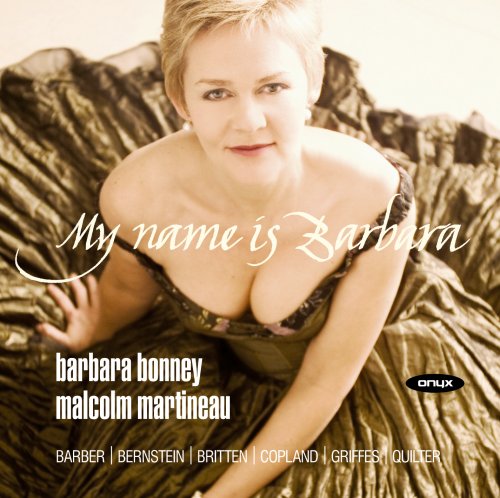
Artist: Barbara Bonney, Malcolm Martineau
Title: My Name Is Barbara
Year Of Release: 2005
Label: Onyx Classics Ltd.
Genre: Classical
Quality: flac lossless (tracks) +Booklet
Total Time: 01:01:07
Total Size: 264 mb
WebSite: Album Preview
TracklistTitle: My Name Is Barbara
Year Of Release: 2005
Label: Onyx Classics Ltd.
Genre: Classical
Quality: flac lossless (tracks) +Booklet
Total Time: 01:01:07
Total Size: 264 mb
WebSite: Album Preview
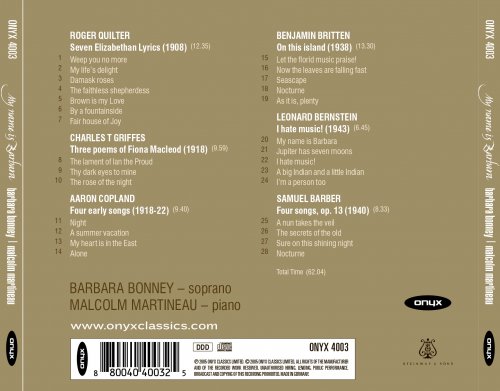
01. Seven Elizabethan Lyrics: Weep You No More
02. Seven Elizabethan Lyrics: My life's delight
03. Seven Elizabethan Lyrics: Damask roses
04. Seven Elizabethan Lyrics: The faithless shepherdess
05. Seven Elizabethan Lyrics: Brown is my Love
06. Seven Elizabethan Lyrics: By a fountainside
07. Seven Elizabethan Lyrics: Fair house of Joy
08. Griffes - Three Poems of Fiona Macleod: The Lament of Ian the Proud
09. Griffes - Three Poems of Fiona Macleod: Thy dark eyes to mine
10. Griffes - Three Poems of Fiona Macleod: The rose of the night
11. Copland - Four early songs: Night
12. Copland - Four early songs: A summer vacation
13. Copland - Four early songs: My heart is in the East
14. Copland - Four early songs: Alone
15. Britten - On this Island: Let the florid music praise!
16. Britten - On this Island: Now the leaves are falling fast
17. Britten - On this Island: Seascape
18. Britten - On this Island: Nocturne
19. Britten - On this Island: As it is, plenty
20. Bernstein - I hate music!: My name is Barbara
21. Bernstein - I hate music!: Jupiter has seven moons
22. Bernstein - I hate music!: I hate music!
23. Bernstein - I hate music!: A big Indian and a little Indian
24. Bernstein - I hate music!: I'm a person too
25. Barber - Four songs, op. 13: A nun takes the veil
26. Barber - Four songs, op. 13: The secrets of the old
27. Barber - Four songs, op. 13: Sure on this shining night
28. Barber - Four songs, op. 13: Nocturne
The title-song, and obviously no one could resist the idea, comes from Leonard Bernstein’s I Hate Music. This quirky song-cycle, with words by the composer, was first sung by Jennie Tourel, who gave it as an encore at the end of a recital with Bernstein accompanying. Tourel’s voice, a plush mezzo, was far away from Barbara Bonney’s gleaming soprano. Wisely, Bonney and Malcolm Martineau keep this jokey little sequence for late in their recital.
This is an eclectic, thoughtful collection. The most substantial item is Britten’s On This Island. Through several recordings by tenors (Pears, of course, Langridge, Tear) it may be forgotten that it was composed for a soprano and was first sung by Sophie Wyss in 1937.
The poems by WH Auden are heavy with symbolism and mystery, from the urgent, opening ‘Let the florid music praise’ through the swirling ‘Seascape’ and then the longest song, ‘Nocturne’, which is almost like a trial run for Britten’s later night-time evocations. The jazzy ‘As it is, plenty’ wraps up the cycle. This is a lovely performance, with Martineau bringing out all the little details in the accompaniment.
The three Griffes songs and the early Copland group are in similar mood: slow with images of restrained passion. In these, as well as the Quilter group with which she opens, Bonney relishes the high-lying phrases but at the same time is too often challenged by the difficulty of getting many words across. The four early Barber songs include his settings of Gerard Manley Hopkins’s ‘A nun takes the veil’ and Yeats’s ‘The secrets of the old’.
The recording inevitably favours the voice; the sequence ends up seeming like a soliloquy on life and love.
![Opus Kink - The Sweet Goodbye (2026) [Hi-Res]](https://www.dibpic.com/uploads/posts/2026-07/1785345641_1.jpg "Opus Kink - The Sweet Goodbye (2026) [Hi-Res]")



![Gordon Goodwin's Big Phat Band - 25 Years Of Phatness (2026) [Hi-Res]](https://img.israbox.com/img/2026-07/30/3n9gagsrklcvx2qlsr0pa41u7.jpg "Gordon Goodwin's Big Phat Band - 25 Years Of Phatness (2026) [Hi-Res]")
![Vladimir Shafranov Japan Trio - What A Wonderful World (2026) [Hi-Res]](https://www.dibpic.com/uploads/posts/2026-07/1785304352_dcim5ah0r9p6f_600.jpg "Vladimir Shafranov Japan Trio - What A Wonderful World (2026) [Hi-Res]")