Cuarteto Latinoamericano - Encores (2011)
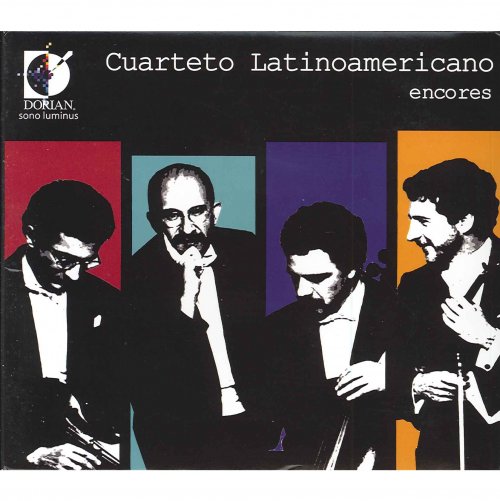
Artist: Cuarteto Latinoamericano
Title: Encores
Year Of Release: 2011
Label: Dorian Sono Luminus
Genre: Classical
Quality: FLAC (tracks + booklet)
Total Time: 1:15:54
Total Size: 375 MB
WebSite: Album Preview
Tracklist:Title: Encores
Year Of Release: 2011
Label: Dorian Sono Luminus
Genre: Classical
Quality: FLAC (tracks + booklet)
Total Time: 1:15:54
Total Size: 375 MB
WebSite: Album Preview
1. Valsa (Arr. E. Nazareth) (03:57)
2. Mambo 7/16 (02:12)
3. Canzoniere messicano (Mexican Songbook): Sandunga (03:15)
4. Cinco para Cuatro: No. 1, Vocalise (01:44)
5. Cinco para Cuatro: No. 2, Chorale (01:50)
6. Cinco para Cuatro: No. 3, Waves (02:46)
7. Cinco para Cuatro: No. 4, Meditation (01:10)
8. Cinco para Cuatro: No. 5, Ostinato Furioso (01:34)
9. Canzoniere messicano (Mexican Songbook): Besame mucho (06:24)
10. Yiddishbbuk: Ia.D.W. - Ib.F.B. - Ic.T.K. (03:33)
11. Yiddishbbuk: I.B.S. (04:33)
12. Yiddishbbuk: L.B. (04:40)
13. Canzoniere messicano (Mexican Songbook): Cuando sale la luna (05:41)
14. La Venus se va de juerga (04:40)
15. Rubaiyat (13:59)
16. Canzoniere messicano (Mexican Songbook): Cancion Mixteca (04:25)
17. Suenos de Sefarad (09:23)
The Encores title of this release by the mostly Mexican Cuarteto LatinoAmericano, which specializes in Latin American music for string quartet, is puzzling. Few of the pieces could be described as light crowd-pleasers, and Osvaldo Golijov's Yiddishbbuk and Carlos Sánchez-Gutiérrez's Cinco para Quatro are substantial multi-movement works. The Golijov is one of the few pieces of chamber music in that very hot composer's output, and the vigorous performance by the group is worth the price of admission. But beyond these are some real small finds. A group of settings of Mexican songs by Italian bassist/composer Stefano Scodanibbio, entitled (in Italian) Canzoniere messicano, follows the lines laid down by Luciano Berio in his folk song settings: the tunes are recognizable, but the music is heavily interpreted through changes in timbre and texture. Dispersed through the program as interludes, these have a compelling combination of simplicity and rigor. The program as a whole offers a varied mix of Latin American works, music composed in the U.S. that reflects Latin influences, and a broader Hispanic continuum that looks out as far as Persia in the Rubaiyat of Spanish composer Adolfo Salazar. Booklet notes, in English only, are by violinist Saúl Bitrán. Recommended for those with any interest in the contemporary Latin American scene.
![Michael Kanan - Live at Mezzrow (2026) [Hi-Res]](https://www.dibpic.com/uploads/posts/2026-07/1785472300_dcxcgf89bzn3v_600.jpg "Michael Kanan - Live at Mezzrow (2026) [Hi-Res]")
![Stan Getz - Big Band Bossa Nova (1962/2026) [Hi-Res]](https://www.dibpic.com/uploads/posts/2026-07/1785431844_cover.jpg "Stan Getz - Big Band Bossa Nova (1962/2026) [Hi-Res]")
![Gordon Goodwin's Big Phat Band - 25 Years Of Phatness (2026) [Hi-Res]](https://img.israbox.com/img/2026-07/30/3n9gagsrklcvx2qlsr0pa41u7.jpg "Gordon Goodwin's Big Phat Band - 25 Years Of Phatness (2026) [Hi-Res]")