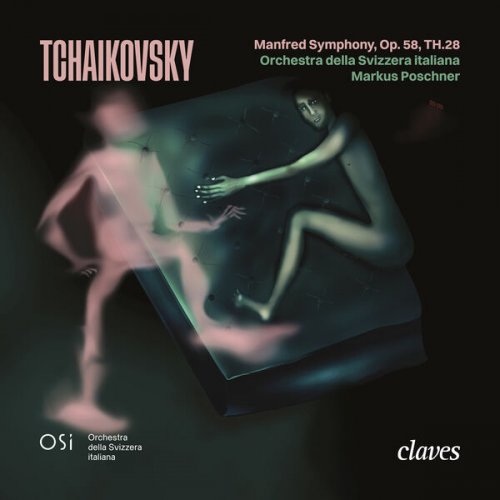
01. Manfred, Symphonie en quatre tableaux d'après le poème dramatique de Byron, Op. 58: I. Lento lugubre
02. Manfred, Symphonie en quatre tableaux d'après le poème dramatique de Byron, Op. 58: II. Vivace con spirito
03. Manfred, Symphonie en quatre tableaux d'après le poème dramatique de Byron, Op. 58: III. Pastorale. Andante con moto
04. Manfred, Symphonie en quatre tableaux d'après le poème dramatique de Byron, Op. 58: IV. Allegro con fuoco
A less suitable suggestion probably could not have been made by Mily Balakirev to his fellow composer Piotr Ilyich Tchaikovsky when in 1882 he sent him the programme for a four-movement symphony in the style of Hector Berlioz, based on Lord Byron’s ‘metaphysical’ drama Manfred, set in the Bernese Alps.
Tchaikovsky was suspicious of both the play as well as its author. Shortly after the premiere of Manfred on 11 March 1886 he wrote to Boris Jurgenson, the son of his publisher: «At your age as well as later, I could find no liking for Byron. He simply seemed to me unbearably boring. Much later I began to understand his strength, and yet many of his works […] still drive me to desolation». And he also felt a ‘hopeless coldness’ towards the programme, as he confessed to Balakirev at the outset. This coldness was partly due to the high regard Tchaikovsky had for Robert Schumann’s Manfred, op. 115 (1852) and – despite the huge success he had with orchestral programme music such as Romeo and Juliet (1870: no opus number), The Tempest, op. 18 (1873), Francesca da Rimini, op. 32 (1877) and the 1812 Overture, Op. 49 (1882) – he held a secret aversion to the genre: «It is a thousand times more pleasant to write without any programme! When I am composing a programme symphony, I feel like a charlatan swindling the public; I’m not paying them real money but worthless notes», he confessed to his former student Sergei Taneyev on 13 June 1885. However, because of his personal bond with Balakirev, he consented to compose the work.
At the centre of Byron’s drama stands the misanthropic nobleman Manfred, who is plagued throughout his life by guilt: for having practised black magic, for invoking spirits as well as for harbouring an incestuous love for his sister Astarte, who took her life as a result. Tired of existence, he himself now longs to die or at least to descend into madness, and yet the spirits he has summoned up refuse the fulfilment of his wish for ‘forgetfulness’, and a chamois hunter, rushing onto the scene, foils his suicide attempt on the Jungfrau mountain. A witch of the Alps promises help if he submits himself to her will but he haughtily declines. Like Orpheus, Manfred descends into the Underworld, from whose ruler Arimanes he demands his sister. When she appears, she does not forgive her brother but instead foretells his own imminent death.
From the drama’s meagre action Vladimir Stassov and Balakirev created a programme of four scenes, the first being a musical depiction of Manfred and his torments (brought on by himself, his guilt and the world at large), his escape into the Alps and his recollections of his beloved sister. There follows (in an inversion of the original order of events) a scene at a waterfall where Manfred invokes the Alpine fairy, before the simple but idyllic rustic life of the chamois hunter comes into focus. The fourth scene, which takes place in the Underworld, contains the most overt changes to Byron’s drama, offering a detailed depiction of a hellish orgy (which is not in Byron). Manfred’s wish to see his sister is granted here too but Astarte now seems to forgive her brother so that he may die in peace, as the relatively serene conclusion hints at. The four scenes make up a very heterogeneous programme: a musical character portrayal, the representation of a natural spectacle (the waterfall) with affiliated dialogue, an idyll and a concluding scene. In order to mitigate this heterogeneity and to shape the work into a coherent whole, Tchaikovsky made use of Berlioz’s idea of linking the individual movements by means of idées fixes, or recurring thematic motifs. The protagonist himself is represented by two themes full of yearning, the first being a downward-plunging phrase played unison on three bassoons and a bass clarinet, extended by emphatic string chords. The second theme begins with a drop of a seventh (i.e. a wide dissonant downward interval) which symbolises Manfred’s emotional breakdown and perhaps also hints at his death. The two themes are heard at the very start of the symphony and will appear one after another several times so that they become easier to recognise later, such as when Manfred consults with the Alpine fairy or when he enters the peaceful idyll of the chamois hunter or interrupts the hellish orgy. Astarte too is given her own theme, which is heard in the first and last scenes and contrasts with Manfred’s theme. It is heard for the first time after the second general pause in the opening scene, played on muted strings and later repeated by the woodwind; lyrical in nature, it fully belongs to the tradition of musical illustrations of ethereal young femininity.
Despite his deep-seated aversion, programme music in fact inspired Tchaikovsky to produce symphonic masterpieces again and again. And Manfred also possesses extraordinary qualities, inspired perhaps by the Swiss landscape and mountains which, from 1870, he visited nine times altogether. As early as 12/24 July 1870, Tchaikovsky wrote to his father: «Interlaken lies between two lakes, Lake Thun and Lake Brienz, and is surrounded on all sides by mighty Alpine mountains and glaciers. This vista is so grandiose and astonishing that, on the first day of my sojourn, I even felt somewhat frightened and oppressed, although by and by I became accustomed to these wonders of nature and I am experiencing a whole host of delights in appreciating the beauty of nature».
The reason for his visit to Davos in the year 1884, however (with Byron’s drama in his luggage), was a sad one for it was here that his friend, the violinist Josef Kotek, lay dying. And this experience was also something that mingled with his reading of Manfred and his musical transformation of it. Never before had the composer written for such a large orchestra which, alongside triple woodwind, full brass and a large body of strings, also calls for two harps and a large percussion section including a tam-tam and a bell ringing from the distance. The symphony is not only Tchaikovsky’s largest and longest orchestral work, however, but probably also his most virtuosic on the technical level. Most of all, it is the filigree Scherzo, depicting a sparkling, frothing waterfall, that is among the most difficult pieces that Tchaikovsky ever composed for orchestra, with its off-the-beat phrases giving rise to a disorientating metrical structure as well as its exceptionally delicate motivic elements. However, the somewhat crude source material and the patchy dramaturgy also caused great problems for the composer. And so, in his usual way, he constantly fluctuated regarding the quality of Manfred, on one occasion describing it as «the best of my symphonic works» (in a letter of 13/25 March 1886 to his patroness Nadezhda von Meck), while on another occasion stating «that this work is a loathsome one and I detest it profoundly» (letter to the Grand Duke Konstantin Konstantinovich of 21 September 1888). Yet for all his self-criticism, Tchaikovsky’s sole foray into multi-movement programme music impresses through its richly coloured instrumentation, its dramatic weight and melodic inventiveness. And finally, Manfred – not least thanks to its programme – has become a further important contribution to cyclical form.
Orchestra della Svizzera italiana
Markus Poschner, conductor

![Erroll Garner - Plays All-Time Hits (1965) [Vinyl]](https://www.dibpic.com/uploads/posts/2026-07/1785260363_5.jpg "Erroll Garner - Plays All-Time Hits (1965) [Vinyl]")

![Tony Grey - Infinity Glitch (2024) [Hi-Res]](https://www.dibpic.com/uploads/posts/2026-07/1784963646_oic3155hsarws_600.jpg "Tony Grey - Infinity Glitch (2024) [Hi-Res]")

![Nils - Chill It (2026) [CD-Rip]](https://www.dibpic.com/uploads/posts/2026-07/1785049728_d885upvliq95k_600.jpg "Nils - Chill It (2026) [CD-Rip]")