Teresia Bokor - My Blue Piano (2026) [Hi-Res]
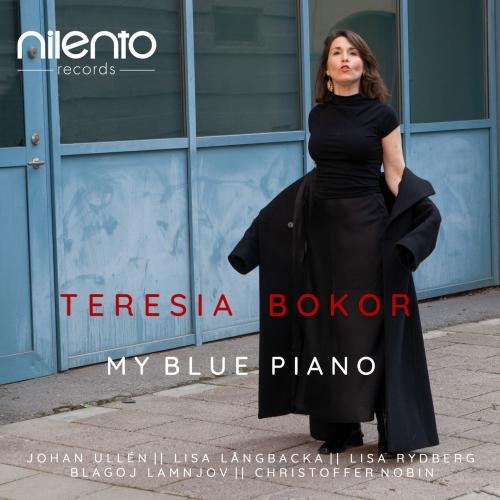
Artist: Teresia Bokor
Title: My Blue Piano
Year Of Release: 2026
Label: Nilento Records
Genre: Classical
Quality: flac lossless (tracks) / flac 24bits - kHz +Booklet
Total Time: 00:28:45
Total Size: 126 / 257 mb
WebSite: Album Preview
TracklistTitle: My Blue Piano
Year Of Release: 2026
Label: Nilento Records
Genre: Classical
Quality: flac lossless (tracks) / flac 24bits - kHz +Booklet
Total Time: 00:28:45
Total Size: 126 / 257 mb
WebSite: Album Preview
01. Nobin Prelude
02. Nobin New York
03. Bartok Elindultam sze?p haza?mbo?l
04. Kapralova Paris
05. Kapralova Navz?dy
06. Smetana Intermezzo
07. Kapralova Ruce
08. Nobin Wien
09. Ligeti Der Sommer
10. Lamnjov No homeland
11. Storm Jerusalem
12. Storm Der gro?e Engel
13. Nobin Postlude
My Blue Piano explores feelings of loneliness, belonging and rootlessness touching on what it means to live and create in exile. The music on the album brings together three Central European composers, Béla Bartók, Vítězslava Kaprálová, and György Ligeti, each of whom was forced to leave their homeland or prevented from returning.
Running throughout the album are poems by Else Lasker-Schüler who lived in Jerusalem during the Second World War. It was there she wrote her final collection of poetry, Mein Blaues Klavier, which gives the album its title. Lasker-Schüler was a poet who both provoked and impressed, a striking presence on the streets of Jerusalem, whose flamboyant lifestyle and eccentric dress never quite found a place in her new city.
The album is structured in four acts – New York, Paris, Wien and Jerusalem – cities where Bartók, Kaprálová, Ligeti and Lasker-Schüler each lived in exile.
New York: This act opens with a clarinet solo, a nod to the beginning of Gershwin’s Rhapsody in Blue, where cultural expressions merge and blend. Here, American and Hungarian musical traditions meet in a new shared soundscape. The clarinet, along with other instruments associated with Hungarian folk music, creates a sonic world filled with memory and longing.
Béla Bartók left his beloved homeland during World War II and lived in exile in New York. The Hungarian folk song Elindultam szép hazámból ("I’m fleeing my beloved homeland") stayed with him throughout his life and holds a central place in this act.
Paris: Czech composer and conductor Vítězslava Kaprálová was never able to return to her homeland. On Christmas night in 1939, her Prélude de Noël was broadcast from Paris to an occupied Czechoslovakia. A melody from this work returns in this act, set against a Parisian backdrop where longing for love is deeply felt. A version of Smetana’s Moldau, by Kaprálová’s fellow countryman, also weaves together two of her songs.
Wien: This act features fragments of Beethoven’s Egmont Overture, a piece frequently played on Hungarian radio during the 1956 revolution. That same year, György Ligeti fled Hungary hidden aboard a postal train, later settling in exile in Vienna.
His song Der Sommer (“The Summer”) evokes green fields slowly fading into autumn. As the train travels across the Hungarian plains, playful clarinet lines suggest transience and the feeling of having no true homeland.
Jerusalem: The album’s final act takes us to Jerusalem, where Staffan Storm’s composition Der große Engel sets Else Lasker-Schüler’s poem War sie der große Engel to music. Here, the circle closes in an atmosphere where rootlessness may itself carry a sense of belonging.
Teresia Bokor, soprano
Blagoj Lamnjov, clarinet
Lisa Långbacka, accordeon
Lisa Rydberg, violin
Johan Ullen, piano
Christoffer Nobin, musical director

![WLMZ - CHAPTER TWO (2026) [Hi-Res]](https://www.dibpic.com/uploads/posts/2026-07/1784826801_xxjv4d1tpo535_600.jpg "WLMZ - CHAPTER TWO (2026) [Hi-Res]")
![Amiri Baraka feat. David Murray & Steve McCall - New Music - New Poetry (2026) [Hi-Res]](https://www.dibpic.com/uploads/posts/2026-07/1784877220_jnpn4r2lh0141_600.jpg "Amiri Baraka feat. David Murray & Steve McCall - New Music - New Poetry (2026) [Hi-Res]")