Marco Grattarola, Matteo Straffi, Roberto Passerini, Valerio Febbroni, Marcello Trinchero & I CONTRAPPUNTISTI - Troll, roemhildt: cantatas, sacred music in thuringia (2026)
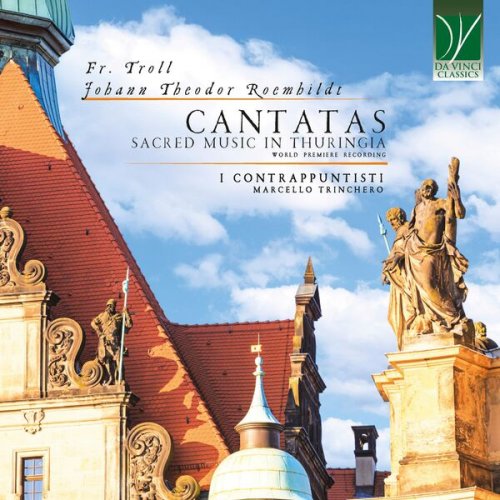
Artist: Marco Grattarola, Matteo Straffi, Roberto Passerini, Valerio Febbroni, Marcello Trinchero, I CONTRAPPUNTISTI
Title: Troll, roemhildt: cantatas, sacred music in thuringia
Year Of Release: 2026
Label: Da Vinci Classics
Genre: Classical
Quality: FLAC (tracks)
Total Time: 57:20 min
Total Size: 265 MB
WebSite: Album Preview
Tracklist:Title: Troll, roemhildt: cantatas, sacred music in thuringia
Year Of Release: 2026
Label: Da Vinci Classics
Genre: Classical
Quality: FLAC (tracks)
Total Time: 57:20 min
Total Size: 265 MB
WebSite: Album Preview
01. Weihnachtskantate: Siehe ich verkündige euch: No. 1, Sonatina et Aria: Siehe ich verkündige euch
02. Weihnachtskantate: Siehe ich verkündige euch: No. 2, Aria con Violinis: Ermuntre dich, mein Geist
03. Weihnachtskantate: Siehe ich verkündige euch: No. 3, Aria con 2 Clarinis: Leib und Seele freuet euch
04. Weihnachtskantate: Siehe ich verkündige euch: No. 4, Aria: Siehe ich verkündige euch
05. Orgelchoräle: Von Gott will ich nicht lassen
06. Kantate zum VI Sonntag nach Trinitatis: Herr Jesu, deiner trost ich mich, RoemV 129: No. 1, Aria: Herr Jesu, deiner trost ich mich
07. Kantate zum VI Sonntag nach Trinitatis: Herr Jesu, deiner trost ich mich, RoemV 129: No. 2, Recitativo: Klebt mir noch immer Böses an
08. Kantate zum VI Sonntag nach Trinitatis: Herr Jesu, deiner trost ich mich, RoemV 129: No. 3, Aria: So bleibstu, Jesu, Trost und Heil
09. Concerto à Flauto Concertante - first half of the 18th century: No. 1, Allegro
10. Concerto à Flauto Concertante - first half of the 18th century: No. 2, Grave
11. Concerto à Flauto Concertante - first half of the 18th century: No. 3, Allegro assai
12. Orgelchoräle: Herr Christ, der einig Gottes Sohn
13. Kantate, Dominica XVIII post Trinitatis: Herr wie groß ist deine Güte, RoemV 201: No. 1, Sonata
14. Kantate, Dominica XVIII post Trinitatis: Herr wie groß ist deine Güte, RoemV 201: No. 2, Choro: Herr wie groß ist deine Güte
15. Kantate, Dominica XVIII post Trinitatis: Herr wie groß ist deine Güte, RoemV 201: No. 3, Aria: Verborgner Gott dein treues Lieben
16. Kantate, Dominica XVIII post Trinitatis: Herr wie groß ist deine Güte, RoemV 201: No. 4, Recitative: Fürwahr wär unser Herze so bereit
17. Kantate, Dominica XVIII post Trinitatis: Herr wie groß ist deine Güte, RoemV 201: No. 5, Aria: Der Hoffnung Sieg erwirbt die Palmen
18. Kantate, Dominica XVIII post Trinitatis: Herr wie groß ist deine Güte, RoemV 201: No. 6, Sonata
19. Kantate, Dominica XVIII post Trinitatis: Herr wie groß ist deine Güte, RoemV 201: No. 7, Choro: Herr wie groß ist deine Güte
20. Orgelchoräle: Christ lag in Todesbanden
21. Osterkantate: Singet dem Herrn ein neues Lied: No. 1, Sonata et Aria: Singet dem Herrn ein neues Lied
22. Osterkantate: Singet dem Herrn ein neues Lied: No. 2, Aria: Auf christliche Seelen Schaut fröhlich hervor
23. Osterkantate: Singet dem Herrn ein neues Lied: No. 3, Aria cum Clarin: Auf christliche Seelen, mein Jesus steht auf
24. Osterkantate: Singet dem Herrn ein neues Lied: No. 4, Aria: Auf christliche Seelenund laßt uns zugleich Gott danken und loben
This recording seeks to illuminate a rich yet often overlooked chapter in the musical life of central Germany during the first half of the eighteenth century. Beyond the celebrated figure of Johann Sebastian Bach, Thuringia and its neighbouring regions nurtured a wealth of composers—some renowned in their own day, others subsequently consigned to obscurity—whose works testify to the extraordinary vitality and diversity of the period.
In 1968, during restoration works at the church of Grossfahner—a village situated approximately 20 km north-west of Erfurt, the capital of Thuringia—a cache of some 300 sacred works by composers from central Germany, dating from the seventeenth and eighteenth centuries, was discovered in a hollow space in the roof, partitioned off by wooden planks. Much of the material had been damaged by exposure to the elements, and in 1969 it was transferred to the Hochschule für Musik “Franz Liszt”, Weimar, for cataloguing and restoration; the collection remains preserved there.
Alongside works by well-known composers such as Gottfried Heinrich Stölzel and Georg Philipp Telemann, the collection chiefly comprises pieces by the so-called “small masters” of Thuringia—relatively obscure figures. Unfortunately, comprehensive biographical information has not been recovered for all the composers represented. For the composer designated “Herr Troll”, in addition to the seven cantatas preserved in the Grossfahner/Eschenbergen collection, only one further cantata is known at the University Library of Göttingen and a violin concerto preserved at the University Library of Münster. The composer’s forename is unknown; however, from the title pages of his works—copied in every instance by Johann Christian Starckloff (1655–1722), the copyist and cantor at the church of Eschenbergen from 1681 to 1722—it may be deduced that it begins with “Fr.”
In 1968, during restoration works at the church of Grossfahner—a village situated approximately 20 km north-west of Erfurt, the capital of Thuringia—a cache of some 300 sacred works by composers from central Germany, dating from the seventeenth and eighteenth centuries, was discovered in a hollow space in the roof, partitioned off by wooden planks. Much of the material had been damaged by exposure to the elements, and in 1969 it was transferred to the Hochschule für Musik “Franz Liszt”, Weimar, for cataloguing and restoration; the collection remains preserved there.
Alongside works by well-known composers such as Gottfried Heinrich Stölzel and Georg Philipp Telemann, the collection chiefly comprises pieces by the so-called “small masters” of Thuringia—relatively obscure figures. Unfortunately, comprehensive biographical information has not been recovered for all the composers represented. For the composer designated “Herr Troll”, in addition to the seven cantatas preserved in the Grossfahner/Eschenbergen collection, only one further cantata is known at the University Library of Göttingen and a violin concerto preserved at the University Library of Münster. The composer’s forename is unknown; however, from the title pages of his works—copied in every instance by Johann Christian Starckloff (1655–1722), the copyist and cantor at the church of Eschenbergen from 1681 to 1722—it may be deduced that it begins with “Fr.”
![Steve Oliver - Inner Fire (2026) [CD-Rip]](https://www.dibpic.com/uploads/posts/2026-07/1785050055_cuh9377x8nmom_600.jpg "Steve Oliver - Inner Fire (2026) [CD-Rip]")
![Bernd Lhotzky, Émile Parisien, Frédéric Couderc, Henning Sieverts, Eric Schaefer - Jazz at Berlin Philharmonic XVIII: Jazz Goes Baroque (2026) [Hi-Res]](https://www.dibpic.com/uploads/posts/2026-07/1785249127_folder.jpg "Bernd Lhotzky, Émile Parisien, Frédéric Couderc, Henning Sieverts, Eric Schaefer - Jazz at Berlin Philharmonic XVIII: Jazz Goes Baroque (2026) [Hi-Res]")
![Joe Pass - Behind Better Days (1971/2024) [Vinyl]](https://www.dibpic.com/uploads/posts/2026-07/1785076354_r-30823554-1722773064-4918.jpg "Joe Pass - Behind Better Days (1971/2024) [Vinyl]")