Ernst Breidenbach, Ingo de Haas, Thomas Rössel, Mikhail Nemtsov - Caspar Joseph Brambach: Complete Piano Quartets & Piano Sextet op. 5 (2026) [Hi-Res]
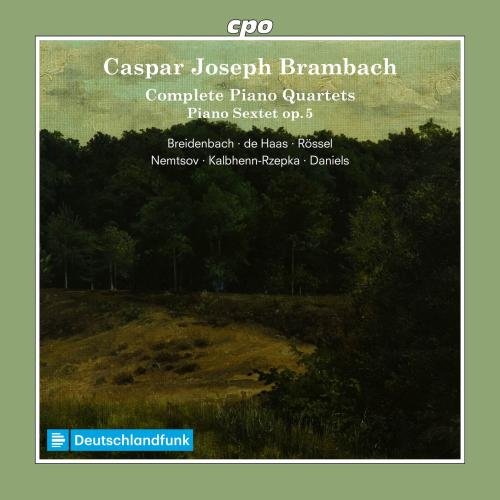
Artist: Ernst Breidenbach, Ingo de Haas, Thomas Rössel, Mikhail Nemtsov
Title: Caspar Joseph Brambach: Complete Piano Quartets & Piano Sextet op. 5
Year Of Release: 2026
Label: CPO
Genre: Classical
Quality: flac lossless (tracks) / flac 24bits - 48.0kHz +Booklet
Total Time: 02:22:48
Total Size: 619 mb / 1.34 gb
WebSite: Album Preview
TracklistTitle: Caspar Joseph Brambach: Complete Piano Quartets & Piano Sextet op. 5
Year Of Release: 2026
Label: CPO
Genre: Classical
Quality: flac lossless (tracks) / flac 24bits - 48.0kHz +Booklet
Total Time: 02:22:48
Total Size: 619 mb / 1.34 gb
WebSite: Album Preview
01. Brambach Piano Sextet in C minor, Op. 5 Allegro appassionato
02. Brambach Piano Sextet in C minor, Op. 5 Allegro energico
03. Brambach Piano Sextet in C minor, Op. 5 Andante
04. Brambach Piano Sextet in C minor, Op. 5 Allegro vivace
05. Brambach Piano Quartet in E flat major, Op. 13 Andante – Allegro molto
06. Brambach Piano Quartet in E flat major, Op. 13 Adagio
07. Brambach Piano Quartet in E flat major, Op. 13 Molto allegro vivace quasi Presto
08. Brambach Piano Quartet in E flat major, Op. 13 Allegro vivace, ma non troppo
09. Brambach Piano Quartet in A minor, Op. 43 Andante sostenuto – Allegro con brio
10. Brambach Piano Quartet in A minor, Op. 43 Andante con moto
11. Brambach Piano Quartet in A minor, Op. 43 Allegro vivace
12. Brambach Piano Quartet in A minor, Op. 43 Allegro
13. Brambach Piano Quartet in G minor, Op. 110 Andante espressivo – Allegro agitato
14. Brambach Piano Quartet in G minor, Op. 110 Adagio non troppo
15. Brambach Piano Quartet in G minor, Op. 110 Scherzo. Allergo molto vivace
16. Brambach Piano Quartet in G minor, Op. 110 Un poco Adagio – Allegro vivace
![Ernst Breidenbach, Ingo de Haas, Thomas Rössel, Mikhail Nemtsov - Caspar Joseph Brambach: Complete Piano Quartets & Piano Sextet op. 5 (2026) [Hi-Res]](https://www.dibpic.com/uploads/posts/2026-02/1770140825_ernst-breidenbach-caspar-joseph-brambach-complete-piano-quartets-piano-sextet-op_-5-2026-back.jpg)
Two months younger than Johannes Brahms, whom he outlived by around five years, Caspar Joseph Brambach was once able to bask in the knowledge that he had attracted considerable attention. He had studied and taught at the Cologne Conservatory and worked as music director in Bonn for eight years before devoting himself primarily to his own work, in which vocal music played the largest role. His male choirs were particularly well received, but his instrumental works were also popular, as the Rhinelander Brambach left no doubt that the masters of Romanticism, above all Robert Schumann, played an essential role in his sensibility. In addition to the sextet for piano and strings from the last Cologne and early Bonn period (around 1860), this first recording contains the three piano quartets, the last of which the composer wrote shortly before the turn of the century.
![Tonino Miano - MOSS/electric (2026) [Hi-Res]](https://www.dibpic.com/uploads/posts/2026-07/1784701046_jvcyq3nja1ann_600.jpg "Tonino Miano - MOSS/electric (2026) [Hi-Res]")

![Marco Benevento - Glera (2026) [Hi-Res]](https://www.dibpic.com/uploads/posts/2026-07/1784663677_a1378390940_10.jpg "Marco Benevento - Glera (2026) [Hi-Res]")
![Iwuda - Music for Iwuda (2026) [Hi-Res]](https://img.israbox.com/img/2026-07/24/dfmvzbxopdxunhnf3jhpvpr95.jpg "Iwuda - Music for Iwuda (2026) [Hi-Res]")