Shauna Rolston and Bernadene Blaha - Strauss, R. / Debussy / Barber: Cello Sonatas (2000)
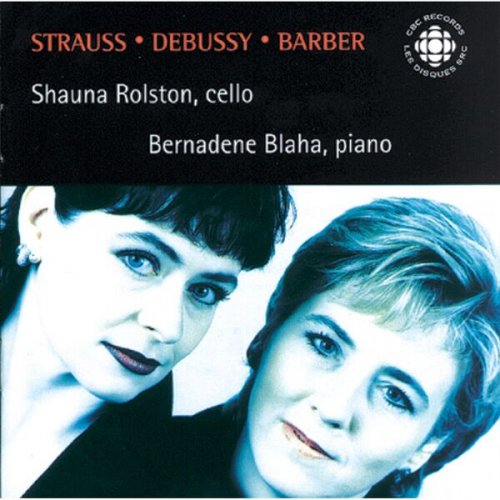
Artist: Shauna Rolston, Bernadene Blaha
Title: Strauss, R. / Debussy / Barber: Cello Sonatas
Year Of Release: 2000
Label: CBC
Genre: Classical
Quality: FLAC (tracks)
Total Time: 1:13:11
Total Size: 265 MB
WebSite: Album Preview
Tracklist:Title: Strauss, R. / Debussy / Barber: Cello Sonatas
Year Of Release: 2000
Label: CBC
Genre: Classical
Quality: FLAC (tracks)
Total Time: 1:13:11
Total Size: 265 MB
WebSite: Album Preview
1. Bernadene Blaha & Shauna Rolston – Cello Sonata In F Major, Op. 6, TrV 115: I. Allegro Con Brio (09:25)
2. Bernadene Blaha & Shauna Rolston – Cello Sonata In F Major, Op. 6, TrV 115: II. Andante Ma Non Troppo (07:59)
3. Bernadene Blaha & Shauna Rolston – Cello Sonata In F Major, Op. 6, TrV 115: III. Finale: Allegro Vivo (08:08)
4. Bernadene Blaha & Shauna Rolston – Cello Sonata In D Minor: I. Prologue: Lent (04:36)
5. Bernadene Blaha & Shauna Rolston – Cello Sonata In D Minor: II. Serenade: Moderement Anime (03:21)
6. Bernadene Blaha & Shauna Rolston – Cello Sonata In D Minor: III. Finale: Anime (03:45)
7. Bernadene Blaha & Shauna Rolston – Cello Sonata, Op. 6: I. Allegro Ma Non Troppo (08:34)
8. Bernadene Blaha & Shauna Rolston – Cello Sonata, Op. 6: II. Adagio (04:27)
9. Bernadene Blaha & Shauna Rolston – Cello Sonata, Op. 6: III. Allegro Appassionata (06:12)
10. Bernadene Blaha & Shauna Rolston – Grave (version for Cello and Piano): Grave - Metamorphoses for Cello and Piano (06:56)
11. Bernadene Blaha & Shauna Rolston – Quatuor Pour la Fin Du Temps (Quartet for the End of Time): Quatour Pour la Fin Du Temps (Quartet for the End of Time): V. Louange a L'Eternite de Jesus (09:43)
Cellist Shauna Rolston and pianist Bernadene Blaha unite on this disc to give us a varied assortment of the cello and piano repertoire. The pieces chosen span nearly 100 years of composition, from the Strauss Sonata from 1883 to the Lutoslawski Metamorphoses of 1981. Despite the various compositional periods visited, Rolston's sound and approach to her instrument do not change along with the piece. This is truly a shame because the result is some of the works being extremely successful while others are much less so.
At the top of the list of pieces that work well is the Debussy Sonata. Rolston's technique is quite impressive and as such all of the nuance and subtly that Debussy calls for in the cello part is immediately evident. The intensity of Rolston's sound and vibrato also work very well in this sonata. Blaha's performance is also fluid and spacious. The other two successful works are the Lutoslawski and the Messiaen, two very slow compositions that really test a performer's sound continuity and bow control. Rolston rises to the occasion, and her Messiaen in particular is ethereal without so much as a hint of an interruption to the sound.
The characteristics that work well in some pieces are the same things that are detrimental to others. In particular, Rolston's fast, intense, and omnipresent vibrato and her tendency to glissando or under-shift most intervals greater than a fourth really take away from the Strauss and Barber sonatas. While these techniques, when used sparingly, can certainly enhance a big shift or a passionate passage, when they're used continuously they make the performance sound over-romanticized and less special.
At the top of the list of pieces that work well is the Debussy Sonata. Rolston's technique is quite impressive and as such all of the nuance and subtly that Debussy calls for in the cello part is immediately evident. The intensity of Rolston's sound and vibrato also work very well in this sonata. Blaha's performance is also fluid and spacious. The other two successful works are the Lutoslawski and the Messiaen, two very slow compositions that really test a performer's sound continuity and bow control. Rolston rises to the occasion, and her Messiaen in particular is ethereal without so much as a hint of an interruption to the sound.
The characteristics that work well in some pieces are the same things that are detrimental to others. In particular, Rolston's fast, intense, and omnipresent vibrato and her tendency to glissando or under-shift most intervals greater than a fourth really take away from the Strauss and Barber sonatas. While these techniques, when used sparingly, can certainly enhance a big shift or a passionate passage, when they're used continuously they make the performance sound over-romanticized and less special.
![Mari Froes - Esquina do Sol (2026) [Hi-Res]](https://www.dibpic.com/uploads/posts/2026-07/1785416231_wlph4evvwuu8p_600.jpg "Mari Froes - Esquina do Sol (2026) [Hi-Res]")
![Firas Zreik - Tarabesque (2026) [Hi-Res]](https://img.israbox.com/img/2026-07/30/n3cqj78x1ea5uesw4kpal7rb8.jpg "Firas Zreik - Tarabesque (2026) [Hi-Res]")
![Nils - Chill It (2026) [CD-Rip]](https://www.dibpic.com/uploads/posts/2026-07/1785049728_d885upvliq95k_600.jpg "Nils - Chill It (2026) [CD-Rip]")