Fabrizio Romano, Gagliano String Quartet - Martucci: Chamber Works (2026)
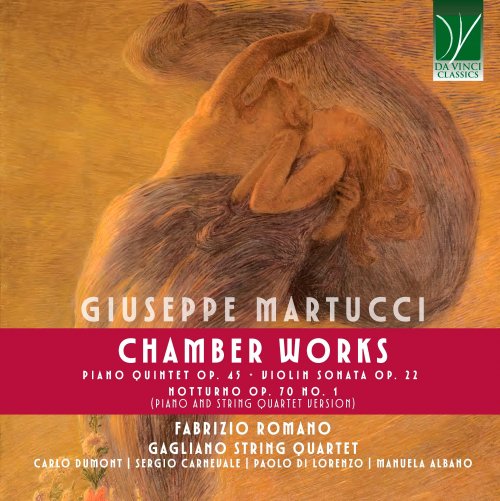
Artist: Fabrizio Romano, Gagliano String Quartet
Title: Martucci: Chamber Works
Year Of Release: 2026
Label: Da Vinci Classics
Genre: Classical
Quality: flac lossless (tracks)
Total Time: 01:04:51
Total Size: 297 mb
WebSite: Album Preview
TracklistTitle: Martucci: Chamber Works
Year Of Release: 2026
Label: Da Vinci Classics
Genre: Classical
Quality: flac lossless (tracks)
Total Time: 01:04:51
Total Size: 297 mb
WebSite: Album Preview
01. Piano Quintet in C Major, Op. 45: I. Allegro giusto
02. Piano Quintet in C Major, Op. 45: II. Andante con moto
03. Piano Quintet in C Major, Op. 45: III. Scherzo: Allegro vivace
04. Piano Quintet in C Major, Op. 45: IV. Finale: Allegro con brio
05. Notturno - Moderato in G-Flat Major, Op. 70 No.1 (For Piano)
06. Sonata in G Minor, Op. 22: I. Allegro passionato
07. Sonata in G Minor, Op. 22: II. Andante con moto
08. Sonata in G Minor, Op. 22: III. Allegro molto
09. Notturno - Moderato in G-Flat Major, Op. 70 No.1 (For String Quartet)
Despite his affinity with Central European symphonic music, there is no evidence that Giuseppe Martucci ever began writing or even planned to compose a string quartet, even though this form was favoured by every composer in that musical area. However, the brief but effective quartet interlude towards the end of the third movement of the Quintet in C, where the obvious echoes of Beethoven’s Heiliger Dankgesang (perhaps a tribute to Opus 132?) are tempered by the decadence typical of his later period, leaves us eager to imagine what his string quartet would have been like, extraordinarily poised between sunny Mediterranean cantabile and the misty humus of the Alps. The transcription for string quartet of the Nocturne in G-flat major Op. 70 no. 1, presented here in its world premiere, stems from this “lack”. It is a reduction of the orchestral version and not an elaboration of the piano version, which is also presented on this disc as a benchmark. The piano invites us to take part in the carefree country walk of an impressionist painting, where the light of sunset, despite the title, and a certain lightness seem to filter through the blades of grass and the clouds, which, however, do not cause too much concern. A veil of nostalgia pervades the atmosphere, together with regret for something that we do not know when it will happen again. Ten years later, at the turn of the new century, the orchestral version transcribed by the composer (which significantly slows down the tempo) changes the scene considerably, and a certain pensiveness, accompanied by a sense of longing, creeps in, accompanied by the realisation that perhaps that carefree stroll will remain only a distant memory. Everything is tinged with silver in the moonlight, which seems to restore the title to its natural, intimate and decadent setting. In its final notes, this time, along with regret, a certain inevitable transience can be perceived: perhaps carefreeness will never return. Something has been lost forever in this early 20th century, which pulverises romantic inspiration and transfigures the night, waiting for the expressionists to reinvent it. The essentiality of the string quartet, in its total lack of redundancy, seems to us to succeed in restoring this fleeting intimacy, this subdued yearning. In the present transcription, the thematic material has not been reworked, but redistributed, essentially entrusting the clarinet and horn solos to the second violin and viola. The first violin and cello parts have remained almost entirely similar to the original (as have the articulations, agogics and dynamics), with only a few accompanying figures or small elements of dialogue added here and there. The structural framework has therefore remained essentially unchanged, but in order to reduce the harmony and orchestral doublings to their essence, an attempt has been made to maintain an idiomatic writing style for the string quartet, entrusting the solos, or fragments of them, to the dialogue between all the parts, not so much for the sake of democratic quartet writing (finally achieved in those years), but to open up the listener’s sound spectrum, making the performance more “choral”.
Carlo Dumont © 2025
The earliest work recorded here, the Sonata for Violin and Piano in G minor op. 22, comes from Martucci’s twenties. Its Allegro passionato opens with a broad gesture: a stern motto is answered by a more pliant idea, and the two are interlaced in a sonata discourse that evokes Schumann yet keeps an Italian lightness of contour. The central Andante con moto suspends time in long melody, allowing phrase to bloom without sentimentality. The finale, Allegro molto, tightens texture and tempo, transforming earlier shapes before a smiling coda restores G minor to sunlight. A young composer is heard internalising northern models without imitation – closer to Saint-Saëns in poise than to Liszt in bravura, and in dialogue with a line of Italian violin writing refined by Bazzini.
By 1877 Martucci had the ambition and the technical command to attempt a larger canvas, the Piano Quintet in C major op. 45, which he would revisit in the early 1890s with the objectivity of an experienced symphonist. The Allegro giusto opens not with tempest but with firmness: a confident C major that hints at the robust transparencies of Brahms’s op. 34 while avoiding its tragic weight. Subjects are clearly profiled, the second leaning towards a dolce cantabile that the strings can shade with discreet portamento. In development Martucci prefers argument to display, setting ideas against one another with contrapuntal tact and reserving climaxes for points of structural cadence. The Andante con moto moves in arches whose span is sustained by harmony rather than by gesture. A song unfolds with restrained ardour, the bass tracing a supple counter-melody while inner parts weave a veil of half-tints. Here period practice yields riches: gut strings can bloom at low dynamic, portamento can articulate rhetorical sighs at cadential points, and vibrato, kept selective, allows the grain of each chord to speak. The middle paragraph intensifies through imitation and chromatic inflection before the opening returns as memory rather than repetition, like a landscape seen again after weather has passed. The Scherzo: Allegro vivace is fleet without frivolity. Its quick bow strokes and light piano figuration suggest a cousin to Mendelssohnian élan, but Martucci’s humour is understated, his wit contrapuntal; the trio relaxes into a rustic song whose unison contours anticipate the quartet interlude later in the work. When the finale, Allegro con brio, arrives, energy returns as measured joy rather than display. Episodes recall earlier ideas, and the peroration shines rather than blazes, faithful to a composer who believed that form could be luminous – the classical inheritance not as constraint but as a vessel for freedom.
Martucci’s nocturnal vein is distilled in the Notturno for Piano op. 70 no. 1, a key favoured for the piano velvet and trusted by Chopin to cradle the singing line. Martucci exploits the same hue while speaking in his own voice. Marked Moderato, it asks for a soft tone and pedalling that lets inner voices breathe without smudging the bass. The melody, seemingly simple, is lifted by chromatic sighs and gentle harmonic turns that suggest rather than state the destination – a page of concentrated lyric thought akin in spirit to Fauré’s nocturnes. A decade later he orchestrated the piece, broadening its canvas and, with the slower pace described above, changing its psychology. Strings and winds tint the moonlight differently from the piano; lines once solitary become communal and suspensions acquire the weight of breath. The quartet transcription heard here, born of the desire to hear Martucci think in fours, honours those colours while working with the grain of four bows. Solos migrate inward, dialogue replaces projection, and the absence of orchestral doubling clarifies the pulse of the harmony, letting fragile intimacy – regret and acceptance – be newly audible. Set beside the youthful sonata and the expansive quintet, the Notturno reveals another thread: Martucci’s fascination with song without words. Even in his larger forms, song keeps interrupting design – a cadence to be caressed, a modulation that opens a window. Sgambati pursued a nobly Beethovenian line; Bazzini refined Italian string writing; later, Respighi, learning much in Bologna, fused contrapuntal discipline with a painter’s ear for colour. Across the Alps, Brahms’s organic development offered a model of integrity, while Fauré showed how economy and long line might coexist. Martucci absorbed these lessons and returned something distinctively his own: classical poise shot through with Mediterranean breath.
This programme is more than a sequence of attractive pieces. It sketches a musical biography: the apprentice asserting instrumental eloquence in the Sonata in G minor; the young master testing symphonic thought within the supple medium of the Piano Quintet in C major; the mature artist distilling mood in the Notturno and, in the quartet version presented here for the first time, inviting us to imagine the path not taken – the string quartet he never wrote, glimpsed in moonlight. Between Naples and Bologna, between salon and concert hall, Martucci fashioned a language at once rigorous and humane. To hear these pieces side by side is to witness a rare reconciliation: design and song, intellect and sensuousness, form and freedom.
![Santana - Amigos (1976) [2026 SACD]](https://www.dibpic.com/uploads/posts/2026-07/1784829394_folder.jpg "Santana - Amigos (1976) [2026 SACD]")


![David Mash - Colors, Textures, Moods (2026) [Hi-Res]](https://www.dibpic.com/uploads/posts/2026-07/1784723161_jgm70mpp0afoz_600.jpg "David Mash - Colors, Textures, Moods (2026) [Hi-Res]")
![WLMZ - CHAPTER TWO (2026) [Hi-Res]](https://www.dibpic.com/uploads/posts/2026-07/1784826801_xxjv4d1tpo535_600.jpg "WLMZ - CHAPTER TWO (2026) [Hi-Res]")