Sara Bacchini - (UN)VEILED: Women Composers Through the 19th and 20th Centuries (2026)
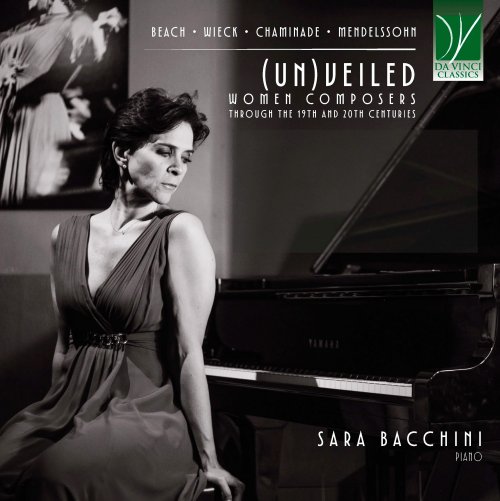
Artist: Sara Bacchini
Title: (UN)VEILED: Women Composers Through the 19th and 20th Centuries
Year Of Release: 2026
Label: Da Vinci Classics
Genre: Classical Piano
Quality: flac lossless (tracks)
Total Time: 01:07:13
Total Size: 206 mb
WebSite: Album Preview
TracklistTitle: (UN)VEILED: Women Composers Through the 19th and 20th Centuries
Year Of Release: 2026
Label: Da Vinci Classics
Genre: Classical Piano
Quality: flac lossless (tracks)
Total Time: 01:07:13
Total Size: 206 mb
WebSite: Album Preview
01. Trois morceaux caractéristiques, Op. 28: No. 1, Barcarolle
02. Trois morceaux caractéristiques, Op. 28: No. 2, Menuet Italien
03. Trois morceaux caractéristiques, Op. 28: No. 3, Danse des Fleurs
04. Quatre pièces caractéristiques, Op. 5: No. 1, Impromptu. Le Sabbat
05. Quatre pièces caractéristiques, Op. 5: No. 2, Caprice à la Boléro
06. Quatre pièces caractéristiques, Op. 5: No. 3, Romance
07. Quatre pièces caractéristiques, Op. 5: No. 4, Scène fantastique. Le Ballet des Revenants
08. Pierrette - Air de Ballet, Op. 41
09. Arlequine, Op. 53
10. Etude Symphonique, Op. 28
11. Vier Lieder für das Pianoforte 8, Op. 8: No. 1, Allegro moderato
12. Vier Lieder für das Pianoforte, Op. 8: No. 2, Andante con espressione
13. Vier Lieder für das Pianoforte, Op. 8: No. 3, Lied
14. Vier Lieder für das Pianoforte, Op. 8: No. 4, Wanderlied
15. Impromptu
History has often arranged the music canon like a portrait gallery of fathers and sons, while, just beyond the frames, women wrote music whose power needed no permission. In parlours where sound was permitted but authorship was suspected, they refined forms that the age considered minor and filled them with major feeling. To listen to the piano works gathered here is to hear how a circumscribed room can become a horizon: melody as air, harmony as weather, rhythm as a door quietly unlatched. They composed while society praised grace and discouraged ambition; they composed while the marketplace asked for spectacle, and they answered with character, proportion, and a lyric courage that still surprises.
Amy Beach stands at the seam where European late-Romantic craft meets an American sense of line and light. Her Trois morceaux caractéristiques op. 28 show how the so-called miniature can carry symphonic imagination. Barcarolle sways in 6/8 like a skiff that knows both the glitter and the weight of water; the left hand rows in supple arcs while the right designs a melody that leans into chromatic sighs, allowing dissonance to speak before it is comforted. A middle span brightens the surface with glancing figurations, then the opening returns subdued, as if evening has folded the shoreline back upon itself. Menuet Italien bows toward the eighteenth century with a smile that belongs to the twentieth: elegant periods, teasing appoggiaturas, and a trio whose harmonic sidestep suggests a traveller pausing to look at ruins and finding them unexpectedly alive. Danse des Fleurs closes the set in a buoyant whirl, a waltz of glinting petals where off-beat accents and sweeping arpeggios bring light through movement, the cadence lands not with triumph but with the satisfied exhale of a room suddenly full of colour.
Long before Beach, Clara Wieck Schumann had shown how drama and design could coexist in concise forms. Her Quatre pièces caractéristiques op. 5, written in her mid-teens, are four panels in a private theatre. Impromptu. Le sabbat turns the rhetoric of the fantastic into clear musical argument: low murmurs kindle rapid figurations, the texture thickens without blur, and a return of the first idea arrives darker and more lucid, like a dream remembered correctly on the second telling. Caprice à la Boléro sets a steady tread beneath capricious melody; as ornaments multiply, the theme does not fray but gathers glitter, and the coda lifts the dance from the floor without breaking step. Romance speaks in long breaths, the inner voices taking their turn to sing so that intimacy becomes architecture; it is music that trusts silence and, by trusting it, ennobles it. Scène fantastique. Le ballet des revenants ends the set with a haunted waltz, its harmonic floor shifting just enough to make each return feel like an apparition that recognizes you. In these pages Clara treats the piano not merely as a vehicle for brilliance but as a narrator able to shade character by touch and timing.
Cécile Chaminade, a composer welcomed by audiences from Paris to London and beyond, understood how a page can suggest a stage without imitating it. Pierrette (Air de Ballet) op. 41 draws the ingénue with strokes both deft and tender: sprightly staccato replies to curving legato, a brief hush opens like a lifted curtain, and the reprise wears its decorations lightly, as if the dancer had learned to trust her own shadow. Arlequine op. 53 throws brighter confetti: syncopations tumble, registral leaps flash, and a sly modulation turns the corner with the briskness of a wink; yet amid the sparkle a cantabile line keeps faith with human breath. Étude Symphonique op. 28 binds discipline to drama. Its broad paragraphs treat figuration as argument – broken octaves, widely spaced chords, and glittering scales are not acrobatics but evidence, supporting a theme that rises, withdraws, and returns with accumulated authority. Chaminade’s gift is to design surfaces that please at once and interiors that reward second hearing.
Fanny Mendelssohn writes with a poise that transforms diary into art. Her Vier Lieder für das Pianoforte op. 8 begins with Allegro moderato, music that walks at a humane pace while the counterpoint glances over the shoulder; the line seems to remember future destinations. Andante con espressione turns inward without dimming, the left hand newly eloquent while the right traces a phrase of speech-like restraint. Lied distils the genre’s promise: balanced antecedent and consequent, a middle that ripens rather than argues, and a return that feels earned. Wanderlied closes the set like an open road, buoyed by buoyant accompaniment figures and a melody that refuses to settle for the nearest horizon.
The bonus page bears the signature Jeanne-Louise Dumont, the birth name of Louise Farrenc, whose career joined artistry to scholarship and who argued, by example, that professionalism is a matter of competence rather than permission. Her Impromptu carries the sheen of improvisation over a framework as lucid as a classical speech. A questioning idea leans into an answering ascent; textures flower into rapid figuration that never occludes the line; a central enlargement gives the lyric thought the room it deserves before the opening returns as memory clarified. The charm is not in surprise alone, but in the assurance with which episodes balance and contrasts reconcile.
The cultural story within these scores is as instructive as the musical one. For generations the repertoire of women was labelled niche, and when it surfaced in public it was often validated by sheer velocity, as though agility could substitute for permission. Yet these works thrive not by dazzlement but by freshness of utterance, by melody that risks plainness and therefore attains sincerity, by harmony that takes a sidestep at precisely the right moment. They remind us that the so-called minor form is not a minor ambition. The short piece asks the composer to compress narrative into gesture, to suggest rather than declare, to leave silences resonant. It is perfectly adapted to the social constraints that sought to confine its makers, and, in a historical turn rich with irony, perfectly adapted to modern listening. To say that these women were limited to the domestic sphere is to miss the alchemy they achieved there. The home became a studio, the afternoon a workshop, the instrument an accomplice. They wrote hundreds of works – sometimes brief, sometimes expansive – testing the grammar of tradition until it spoke in their own accents. Where orchestral forces were unavailable, the piano became an orchestra in miniature; where public platforms were withheld, the page became a stage. The resulting music does not plead for exemption from standards; it meets those standards and, in places, resets them. Hearing these pieces in succession allows their differences to converse. Beach sets a luminous varnish over muscular harmony; Clara teaches gesture to argue and argument to dance; Chaminade turns theatre into thought without losing sparkle; Fanny composes proportion with the inevitability of speech; Farrenc balances poise and fire with the calm of a seasoned voice. Together they map a pedagogy of attention: listen to the inner voices, to the hinge notes where a phrase changes temperature, to the emphatic rests that are not absence but presence preparing to speak.
Perhaps the most fitting metaphor is the veil announced and removed. The veil is not silence; it is a thin scrim that softens outlines and edits expectations. When it lifts, one does not discover a different art but the same art seen whole. The canon expands not by charity but by perception, and perception, once altered, will not return to its earlier dimension. In these works, character becomes form, form becomes feeling, and feeling becomes knowledge. The room is no longer small; the horizon has come indoors. The listener leaves with the sense that something essential has been restored: the right to hear the century in all its voices. A closer listen rewards attention to design. Beach’s triptych prefers an A-B-A imagination: the Barcarolle frames a brighter middle whose figuration aerates the texture; the Menuet’s da capo returns lightly ornamented, as if etiquette had learned to improvise. In Clara’s set, voice-leading is the engine: contrary motion tightens the Sabbat’s climaxes, the boléro treads on an ostinato, the Romance shapes its apex by suspensions that delay and sweeten, and the Ballet des revenants offsets its three-beat lilt with harmonic sidesteps so the floor seems to glide. Chaminade’s theatre of character rides on rhythm and register: Pierrette balances playful upper sparks against a warm middle; Arlequine relishes displaced accents and feints between relative keys; the Étude Symphonique converts technical patterns – broken octaves, chromatic runs, octave-doubled tunes – into paragraphs that know their destination. Fanny’s Lieder are laboratories of proportion: four- and eight-bar breathing guides symmetry, while modal mixture or a Neapolitan shadow turns balance into narrative. Wanderlied’s buoyancy grows from a two-note upbeat; Il saltarello romano sets quick duple energy flashing with cross-accents like sun on stone. Farrenc’s Impromptu moves by variation: each return remembers the first thought, and a closing codetta speaks with the calm of work well argued. Giliano Marco Mattioli

![UROBORO - outside (2026) [Hi-Res]](https://www.dibpic.com/uploads/posts/2026-07/1784826553_ekh6v3xzdjcfc_600.jpg "UROBORO - outside (2026) [Hi-Res]")
![Marshall Allen - 101: An Audio Odyssey (2026) [Hi-Res]](https://www.dibpic.com/uploads/posts/2026-07/1784741979_a1305217540_10.jpg "Marshall Allen - 101: An Audio Odyssey (2026) [Hi-Res]")

![The Brothers Nylon - Nylon Archives Vol. 3: Elevator Vibes (2026) [Hi-Res]](https://img.israbox.com/img/2026-07/23/2xm25exoxhg740xkr8cmc1ncu.jpg "The Brothers Nylon - Nylon Archives Vol. 3: Elevator Vibes (2026) [Hi-Res]")