Bruno Pernadas - unlikely, maybe (2026) Hi Res
Artist: Bruno Pernadas
Title: unlikely, maybe
Year Of Release: 2026
Label: Self-Released
Genre: Art Pop, Progressive Pop, Jazz, Fusion
Quality: 320 kbps | FLAC (tracks) | 24Bit/48 kHz FLAC
Total Time: 00:47:01
Total Size: 108 mb | 307 mb | 583 mb
WebSite: Album Preview
Tracklist:Title: unlikely, maybe
Year Of Release: 2026
Label: Self-Released
Genre: Art Pop, Progressive Pop, Jazz, Fusion
Quality: 320 kbps | FLAC (tracks) | 24Bit/48 kHz FLAC
Total Time: 00:47:01
Total Size: 108 mb | 307 mb | 583 mb
WebSite: Album Preview
01 - Bruno Pernadas - Untitled (raindrops)
02 - Bruno Pernadas, Maya Blandy - Juro que vi túlipas
03 - Bruno Pernadas - Steady Grace
04 - Bruno Pernadas, Lívia Nestrovski - Já não tem mais encanto
05 - Bruno Pernadas - Campus on Fire
06 - Bruno Pernadas, Margarida Campelo - His world
07 - Bruno Pernadas, Leonor Arnaut - Spiritual Spaceman
08 - Bruno Pernadas, Leonor Arnaut, Margarida Campelo - Leo Minor
09 - Bruno Pernadas, José Soares - Song in MT-65
Since How Can We Be Joyful in a World Full of Knowledge? (2014), Bruno Pernadas has established himself as one of the most unique creators of contemporary Portuguese music. Those Who Throw Objects at the Crocodiles Will Be Asked to Retrieve Them (2016) opened international doors for him, Worst Summer Ever (2016) consolidated a style where psychedelic pop, jazz fusion, and meticulous arrangements coexist effortlessly, and Private Reasons (2021) deepened this tension between harmonic sophistication and melodic fluidity. At the same time, he has multiplied his work as a producer, arranger, and composer for film, theater, and dance, building a coherent trajectory despite the diversity of media for which he has developed works.
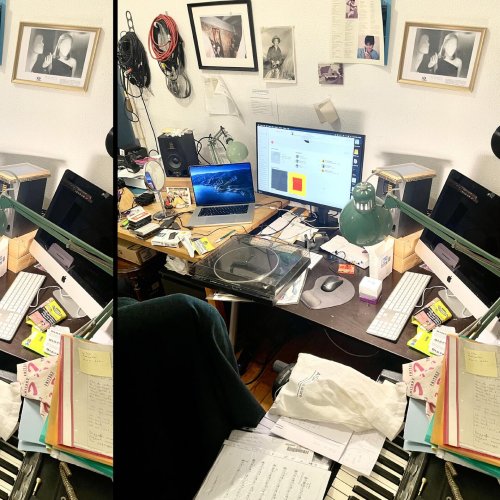
In unlikely, maybe, there are signs of a shift to new territories. The cover abandons the collage aesthetic and shows his own work table, replacing the exotic imagery used until now to illustrate his releases with a dose of reality that may translate the meticulous nature of his work. On the other hand, the music approaches a more spiritual jazz and hints at new coordinates. In this conversation, which extends the recent "track-by-track" published in Rimas e Batidas, we talk about this transition, the references assumed and rejected, the obsession with studio realization, and the stage as a new equation to be solved.
In unlikely, maybe, there are signs of a shift to new territories. The cover abandons the collage aesthetic and shows his own work table, replacing the exotic imagery used until now to illustrate his releases with a dose of reality that may translate the meticulous nature of his work. On the other hand, the music approaches a more spiritual jazz and hints at new coordinates. In this conversation, which extends the recent "track-by-track" published in Rimas e Batidas, we talk about this transition, the references assumed and rejected, the obsession with studio realization, and the stage as a new equation to be solved.
![Sbatax + Gross - Lapilli (2026) [Hi-Res]](https://www.dibpic.com/uploads/posts/2026-10/1792302944_cover.jpg "Sbatax + Gross - Lapilli (2026) [Hi-Res]")
![Aria - Rectify (2026) [Hi-Res]](https://www.dibpic.com/uploads/posts/2026-10/1792589967_592x592bb.jpg "Aria - Rectify (2026) [Hi-Res]")