Elena Cecconi, Matteo Fedel, Luigi Magistrelli - J. Montelli: Three Trios for Flute, Clarinet and Viola (2026)
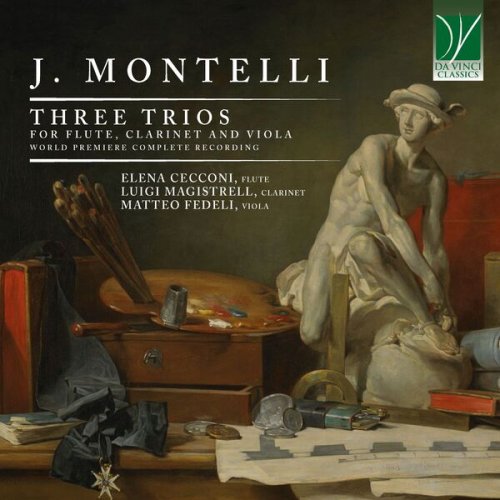
Artist: Elena Cecconi, Matteo Fedel, Luigi Magistrelli
Title: J. Montelli: Three Trios for Flute, Clarinet and Viola
Year Of Release: 2026
Label: Da Vinci Classics
Genre: Classical
Quality: flac lossless (tracks)
Total Time: 00:57:00
Total Size: 229 mb
WebSite: Album Preview
TracklistTitle: J. Montelli: Three Trios for Flute, Clarinet and Viola
Year Of Release: 2026
Label: Da Vinci Classics
Genre: Classical
Quality: flac lossless (tracks)
Total Time: 00:57:00
Total Size: 229 mb
WebSite: Album Preview
01. Trio No. 1 in E-Flat Major: No. 1, Allegro
02. Trio No. 1 in E-Flat Major: No. 2, Adagio
03. Trio No. 1 in E-Flat Major: No. 3, Rondo
04. Trio No. 2 in A Major: No. 1, Allegro
05. Trio No. 2 in A Major: No. 2, Adagio
06. Trio No. 2 in A Major: No. 3, Rondo Polonese
07. Trio No. 3 in F Major: No. 1, Allegro
08. Trio No. 3 in F Major: No. 2, Adagio
09. Trio No. 3 in F Major: No. 3, Rondo
A Rare Soundworld: Flute–Clarinet–Viola Trios in the Late-Classical Era and the Case of “Montelli”
Trios for flute, clarinet and viola are vanishingly rare in the later eighteenth and early nineteenth centuries. While Classical chamber music tended to favour string ensembles or, following Mozart’s example, the clarinet–viola–piano constellation, music written expressly for flute, clarinet and viola scarcely surfaces in the historical record. The timbral logic of the combination is, however, striking: the clarinet’s mellow middle register overlaps the viola’s range, while the flute supplies a luminous soprano line—a palette that privileges colouristic interplay over sonorous weight and draws a subtler chiaroscuro from the inner parts than the more familiar Parisian wind trios (for instance, flute–clarinet–bassoon).
Three trios for this unusual combination were published under the name ‘Montelli’ around the turn of the nineteenth century; they survive in multiple issues from Paris and Offenbach, notably with Sieber, Imbault and the house of André. Printed in Paris between c. 1799 and 1801 and in Offenbach, the set circulated widely enough to imply a degree of contemporary esteem. Their design and practical details place them squarely in the late Classical idiom: first movements of ample span that distribute principal themes among all three instruments; concise central slow movements with an unabashedly cantabile profile; and finales in lively rondo forms, sometimes with dance colouring (one explicitly marked Rondo Polonese). The parts show that Montelli wrote not merely for three players but with them—granting each instrument genuine concertante agency. Accompaniment figures migrate between parts; material is rotated with a keen sense of balance; the viola line, in particular, is more than an inner-voice convenience and at times technically demanding. The choice of A clarinet in one trio (and B♭ in another) appears calculated to shift the ensemble’s centre of gravity, the A instrument yielding a darker blend with the viola and subtly altering the colour of the whole. Older notices also report a Toulouse issue bearing ‘Op. 1’ on the title page; while plausible, this attribution awaits confirmation from surviving exemplars. André—renowned at the time for its Mozart holdings—was evidently alert to such chamber novelties.
The name Montelli itself remains elusive. Elsewhere it is associated with a set of Three Piano Sonatas, Op. 1 (Paris, Lemoine, c. 1811), bearing a dedication to Louis de Grimaldi and giving only the initial ‘J.’ as forename. Older claims linking the trios to further regional prints are historically plausible but, to date, unconfirmed by accessible title pages or catalogues. As matters stand, the composer’s identity resists positive identification. The notion that Anton Reicha might lie behind the mask has been aired in modern editorial circles—notably in a Kunzelmann preface—yet, absent documentary proof or unmistakable stylistic fingerprints, it remains an elegant conjecture rather than a conclusion.
What can be said with confidence is that these trios open a rare soundworld. By substituting the flute for the piano of Mozart’s Kegelstatt archetype and by dispensing with a dedicated bass voice, Montelli privileges a chamber texture in which resonance, resonance-in-miniature and dialogue are everything. The clarinet and viola form a darkly resonant core, the flute tracing lines of brightness above or cutting discreetly through the ensemble. The writing invites a style of playing that is both conversational and finely balanced: equal parts lyrical poise and poised virtuosity. The clarinet–viola–piano lineage later cultivated by Schumann and Reinecke offers an instructive parallel, as do lateral experiments such as Küffner’s trios for clarinet, viola and guitar, and the Archduke Rudolph’s serenade for clarinet, viola, guitar and bassoon—ensembles that share Montelli’s ear for inner-voice colour and conversational equilibrium.
From an editorial and performance perspective, the surviving sources allow practical choices to be made with confidence, not least regarding the intended clarinet (A or B♭) in the respective trios and the distribution of material among the parts. Modern editions have facilitated renewed access to the music, and performers attuned to the period’s idiom will recognise the blend of craft and invention that animates these pages. Recorded together here, the three trios invite renewed attention to a composer who, though still veiled by a pseudonym, speaks with a distinctive and quietly individual voice. Whether ‘J. Montelli’ conceals a known figure or an otherwise lost voice of the age, these works deserve their place—not as footnotes to better-known traditions, but as a quietly original contribution to the late Classical chamber repertoire.


![Ramsey Lewis - Sun Goddess (1974) [Vinyl]](https://www.dibpic.com/uploads/posts/2026-07/1784187548_g279hpq7nmtob_600.jpg "Ramsey Lewis - Sun Goddess (1974) [Vinyl]")

![Vincent Yuen Ruiz - Trio (2026) [Hi-Res]](https://img.israbox.com/img/2026-07/17/aftaguhuhbcnzmjigou5v1znw.jpg "Vincent Yuen Ruiz - Trio (2026) [Hi-Res]")