Ensemble A l'antica - Fiorillo: Six quatuors pour Flute, Violon, Viola & Violoncelle (2006)
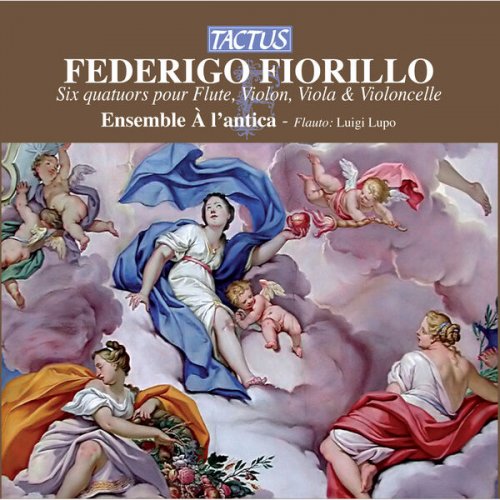
Artist: Ensemble A l'antica
Title: Fiorillo: Six quatuors pour Flute, Violon, Viola & Violoncelle
Year Of Release: 2006
Label: Tactus
Genre: Classical
Quality: flac lossless (tracks) +Booklet
Total Time: 01:12:38
Total Size: 361 mb
WebSite: Album Preview
TracklistTitle: Fiorillo: Six quatuors pour Flute, Violon, Viola & Violoncelle
Year Of Release: 2006
Label: Tactus
Genre: Classical
Quality: flac lossless (tracks) +Booklet
Total Time: 01:12:38
Total Size: 361 mb
WebSite: Album Preview
01. Flute Quartet No. 6 in E Minor: I. Adagio
02. Flute Quartet No. 6 in E Minor: II. Allegro Moderato
03. Flute Quartet No. 6 in E Minor: III. Allegretto
04. Flute Quartet No. 4 in F Major: I. Allegro spiritoso
05. Flute Quartet No. 4 in F Major: II. Romance Cantabile
06. Flute Quartet No. 4 in F Major: III. Minuetto allegretto - Rondo
07. Flute Quartet No. 5 in D Major: I. Allegro assai
08. Flute Quartet No. 5 in D Major: II. Larghetto
09. Flute Quartet No. 5 in D Major: III. Minuetto - Trio
10. Flute Quartet No. 1 in C Major: I. Allegro
11. Flute Quartet No. 1 in C Major: II. Rondo vivace
12. Flute Quartet No. 3 in G Major: I. Allegro Moderato
13. Flute Quartet No. 3 in G Major: II. Allegretto
14. Flute Quartet No. 2 in A Major: I. Allegro non troppo
15. Flute Quartet No. 2 in A Major: II. Rondo allegro
Federigo was born in Germany (near Hanover) and came from a Neapolitan family of musicians: an ancestor, Carlo, had published a book of madrigals in the 16th century, and his father, Ignazio, had made a name for himself in Europe as an opera composer and maestro di cappella. When Federigo was born, there was no impression that the center of European musical culture was shifting from Italy to the north, particularly to Germany.
Haydn was 25 years old at the time, Scarlatti and Handel were both in their seventies, Bach, who soon fell into oblivion, had already been dead for five years. Mozart was born nine months later and Beethoven just over a decade later.
Fiorillo was an excellent violinist and violist, but also a mandolin soloist and teacher.
His 36 Caprices Etude pour le violon formant are still well known among violin students today, while harpists could practise his 72 exercises for the harp.
His compositions also include some works written for the harpsichord and others for the piano, a sign that times were changing.
At the age of thirty, Federigo traveled to Paris and took part in the Concert Spirituel, which was run by the Philidors, a large family of composers, performers and instrument makers.
During his stay there, he undoubtedly met Françoise-André, the most famous of the Philidor family: a composer, French exile (on the run from creditors) and excellent chess player. His compositions include 6 quartets for flute and three strings. A few years later, Federigo Fiorillo printed his own 6 quartets for flute, violin, viola and cello.
There are two editions which are practically identical: The first dates from the early 1790s (though the exact date is unknown) and was printed in Paris by Sieber (as was his Opus 4); the second was published in 1798 (as was Opus 7) in Berlin by Hummel (whose catalog also included works by Haydn).
The dating of these compositions is therefore uncertain, a common situation for music of the 18th century, a time when there were no author's rights and title pages often did not indicate the date of publication.
![Mark Soskin - Live at Smalls (2026) [Hi-Res]](https://www.dibpic.com/uploads/posts/2026-07/1784866472_h7kjdafh2vgom_600.jpg "Mark Soskin - Live at Smalls (2026) [Hi-Res]")
![Karl-Martin Almqvist, Carl Winther, Johnny Aman, Anders Mogensen - Live at Christiania Jazz Club, 2nd set (Live) (2025) [Hi-Res]](https://www.dibpic.com/uploads/posts/2026-07/1784533426_p0nq8c8dkp3ga_600.jpg "Karl-Martin Almqvist, Carl Winther, Johnny Aman, Anders Mogensen - Live at Christiania Jazz Club, 2nd set (Live) (2025) [Hi-Res]")
![The Wesley Parker Quartet - Jazz at the Zoo (2026) [Hi-Res]](https://www.dibpic.com/uploads/posts/2026-07/1784525603_pfndos7a1vkbb_600.jpg "The Wesley Parker Quartet - Jazz at the Zoo (2026) [Hi-Res]")