Schola Cantorum di Santa Giustina, Alberto e Fabrizio da Ros, Fabrizio Da Ros - Balbi: Psalmi ad Vesperas Canendi per Annum, Vol. 1-2 (2012)
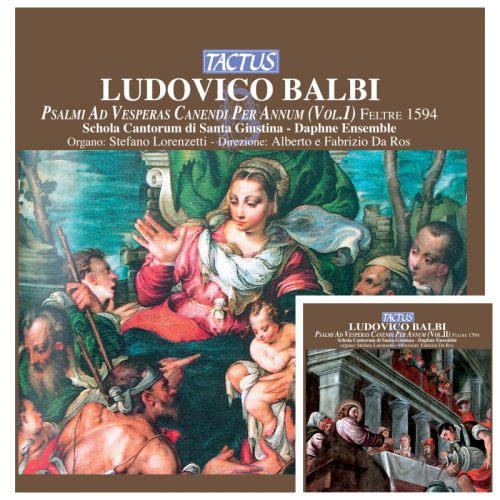
Artist: Schola Cantorum di Santa Giustina, Alberto e Fabrizio da Ros, Fabrizio Da Ros
Title: Balbi: Psalmi ad Vesperas Canendi per Annum, Vol. 1-2
Year Of Release: 2012
Label: Tactus
Genre: Classical
Quality: flac lossless (tracks) +Booklet
Total Time: 02:20:02
Total Size: 582 mb
WebSite: Album Preview
TracklistTitle: Balbi: Psalmi ad Vesperas Canendi per Annum, Vol. 1-2
Year Of Release: 2012
Label: Tactus
Genre: Classical
Quality: flac lossless (tracks) +Booklet
Total Time: 02:20:02
Total Size: 582 mb
WebSite: Album Preview
Balbi: Psalmi ad Vesperas Canendi per Annum, Vol. 1
01. Toccata
02. Psalmi ad Vesperas Canendi per Annum: Laetatus sum
03. Psalmi ad Vesperas Canendi per Annum: Laudate pueri
04. Fantasia VI toni
05. Psalmi ad Vesperas Canendi per Annum: Beatus Vir
06. Psalmi ad Vesperas Canendi per Annum: Memento Domine
07. Hymnus in festo confessorum
08. Psalmi ad Vesperas Canendi per Annum: Nisi Dominus
09. Hymnus Ave Maris Stella
10. Psalmi ad Vesperas Canendi per Annum: De profundis
11. Psalmi ad Vesperas Canendi per Annum: Magnificat I toni
One would have to look hard to find a composer more forgotten than sixteenth century maestro Ludovico Balbi, who operated on the periphery of the high Renaissance style among several important churches in Italy and whose works were published by Gardano. Judging from Tactus' Ludovico Balbi: Psalm ad Versperas Calendi Per Annum, Vol. 1, Feltre 1594, reveals a composer who was writing in an idiom that might be termed Palestrina-lite, and Balbi is known to have rejected all incipient forms of the manneristic second practice that began to emerge toward the end of his career. In some cases, listening to conservative late Renaissance composers can be rewarding; however in this one, the rewards are indeed hard to locate. The music is taken not from a Gardano print, but a unique manuscript in Feltre cathedral dated 1594 containing numerous settings of the Magnificat and movements for Vespers services; Tactus assures us that this disc is the first of three exposing all of the music in that dusty volume, in conjunction with its publication by Pro Music Studium. The program is broken up by a selection of organ pieces by Giovanni Gabrieli as played by Stefano Lorenzetti, who turns in stilted, clunky, and rather vapid readings of them. The Schola Cantorum di Santa Giustina and its satellite ensemble, Schola Gregoriana, are placed in widely divergent points in the hall; the Schola Gregoriana provides the chant incipits and the Schola Cantorum Balbi's settings of them. The Gregoriana is situated so far back in the hall that you can hardly hear them, whereas by comparison, when the Schola Cantorum starts singing you might wish you could hear them less; tempi are sluggish, the performances are one-dimensional, and the male altos are flat and unattractive sounding. There remains a lot of unrecorded Renaissance music that deserves recording, but this one is definitely an exception, and unless your devotion to sixteenth century Italian music is absolute, Tactus' Ludovico Balbi: Psalm ad Versperas Calendi Per Annum, Vol. 1, Feltre 1594. is likely one to pass on.
Balbi: Psalmi ad Vesperas Canendi per Annum, Vol. 2
01. Toccate e partite d'intavolatura di cimbalo et organo, libro primo: Toccata undecima
02. Concerti Ecclesiastici: Nativitas tua Dei genitrix
03. Psalmi ad Vesperas Canendi per Annum: Confitebor Angelorum
04. Fiori Musicali: Recercar con obbligo di cantar la V parte
05. Psalmi ad Vesperas Canendi per Annum: Dixit Dominus
06. Il secondo libro di toccate, canzone, versi d'hinni, Magnificat, gagliarde, correnti: Canzona terza
07. Psalmi ad Vesperas Canendi per Annum: Laudate Dominum
08. Il secondo libro di toccate, canzone, versi d'hinni, Magnificat, gagliarde, correnti: Canzona sesta
09. Psalmi ad Vesperas Canendi per Annum: Beati omnes
10. Il secondo libro di toccate, canzone, versi d'hinni, Magnificat, gagliarde, correnti: Aria detta La Frescobalda
11. Psalmi ad Vesperas Canendi per Annum: Lauda Jerusalem
12. Il secondo libro di toccate, canzone, versi d'hinni, Magnificat, gagliarde, correnti: Toccata terza per l'elevatione
13. Psalmi ad Vesperas Canendi per Annum: Magnificat tuoni quinti
Italy's Tactus label, here employing the services of the Schola Cantorum di Santa Giustina and Daphne Ensemble, has specialized in neglected repertoire, mostly of the Renaissance and Baroque eras. Here, as elsewhere in the label's catalog, you don't get anything resembling cutting-edge performance, but if you're seriously interested in early music, you do get to hear music that's unavailable anywhere else. Ludovico Balbi, born around 1545, was a contemporary of the Gabrielis, trained in Venice but mostly employed in the smaller cities of northeastern Italy whose musical repertories have been little investigated. The Balbi pieces on this recording present a selection from a manuscript at the cathedral in the mountain town of Feltre. The choral pieces are interspersed with organ music, both between them and within the verses of the longer pieces. When you hear the magnificent elevation toccata by Frescobaldi (track 11), very nicely played on a small Renaissance organ by Stefano Lorenzetti, you realize why Frescobaldi is remembered while Balbi has been forgotten, and indeed why he bounced around quite a bit during his own career; Balbi's choral style is basically cautious, with only limited experimentation with the expressive monodic style that was taking shape at the time and that would give birth to opera. Yet there are interesting details here. Most intriguing of all is the resurrection, claimed to be unique to this album and quite probably so, of an old practice whereby lines of chant would be sung along with the passages of organ music in which they are paraphrased. You can hear this rather unearthly effect in the Frescobaldi piece marked Recercar con obbligati di cantar V parte (track 4), and again in Balbi's Magnficat (track 12), which is performed with organ verses by a different composer. The varied sounds involved in the performance suggest many avenues to future performers, and the experimental quality of the entire effort recommends it to Renaissance performers and aficionados.
![Andrew Kim - Lineage (2026) [Hi-Res]](https://img.israbox.com/img/2026-07/23/28j8gm89d5zfmcym0tb9inxjo.jpg "Andrew Kim - Lineage (2026) [Hi-Res]")
![Catherine Sikora & Finola Merivale - Abhaile (2026) [Hi-Res]](https://www.dibpic.com/uploads/posts/2026-07/1784834364_cover.jpg "Catherine Sikora & Finola Merivale - Abhaile (2026) [Hi-Res]")
![Van Morrison, Georgie Fame, Mose Allison, Ben Sidran - Tell Me Something: The Songs of Mose Allison (Remastered) (2026) [Hi-Res]](https://www.dibpic.com/uploads/posts/2026-07/1784706816_folder.jpg "Van Morrison, Georgie Fame, Mose Allison, Ben Sidran - Tell Me Something: The Songs of Mose Allison (Remastered) (2026) [Hi-Res]")