Carlo Fierens - Coste: Complete Guitar Works Vol. 7: Pièces de Concert II (2026)
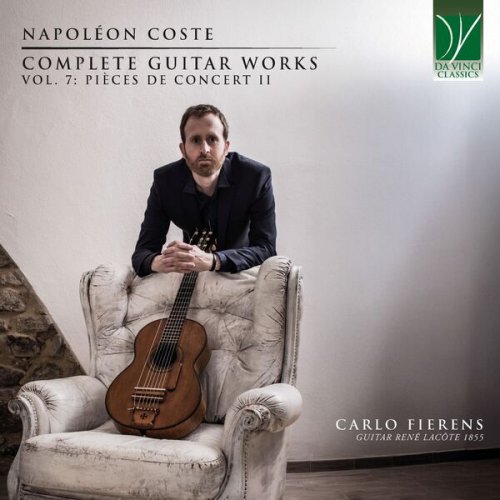
Artist: Carlo Fierens
Title: Coste: Complete Guitar Works Vol. 7: Pièces de Concert II
Year Of Release: 2026
Label: Da Vinci Classics
Genre: Classical Guitar
Quality: flac lossless (tracks)
Total Time: 00:59:14
Total Size: 238 mb
WebSite: Album Preview
TracklistTitle: Coste: Complete Guitar Works Vol. 7: Pièces de Concert II
Year Of Release: 2026
Label: Da Vinci Classics
Genre: Classical Guitar
Quality: flac lossless (tracks)
Total Time: 00:59:14
Total Size: 238 mb
WebSite: Album Preview
01. Grand Solo, Op. 24
02. Fantaisie symphonique, Op. 28b
03. La Chasse des Sylphes, Op. 29
04. Grande Sérénade, Op. 30
05. La Ronde de Mai, Op. 42
Life
Napoléon Coste was born on the 27th of June 1805 in Amondans in the department of Doubs in eastern France, a date that was not established until 1982. He grew up in the neighbourhood of Ornans, to which he later dedicated several compositions. In 1813 he was in the Dutch town of Delfzijl with his father, a captain in the French army, he passed the Zuiderzee and crossed the river Rhine. The memory of these places returned in his compositions, the Souvenirs. He started his career as a guitarist in 1826 in Valenciennes, where he lived as a youth, began to compose, and played in a concert with the travelling virtuoso Sagrini. At the end of 1828 he settled in Paris, where he stayed for almost the rest of his artistic career. There, in the centre of important musical developments, he joined the circles of musicians who originated from Valenciennes, and also of famous guitarists, among whom Sor became of great importance to him, as he studied harmony and counterpoint with him and became his friend, joining him in concerts. His life in Paris is expressed in several programmatic compositions, after Berlioz’ invention of musical drama.
He developed his artistic talent, participated in mixed concerts, where he played his own compositions, most of which were published by well-known publishers or by himself, chez l’auteur. His performance and compositions were praised in the upcoming musical journals of the time, but the guitar as an instrument was generally disdained, in such a way that it eventually disappeared from the musical scene during his lifetime. When Coste came to Paris, the guitar was very popular and was played at a high level, as can be seen in the many guitar methods of the time. But the instrument became popular among amateurs mostly, causing more artistic compositions to become difficult to publish. Therefore, Coste composed and arranged much popular music for pedagogical and commercial purpose. As a guitar teacher he has many pupils and he made a revision of Sor’s method in 1851, one of the last methods published in Paris, known as the Méthode Coste-Sor. He entered upper class musical society upon joining the Société académique des Enfants d’Apollon in 1841 and the musical freemasons’ lodge Les Frères Unis Inséparables in 1843, where he gave concerts on his heptacorde, the seven-string guitar made for him by the luthier Lacôte. Many of his compositions were meant for this instrument. The recordings of this compact disc are performed by Carlo Fierens on an original heptacorde made by René Lacôte in 1855, which matches the very same heptacorde Coste designed. His fame reached international level and he was visited in Paris by admirers from Stockholm, Copenhagen, Riga, and St. Petersburg. In 1856 the Russian guitar-playing nobleman Makaroff opened a contest for guitar composition and construction in Brussels. Coste sent in five compositions, out of which his Grande Sérénade opus 30 wan second prize, coming in after Mertz’s Concertino. He made no use of this laureate to travel through Europe as a guitar virtuoso, but returned to Paris, and also, to his own regret, to the job he had as an administrator at the municipality, from which he was pensioned in 1875. He had fewer pupils, had to publish his works by himself, and moreover injured his left shoulder twice, first in 1863, then again in 1874, but nevertheless he continued to perform in concerts.
His Éudes de Genre opus 38 were published by Richault c. 1872 and were dedicated to many of his pupils, among them Louise Olive Pauilhé, who he married in 1871, during the Prussian occupation of Paris. In his last years he still composed masterpieces as before, but also more didactic and easy pieces, which nevertheless are fine examples of his Romantic style. He died on 14 January 1883. His works were collected by admirers but disappeared from the concert repertoire. Only a few of his studies remained well known among guitarists, until Simon Wynberg publishes his complete works in 1981, opening up new attention for his oeuvre, that appears more and more in concert life since that time. This is becoming evident in the present series of recordings by Carlo Fierens.
Work
The music of Coste displays a wide spectrum of characteristics of the Romantic style. The theme and variation genre aside, Coste chooses to continue the composition with new musical ideas or varied repetition of these, which gives his works an episodic or rhapsodic character. Over time his compositions show more and more Romantic characteristics. There is a wave of periods with strong Romantic and light Romantic compositions. The latter have a more didactic or commercial purpose.
The importance of Romanticism in Coste’s music is reflected mostly in aspects of harmony, wherein complexity and intensity of texture are characteristic. His use of altered chords and dissonances can be related to that of Liszt, his harmonic progressions to those of Berlioz, his harmonic freedom to that of Chopin. His chromatic modulations, with or without common tone, are comparable to those of Schubert. In melody the figurations are most important, showing the aspect of virtuosity in his music. Without being an imitator, his texture can be related to the figuration and passages of Chopin, his practice of chromaticism with that of Schubert, his high level of playing technique to that of Liszt – all this connected to his great control of the instrument, with which he expands the limits of technical possibilities, based on the principles of Sor.
In musical expression, dynamics and articulation contribute to the emotion. Here external references can be made to the vocal portamento of Chopin and the arioso of Schubert. Few indications to exoticism are found, except perhaps influences from Spanish music that could be considered exotic. In the Romanticism of Coste story as well as folklore and the use of rests contribute to the narrative character of his music. Here, historicism plays a role in his programmatic works, which represent, just as with Berlioz, musical dramatics. For all these aspects, Coste can be placed at the centre of the musical developments appearing in Romantic music in Paris in the middle of the 19th century. True enough, in his own words, a modest composer for a modest instrument, in his masterpieces, Napoléon Coste has succeeded in elevating Romantic guitar music to a high level. Among the great three composers of Romantic guitar music, with Mertz and Zani de Ferranti, Coste can be considered as most important. Coste surpasses the other two in a musical way and knows how to express a multifaceted palette of Romantic elements in his music, which is further enhanced by his intensive harmonic writing. His work is versatile and varied, attractive to the listener, player, and analyst in both its broad lines and its details. From his early works on, which already show some boisterousness, a great development leading to his masterworks can be seen in the middle of the century, in which the Makaroff compositions play a major role. His approach towards virtuosity and complexity is of such a delicate and logical nature that his music attains a high technical level, never at the cost of performance. The musical expression, to which Coste gives his full attention, comes to maturity this way. In this study the Romanticism in his music becomes transparent, by way of analysis and defining criteria. These premises and results can be used as a starting point for research into the works of Zani and Mertz, to further demonstrate the importance of Coste for Romantic guitar music.
![Geof Bradfield, Myra Melford, Ben Goldberg & Dana Hall - Open Or Close (2026) [Hi-Res]](https://www.dibpic.com/uploads/posts/2026-09/1788498209_mu4ovyef12ckv_600.jpg "Geof Bradfield, Myra Melford, Ben Goldberg & Dana Hall - Open Or Close (2026) [Hi-Res]")
![Yaelokre, Keath Ósk - Foreword (2026) [Hi-Res]](https://img.israbox.com/img/2026-09/04/oteoeobakw43l438doz0aeq9u.jpg "Yaelokre, Keath Ósk - Foreword (2026) [Hi-Res]")

![Peter Lehel - Giant Impressions (2026) [Hi-Res]](https://img.israbox.com/img/2026-09/04/vod70v8mnscr43x9owtde1545.jpg "Peter Lehel - Giant Impressions (2026) [Hi-Res]")
![Jean-Luc Ponty - Cosmic Messenger (1978) [Vinyl]](https://www.dibpic.com/uploads/posts/2026-08/1788177000_0075678155062_600.jpg "Jean-Luc Ponty - Cosmic Messenger (1978) [Vinyl]")