Tatiana Samouil, Maryana Kozyreva - Felix & Fanny Mendelssohn: Music for Violin and Piano - Original Works and Arrangements (2026)
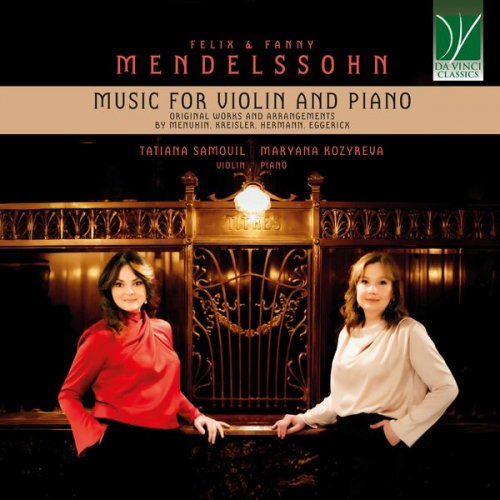
Artist: Tatiana Samouil, Maryana Kozyreva
Title: Felix & Fanny Mendelssohn: Music for Violin and Piano - Original Works and Arrangements
Year Of Release: 2026
Label: Da Vinci Classics
Genre: Classical
Quality: flac lossless (tracks)
Total Time: 00:45:26
Total Size: 191 mb
WebSite: Album Preview
TracklistTitle: Felix & Fanny Mendelssohn: Music for Violin and Piano - Original Works and Arrangements
Year Of Release: 2026
Label: Da Vinci Classics
Genre: Classical
Quality: flac lossless (tracks)
Total Time: 00:45:26
Total Size: 191 mb
WebSite: Album Preview
01. Scherzo, Op. 61 No. 2
02. Adagio, H 72
03. Schwanenlied from Sechs Lieder, Op. 1
04. Song without Words, Op. 62 No. 1
05. Four Songs without Words, Op. 30 No. 4: No. 1, The Wanderer
06. Four Songs without Words, Op. 30 No. 6: No. 2, Venetian Gondola Song
07. Four Songs without Words, Op. 38 No. 2: No. 3, Lost Happiness
08. Four Songs without Words, Op. 67 No. 2: No. 4, Lost Illusions
09. Sonata in F Major, MWV Q 26: I. Allegro vivace
10. Sonata in F Major, MWV Q 26: II. Adagio
11. Sonata in F Major, MWV Q 26: III. Assai vivace
The artistic dialogue between Tatiana and Maryana provided the conceptual starting point for this album, echoing, in a very different historical context, the close creative relationship between Felix and Fanny Mendelssohn. Rather than proposing a biographical parallel, the programme explores how intimacy, collaboration, and mutual influence can shape musical language across time.
This recording goes beyond music alone. It reveals emotions, ideas, and invisible threads that unite a brother and sister — souls connected across the boundaries of gender and time.
The album opens with an arrangement by Belgian composer Alexandre Eggericx of the famous Scherzo from Felix Mendelssohn’s A Midsummer Night’s Dream, capturing the spirit of fantasy, brilliance, and the eternal dance between light and darkness.
Essay
Establishing yourself as a female composer in the 19th century was an uphill struggle. In addition, it was difficult to stand out as an artist in a patriarchal society that expected women to master drawing and music, as domestic skills that were considered to be only valuable assets for a future husband. Within the Mendelssohn family, the study of music and poetry constituted an integral component of the education of all four children. Weekly concerts were organised, the only opportunity for Fanny, the eldest (1805-1847), to perform in public. The concerts included her own compositions, for example a series of songs written for her sister Rebecca, who graced the stage with her vocals. However, the true highlight of the evenings was the performance of works by Felix (1809-1847), the younger brother of Fanny. He was destined for a career as a composer and pianist and it was here that he had the opportunity to share his creations with the audience. Fanny was also known for her early musical talent, both in playing the piano and in her own compositions.
Brother and sister had a very close relationship and their musical complicity was built up from childhood.
Felix and Fanny maintained an intense artistic exchange from childhood onwards, documented in their correspondence, which reveals a constant dialogue on compositional ideas and musical aesthetics. Felix held his sister’s musical judgement in the highest esteem. It is said that they competed and admired each other, dedicated their compositions to each other and supported each other.
But Fanny wanted to continue composing. But how?
She was not a rebel, but she was very stubborn. She decided to collaborate with Felix, who will publish her first compositions under his own name, and so their father, who insisted that music should remain for her a hobby and never become a career, could rest quietly!
From now on, Fanny agreed to stay in the shadows so that her brother can take centre stage.
His works were a great success, and the public remained unaware that some of them were not written by Felix, but by Fanny. In this way Felix remained faithful to his father’s demands, to the spirit of the times and to his sister. It seemed that he was attempting to shield his sister from what he perceived to be the challenges associated with the male-dominated realm of composers…
Long marginalised in historiography, Fanny Mendelssohn’s output has been the subject of renewed interest since the late 20th century, leading to a reassessment of her position within 19th-century musical culture. She left behind a substantial legacy of 450 works, predominantly falling within the following genres: Lieder, pieces for solo piano, for piano and violin, and later a few forays into orchestral and choral works.
Once she had distanced herself from her brother and father by marrying the painter Wilhelm Hensel (in 1829), who encouraged her to play and publish (he even illustrated his wife’s compositions), she was liberated and dared to experiment with large-scale forms, constantly renewing herself. She even composed a quartet, a domain closed to women, a noble genre par excellence, which she dedicated to Felix, who found the form too free…
She also put a lot of energy into organising the Musical Sundays, which characterised Berlin’s cultural life for some twenty years, inviting musicians at the forefront of modernity. She also presented her own works. Her contributions were eventually recognised, leading to the publication of her works, though this process was undertaken without consulting Felix. Notably, Charles Gounod played a pivotal role in encouraging her to compose more frequently and to free herself from social conventions. He saw in her amazing talent the most brilliant pianist and an exceptional composer.
The collection of songs published in 1846 was a great source of satisfaction for Fanny, as it allowed her to finally see an entire volume published under her own name. However, she passed away just a year after her first publications, and Félix died six months later.
Both shared a taste for chamber music, with a preference for small forms and salon works such as the delightful Romances sans paroles, in which they demonstrate a sensitive talent for creating refined, pointillist images. Felix dedicated them to the young women in his circle, as he felt the genre suited them particularly well. Fanny inspired Felix with her freedom and her very personal musical language.
Félix was fortunate enough to be able to tackle the big forms quite early on, such as operas and symphonies, and publish them successfully. He was already considered one of the greatest European composers during his lifetime, and his art, which is both lyrical and formally refined, seems to be a profound synthesis of the German Romanticism of the greatest refinement and the classicism of his predecessors, whose rediscovery he promoted.
He is considered the master of the scherzo, to which he gave a special character of great virtuosity, as it translates the world of the fairies in A Midsummer Night’s Dream. The Sonata in F Major is a work for violin and piano that many consider to be masterful: it begins with an exuberant first Allegro vivace, followed by an intensely lyrical and dramatic Adagio, and concludes with a Finale that many find irresistible and which returns to the verve of the first movement in the form of a perpetuum mobile.

![David Caswell - Serendipity (2026) [Hi-Res]](https://img.israbox.com/img/2026-08/31/b478zdr27nscj76ac3i5r26y8.jpg "David Caswell - Serendipity (2026) [Hi-Res]")
![Wyclef Jean - Q Theory - Quantum Leap, Vol. 2 (2026) [Hi-Res]](https://img.israbox.com/img/2026-08/31/qe5stsxpf31pb0ptahgpqaq78.jpg "Wyclef Jean - Q Theory - Quantum Leap, Vol. 2 (2026) [Hi-Res]")