Artist:
Various Artists, Stephen Drury, Ty Bouque, Andy Kozar, William Lang, Ben Melsky, Ben Roidl-Ward, Adrián Sandí, Jesse Langen, Rachel Brake, Nicolette Sullivan-Cozza, Kei Otake, Mark Abramovski, Kai Burns, Evan Haskin
Title:
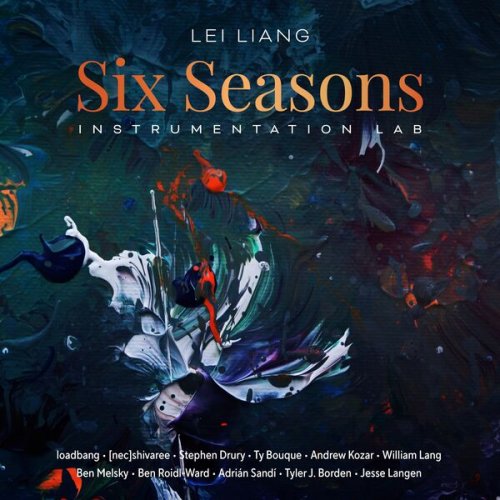
Lei Liang: Six Seasons — Instrumentation Lab
Year Of Release:
2026
Label:
New Focus Recordings
Genre:
Classical
Quality:
FLAC (tracks + booklet) [96kHz/24bit]
Total Time: 2:01:04
Total Size: 2.1 GB / 545 MB
WebSite:
Album Preview
Tracklist:Disc 1
1. Stephen Drury – Six Seasons: Prelude (01:38)
2. Ty Bouque – Six Seasons: No. 1, New Ice (Version for Voice) (00:39)
3. Andy Kozar – Six Seasons: No. 1, New Ice (Version for Trumpet & Trombone) (03:34)
4. Stephen Drury – Six Seasons: No. 2, Darkness (Version for Piano) (05:55)
5. Ben Melsky – Six Seasons: No. 2, Darkness (Version for Harp) (07:46)
6. Ben Roidl-Ward – Six Seasons: No. 2, Darkness (Version for Bassoon) (05:04)
7. loadbang – Six Seasons: No. 3, Sunrise (Version for Ensemble) (01:44)
8. Andy Kozar – Six Seasons: No. 4, Migration (Version for Trumpet) (07:00)
9. Ty Bouque – Six Seasons: No. 5, Cacophony (Version for Voice) (06:35)
10. William Lang – Six Seasons: No. 5, Cacophony (Version for Trombone) (04:03)
11. Adrián Sandi – Six Seasons: No. 5, Cacophony (Version for Bass Clarinet) (04:40)
12. Stephen Drury – Six Seasons: No. 5, Cacophony (Version for Piano) (10:25)
13. Tyler J. Borden – Six Seasons: No. 5, Cacophony (Version for Cello) (05:21)
14. Jesse Langen – Six Seasons: No. 6, Bloom (Version for Electric Guitar) (06:19)
15. loadbang – Six Seasons: Postlude I (01:25)
16. Stephen Drury – Six Seasons: Postlude II (01:32)
Disc 2
1. [nec]shivaree – Six Seasons: No. 1, New Ice (Version for Ensemble) (08:57)
2. [nec]shivaree – Six Seasons: No. 2, Darkness (Version for Ensemble) (06:51)
3. [nec]shivaree – Six Seasons: No. 3, Sunrise (Version for Ensemble) (08:48)
4. [nec]shivaree – Six Seasons: No. 4, Migration (Version for Ensemble) (07:10)
5. [nec]shivaree – Six Seasons: No. 5, Cacophony (Version for Ensemble) (06:01)
6. [nec]shivaree – Six Seasons: No. 6, Bloom (Version for Ensemble) (05:12)
7. [nec]shivaree – Six Seasons: Coda (04:13)
Lei Liang crafts multi-disciplinary works that bridge scientific research, electroacoustic composition, and contemporary improvisation to create a cohesive message of holistic symbiosis. Partnering with musicians from Ensemble Dal Niente, Mivos Quartet, loadbang, [nec]shivaree, and pianist Stephen Drury, Lei Liang’s newest release is an ambitious snapshot of his current aesthetic direction.
On his 2023 New Focus release, Hearing Landscapes/Hearing Icescapes (FCR360), Lei Liang worked collaboratively with oceanographers from the Qualcomm Institute to create a dialogue between deep-ocean field recordings, electronic music, and extended instrumental technique. Six Seasons is an expansion of this work, extrapolating this collaboration with oceanographer Joshua Jones, to solo and chamber collaborations across two discs worth of recordings. Lei Liang’s process on these works challenges fundamental definitions of what an instrument is, the nature of interaction with and cultivation of field recordings, as well as the boundaries between composition and improvisation. The raw source material was recorded in the Chukchi sea, off the coast of Alaska, but Lei Liang sees this material as ripe for excavation and molding. Original sounds are preserved, but their sequence is open to reordering, frequencies are subject to isolation and highlighting, and timbres are layered, filtered, and denoised. In this way, Lei Liang composes with the sounds of the ocean, and then brings live players into the project to interact with this curated environment. Featured performers on the first disc are the members of loadbang (Ty Boque, baritone; Andy Kozar, trumpet; William Lang, trombone; Adrián Sandi, clarinet), pianist Stephen Drury, cellist Tyler Borden, harpist Ben Melsky, basoonist Ben Roidl-Ward, and electric guitarist Jesse Langen. The second disc features Stephen Drury’s ensemble at the New England Conservatory, [nec]shivaree. Both are structured in the form of a six part cycle, with the whole forming a kind of two act piece, a layered palimpsest of curation and invention over similar source material. Moreover, Lei Liang’s work in this field represents a landmark in environmentally engaged music, drawing attention and reverence to our natural world while bringing it inside a living, creative process.
Disc one opens with the clarion call of a beluga whale, answered by an overtone rich sustain on Stephen Drury’s keyboard. This type of dialogue, a mix of primary and secondary voices with a fusion of timbres, characterizes the relationship between pre-recorded and performed material Lei Liang strives for in these tracks. Close up sounds of ice formation provide the material for “Season 1: New Ice”: Ty Bouque’s grinding inhaled breath spans the duration of the first section, while trumpeter Kozar and trombonist Lang find a way into the frigid physicality of the sound with a striking vocabulary of non-pitched timbres through the mouthpieces. The dry, crackling sounds of “Season Two: Darkness” are fodder for fragile, friction laden timbres in the inside of Drury’s keyboard, furtive tremolos, swooping glissandi, and haunting arpeggios and harmonics on Melsky’s harp, and oscillating multiphonics in Roidl-Ward’s bassoon. The full loadbang quartet comes together for the short “Season 3: Sunrise,” focusing on breathy, plosive timbres. Marine life returns to the fore in “Season 4: Migration,” with Kozar’s trumpet intertwined with seal and whale calls. “Season 5: Cacophony” sees the return of the previous musicians, with first solo appearances by loadbang’s Lang and Sandi, as well as cellist Tyler Borden’s first performance. The background source material is primarily grainy, like small insects circling a point of focus, with foreground marine animal calls. Drury actives sine tone like sustains on the keyboard with an ebow and steely plucks directly on the strings, while Borden’s cultivates an elastic, liquid relationship to pitch and gesture that could easily be mistaken for a field recording of another exotic ocean creature. Jesse Langen’s electric guitar communes with high frequency animal calls, using a beguiling series of effects to create a refracted, synthetic sonic vocabulary that melds perfectly with the underwater soundworld. Two postludes close the opening cycle, first with loadbang on tactile timbres that are interrupted by a dramatic crash midway through, and finally by ethereal sustains from Drury’s piano, in mystical conversation with the plaintive song of the whale.
The second cycle, now featuring the [nec]shivaree ensemble, is mapped out along the same progression of seasons as the first. Naturally the addition of more instruments leads to a wider fieldl of activity, but Drury and his players display an admirable discipline and their restraint and composite awareness results in an organic, spacious realization. Lei Liang leans on pitch as a more functional component of this realization, as central tones and harmonies echo through the ensemble as architectural pillars, connective tissue for the continued expansion and exploration of common timbral ground between instruments and environmental recordings. In “Season 3: Sunrise,” a gradually intensifying pad of white noise provides the impetus for an ensemble accumulation, punctuated by a series of fleeting soloistic passages. As the immersive noise envelops the ensemble, the instruments find ways to play inside its spectrum both timbrally and harmonically, leading to a dramatic climax about seven and a half minutes through the track. “Season 4: Migration” begins with a dramatic crash, a breaking away that leaves a hollow cavern of sound into which delicate instrumental swells, pops, and clicks interact with an otherworldly landscape. As in the counterpart sections in the first cycle, “Season 5: Cacophony” features a granular background, but here the ensemble’s sonic diversity really brings the texture alive, with distorted high partial electric guitar harmonics, fluttering percussive sounds, and whistiling wind and string glissandi creating a veritable biosphere. There is a large scale progression towards expressive pitch and gesture that emerges in this ensemble cycle, culminating in the last three seasons, as the sonorities become richer. The final coda hearkens back to the recording’s first track, giving the beluga whale’s stark, poignant call the last word.
- Dan Lippel

![Asaf Yuria - In Light of a New Moon (2026) [Hi-Res]](https://img.israbox.com/img/2026-09/03/hz3xecsw41w3x7lirx0ozela2.jpg "Asaf Yuria - In Light of a New Moon (2026) [Hi-Res]")