Ensemble Amati & Raymond Dessaints - Rossini: Complete Sonatas For Strings (1991)
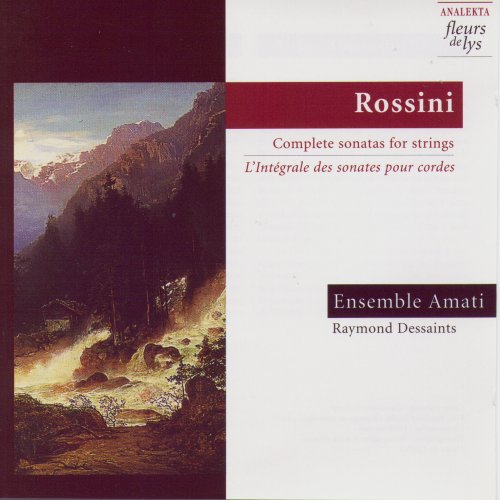
Artist: Ensemble Amati, Raymond Dessaints
Title: Rossini: Complete Sonatas For Strings
Year Of Release: 1991
Label: Analekta
Genre: Classical
Quality: FLAC (tracks)
Total Time: 1:14:51
Total Size: 354 MB
WebSite: Album Preview
Tracklist:Title: Rossini: Complete Sonatas For Strings
Year Of Release: 1991
Label: Analekta
Genre: Classical
Quality: FLAC (tracks)
Total Time: 1:14:51
Total Size: 354 MB
WebSite: Album Preview
01. Sonata No. 1 In G Major: I. Moderato
02. Sonata No. 1 In G Major : II. Andantino
03. Sonata No. 1 In G Major: III. Allegro
04. Sonata No. 2 In A Major: I. Allegro
05. Sonata No. 2 In A Major: II. Andantino
06. Sonata No. 2 In A Major: III. Allegro
07. Sonata No. 3 In C Major: I. Allegro
08. Sonata No. 3 In C Major: II. Andante
09. Sonata No. 3 In C Major: III. Moderato
10. Sonata No. 4 In B-flat Major: I. Allegro Vivace
11. Sonata No. 4 In B-flat Major: II. Andantino
12. Sonata No. 4 In B-flat Major: III. Allegretto
13. Sonata No. 5 In E-flat Major: I. Allegro Vivace
14. Sonata No. 5 In E-flat Major: II. Andantino
15. Sonata No. 5 In E-flat Major: III. Allegretto
16. Sonata No. 6 In D Major: I. Allegri Spirituoso
17. Sonata No. 6 In D Major: II. Andante Assai
18. Sonata No. 6 In D Major: III. Tempesta; Allegro
In 1803, when he was only 11, Gioacchino Rossini befriended the wealthy Malerbi family in Lugo. He had access to their rich music library and took singing lessons from Canon Giuseppe Malerbi. Under Malerbi's guidance, Rossini also developed the foundations of what was to become his own unique style of composition. In addition to singing, he played the harpsichord and was able to decipher and interpret much of the music of his time, particularly the works of Mozart and Haydn, which were to leave a permanent mark on his style.
The six sonate a quattro for two violins, cello and double bass were composed by Rossini for the landowner and merchant Agostino Triossi, in the summer of 1804. It is noteworthy to mention that the unusual composition of the score – the absence of violas – was not a deliberate choice by Rossini but was rather determined by the absence of viola players among his friends, generally the prospective interpreters of his works. The six sonatas display a remarkable mastery of form and tonal contrasts for a 12-year-old composer. They also show an instinctive feel for rhythm, where good humor is accompanied by a rich lyricism. Moreover, they reveal his rising opera buffa style, of which he will make such perfect use in the operatic masterpieces to follow.
Later in his life, Rossini was fond of writing ironic attestations on his old autograph manuscripts. On these youthful sonatas he wrote this charming comment: "First violin, second violin, violoncello and contrabass parts for six terrible sonatas composed by me at the country house (near Ravenna) of my friend and patron Agostino Triossi, and this at a most youthful age, not having even received a lesson in thorough bass. They were all composed and copied in three days and performed in a doggish manner by Triossi, contrabass; Morini (his cousin), first violin; the latter's brother, violoncello; and the second violin by myself, who was not the least of the dogs in the group." Despite the apparent denigration this statement may contain, the numerous corrections and the new versions he would publish over the years proved the importance Rossini would lend to his first works. It comes as no surprise that he criticized the first performance of these sonatas, considering their great technical difficulties. The virtuoso passages are played in turn by the first and the second violins; we can assume that Rossini, playing second violin, went along with this game out of pure bravado.
In order to accurately restore this "duel" between the first and the second violins during the recording, the second violins were placed to the right and the first violins, to the left. This positioning produces a most startling and natural stereophonic effect.
© Gilles Potvin, Raymond Dessaints
The six sonate a quattro for two violins, cello and double bass were composed by Rossini for the landowner and merchant Agostino Triossi, in the summer of 1804. It is noteworthy to mention that the unusual composition of the score – the absence of violas – was not a deliberate choice by Rossini but was rather determined by the absence of viola players among his friends, generally the prospective interpreters of his works. The six sonatas display a remarkable mastery of form and tonal contrasts for a 12-year-old composer. They also show an instinctive feel for rhythm, where good humor is accompanied by a rich lyricism. Moreover, they reveal his rising opera buffa style, of which he will make such perfect use in the operatic masterpieces to follow.
Later in his life, Rossini was fond of writing ironic attestations on his old autograph manuscripts. On these youthful sonatas he wrote this charming comment: "First violin, second violin, violoncello and contrabass parts for six terrible sonatas composed by me at the country house (near Ravenna) of my friend and patron Agostino Triossi, and this at a most youthful age, not having even received a lesson in thorough bass. They were all composed and copied in three days and performed in a doggish manner by Triossi, contrabass; Morini (his cousin), first violin; the latter's brother, violoncello; and the second violin by myself, who was not the least of the dogs in the group." Despite the apparent denigration this statement may contain, the numerous corrections and the new versions he would publish over the years proved the importance Rossini would lend to his first works. It comes as no surprise that he criticized the first performance of these sonatas, considering their great technical difficulties. The virtuoso passages are played in turn by the first and the second violins; we can assume that Rossini, playing second violin, went along with this game out of pure bravado.
In order to accurately restore this "duel" between the first and the second violins during the recording, the second violins were placed to the right and the first violins, to the left. This positioning produces a most startling and natural stereophonic effect.
© Gilles Potvin, Raymond Dessaints
![DOMi & JD BECK - YOU ASKED! (Instrumental) (2026) [Hi-Res]](https://www.dibpic.com/uploads/posts/2026-08/1786646102_cover.jpg "DOMi & JD BECK - YOU ASKED! (Instrumental) (2026) [Hi-Res]")
![Too Noisy Fish - Tolstoy (2026) [Hi-Res]](https://www.dibpic.com/uploads/posts/2026-08/1786680316_m5fydcsu3awy6_600.jpg "Too Noisy Fish - Tolstoy (2026) [Hi-Res]")

![Rafa M. Guillén & The Jazz Walkers - Always Forward (2026) [Hi-Res]](https://www.dibpic.com/uploads/posts/2026-08/1786950172_cover.jpg "Rafa M. Guillén & The Jazz Walkers - Always Forward (2026) [Hi-Res]")
![Yoron Israel - Inspiration (2026) [Hi-Res]](https://img.israbox.com/img/2026-08/16/2wqbdih7opt0hev0m6wxv61i4.jpg "Yoron Israel - Inspiration (2026) [Hi-Res]")
![Steve Rawlins - Word On The Street (2026) [Hi-Res]](https://img.israbox.com/img/2026-08/16/hacucrg92rxrz9hkja7risnvj.jpg "Steve Rawlins - Word On The Street (2026) [Hi-Res]")