Ensemble Amati, Raymond Dessaints & Rémi Boucher - Sonatina Para Guitarra y Orchestra, Interludio I, Interludio II, Concierto Mudéjar (1995)
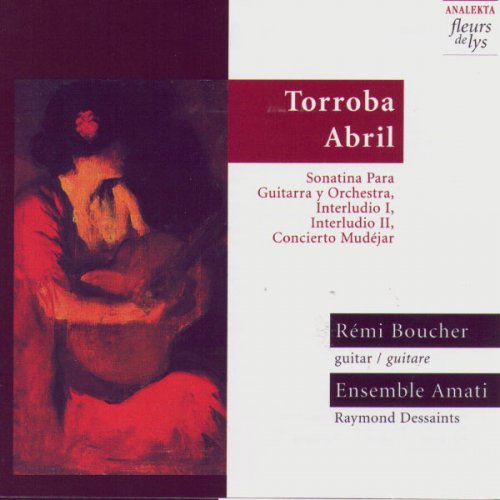
Artist: Ensemble Amati, Raymond Dessaints, Rémi Boucher
Title: Sonatina Para Guitarra y Orchestra, Interludio I, Interludio II, Concierto Mudéjar
Year Of Release: 1995
Label: Analekta
Genre: Classical
Quality: FLAC (tracks)
Total Time: 45:35
Total Size: 149 MB
WebSite: Album Preview
Tracklist:Title: Sonatina Para Guitarra y Orchestra, Interludio I, Interludio II, Concierto Mudéjar
Year Of Release: 1995
Label: Analekta
Genre: Classical
Quality: FLAC (tracks)
Total Time: 45:35
Total Size: 149 MB
WebSite: Album Preview
1. Rémi Boucher – Sonatina Para Guitarra y Orchestra: I. Allegretto (04:00)
2. Rémi Boucher – Sonatina Para Guitarra y Orchestra: II. Andante (04:24)
3. Rémi Boucher – Sonatina Para Guitarra y Orchestra: III. Allegro (03:40)
4. Rémi Boucher – Sonatina Para Guitarra y Orchestra: IV. Interludio I (05:34)
5. Rémi Boucher – Sonatina Para Guitarra y Orchestra: V. Interludio II (04:05)
6. Rémi Boucher – Concierto Mudéjar: Moderato (07:41)
7. Rémi Boucher – Concierto Mudéjar: Andante (09:52)
8. Rémi Boucher – Concierto Mudéjar: Allegro (06:17)
Torroba: Sonatina and Interludio
Federico Moreno Torroba was born in Madrid on the 3rd of March, 1891. He began his musical studies with his father, José Moreno Ballesteros, at the Madrid Conservatory, and later studied, still at the Conservatory, with composer Conrado del Campo. The first works which brought him a certain amount of succes were works written for the orchestra – most of them were, at the time, performed by the symphonic and philharmonic orchestras of Madrid. Then came the operas, such as La virgen del Mayo, in 1926, and, especially, the zarzuelas. These light operas – the origins of which can be traced to Calderí³n, in the 17th century – will make Moreno Torroba famous throughout the Spanish world and abroad. He composed about thirty zarzuelas, among them La chulapona (1924), Monte Carmelo (1936), La caramba (1942) and, probably one of the public's favorite, Luisa Fernanda (1932).
Moreno Torroba had a late "conversion" to the guitar. It is not until the mid-1920s, after meeting guitarist Andrès Ségovia, that Moreno Torroba composed his first work for the instrument. It was Ségovia who asked Moreno Torroba to write for the guitar, as he had done before with other composers, and will continue to do throughout his career in his quest to give the guitar the respectability enjoyed on the international scene by such instruments as the piano or the violin.
There is something very classical about Moreno Torroba's music, not in its structure, which is relatively free, but in its style and expression. The rafinement and subtlety he brings to his orchestrations also participates in the reserve we feel present in his work. Moreover, Moreno Torroba knows how to avoid the traps and excesses of easy "folklorism" to the advantage of a moving sobriety. As Larry Snitzler points out (Guitar Review), if Torroba's music evokes a certain Castilan atmosphere, his melodies are nevertheless stickly his: "The music of Castile was in his blood [...]. He didn't have to go out to notate some ‘folk' melody; he just wrote down what was in his head and heart."
Sonatina para guitarra y orchestra
The Sonatina for guitar and orchestra, written at the beginning of the century, is dedicated, as can be expected, to Andrès Segovia. This beautiful work in three movements has, since its first performance, been a favorite of concertgoers and guitarists alike. The Sonatina is also a warhorse of guitar competitions, not to mention a concert showstopper.
The version presented on this record is a first: a few months before his passing away, the composer decided to give the Sonatina a bold new look by transcribing it for guitar and orchestra.
Interludio I y II
The two Interludio which follow – composed originally for a wind quintet – have been arranged and re-orchestrated by the son of the composer, named Federico like his father. They encompass the passion, the exaggerated romanticism and the restraint so often encountered in Andalusian music. It should be noted that Interludio II is not without evoking, in its color and simple grace, the Pavane pour une infante défunte of Maurice Ravel.
Abril: Concierto Mudéjar (1986)
Born in 1933 in Teruel, main city of the Aragon province, Anton Garcia Abril is clearly a master of a generation, who, in the footsteps of Albeniz, Falla, Granados and Turina, were the builders of Spanish classical music. His growth as an artist and composer also encompasses the many deeply-rooted influences of Machado and Lorca (poetry), Juan Ramon Jimenez and Unamuno (litterature), of popular folk music and flamenco. Islamic Spain is also of particular importance to him: the word "mudéjar" stems from this time period, one of the richest culturally in the history of Spain, and refers to this superb and unique artform developed between the eleventh and the fifteenth century.
The Mudéjar Concerto follows the classical tradition of three movements while showing a great deal of internal freedom. In the initial Moderato, very fantasia-like,the guitar sings first, alone, before introducing the first theme, elegantly clad in a lively and rythmic Allegro. Within this theme, guitar and orchestra are set in answer-like dialogues. The following Andante, with its truly Arabic-styled ornementation, is built on two themes, also alternating questions and answers in a beautiful and subdued style. The last movement is strongly anchored in the zapateado. The structure is precisely set, but Abril also makes good use of oriental-type modulations, and their subtle science of contrasts, slowly building to a spectacular climax.
© Patrick Schupp, Alex Benjamin
Federico Moreno Torroba was born in Madrid on the 3rd of March, 1891. He began his musical studies with his father, José Moreno Ballesteros, at the Madrid Conservatory, and later studied, still at the Conservatory, with composer Conrado del Campo. The first works which brought him a certain amount of succes were works written for the orchestra – most of them were, at the time, performed by the symphonic and philharmonic orchestras of Madrid. Then came the operas, such as La virgen del Mayo, in 1926, and, especially, the zarzuelas. These light operas – the origins of which can be traced to Calderí³n, in the 17th century – will make Moreno Torroba famous throughout the Spanish world and abroad. He composed about thirty zarzuelas, among them La chulapona (1924), Monte Carmelo (1936), La caramba (1942) and, probably one of the public's favorite, Luisa Fernanda (1932).
Moreno Torroba had a late "conversion" to the guitar. It is not until the mid-1920s, after meeting guitarist Andrès Ségovia, that Moreno Torroba composed his first work for the instrument. It was Ségovia who asked Moreno Torroba to write for the guitar, as he had done before with other composers, and will continue to do throughout his career in his quest to give the guitar the respectability enjoyed on the international scene by such instruments as the piano or the violin.
There is something very classical about Moreno Torroba's music, not in its structure, which is relatively free, but in its style and expression. The rafinement and subtlety he brings to his orchestrations also participates in the reserve we feel present in his work. Moreover, Moreno Torroba knows how to avoid the traps and excesses of easy "folklorism" to the advantage of a moving sobriety. As Larry Snitzler points out (Guitar Review), if Torroba's music evokes a certain Castilan atmosphere, his melodies are nevertheless stickly his: "The music of Castile was in his blood [...]. He didn't have to go out to notate some ‘folk' melody; he just wrote down what was in his head and heart."
Sonatina para guitarra y orchestra
The Sonatina for guitar and orchestra, written at the beginning of the century, is dedicated, as can be expected, to Andrès Segovia. This beautiful work in three movements has, since its first performance, been a favorite of concertgoers and guitarists alike. The Sonatina is also a warhorse of guitar competitions, not to mention a concert showstopper.
The version presented on this record is a first: a few months before his passing away, the composer decided to give the Sonatina a bold new look by transcribing it for guitar and orchestra.
Interludio I y II
The two Interludio which follow – composed originally for a wind quintet – have been arranged and re-orchestrated by the son of the composer, named Federico like his father. They encompass the passion, the exaggerated romanticism and the restraint so often encountered in Andalusian music. It should be noted that Interludio II is not without evoking, in its color and simple grace, the Pavane pour une infante défunte of Maurice Ravel.
Abril: Concierto Mudéjar (1986)
Born in 1933 in Teruel, main city of the Aragon province, Anton Garcia Abril is clearly a master of a generation, who, in the footsteps of Albeniz, Falla, Granados and Turina, were the builders of Spanish classical music. His growth as an artist and composer also encompasses the many deeply-rooted influences of Machado and Lorca (poetry), Juan Ramon Jimenez and Unamuno (litterature), of popular folk music and flamenco. Islamic Spain is also of particular importance to him: the word "mudéjar" stems from this time period, one of the richest culturally in the history of Spain, and refers to this superb and unique artform developed between the eleventh and the fifteenth century.
The Mudéjar Concerto follows the classical tradition of three movements while showing a great deal of internal freedom. In the initial Moderato, very fantasia-like,the guitar sings first, alone, before introducing the first theme, elegantly clad in a lively and rythmic Allegro. Within this theme, guitar and orchestra are set in answer-like dialogues. The following Andante, with its truly Arabic-styled ornementation, is built on two themes, also alternating questions and answers in a beautiful and subdued style. The last movement is strongly anchored in the zapateado. The structure is precisely set, but Abril also makes good use of oriental-type modulations, and their subtle science of contrasts, slowly building to a spectacular climax.
© Patrick Schupp, Alex Benjamin
![Steve Rawlins - Word On The Street (2026) [Hi-Res]](https://img.israbox.com/img/2026-08/16/hacucrg92rxrz9hkja7risnvj.jpg "Steve Rawlins - Word On The Street (2026) [Hi-Res]")
![Too Noisy Fish - Tolstoy (2026) [Hi-Res]](https://www.dibpic.com/uploads/posts/2026-08/1786680316_m5fydcsu3awy6_600.jpg "Too Noisy Fish - Tolstoy (2026) [Hi-Res]")
![Paul Janoschka - TRIO (2026) [Hi-Res]](https://www.dibpic.com/uploads/posts/2026-08/1786700450_uq7c5grbp8djz_600.jpg "Paul Janoschka - TRIO (2026) [Hi-Res]")
![VA - DJ Perry Louis (JazzCotech) presents the Shiftless Shuffle (2026) [Hi-Res]](https://www.dibpic.com/uploads/posts/2026-08/1786537228_1.jpg "VA - DJ Perry Louis (JazzCotech) presents the Shiftless Shuffle (2026) [Hi-Res]")