Vienna State Opera Orchestra & Hans Swarowsky - Symphony No. 6 (Pastorale) In F Major, Opus 68 (1959) [Hi-Res]
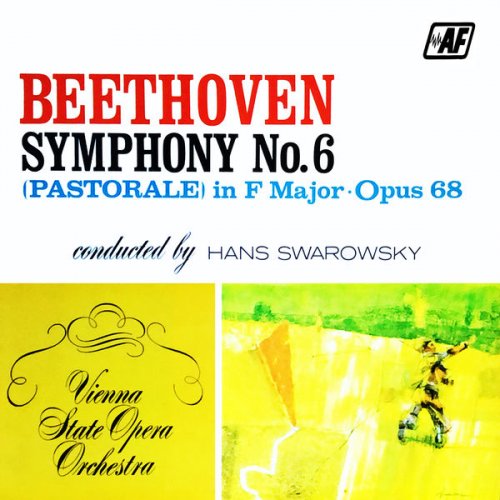
Artist: Vienna State Opera Orchestra, Hans Swarowsky
Title: Symphony No. 6 (Pastorale) In F Major, Opus 68
Year Of Release: 1959
Label: Audio Fidelity
Genre: Classical
Quality: FLAC (tracks) [96kHz/24bit]
Total Time: 42:59
Total Size: 655 MB
WebSite: Album Preview
Tracklist:Title: Symphony No. 6 (Pastorale) In F Major, Opus 68
Year Of Release: 1959
Label: Audio Fidelity
Genre: Classical
Quality: FLAC (tracks) [96kHz/24bit]
Total Time: 42:59
Total Size: 655 MB
WebSite: Album Preview
1. Symphony No.6, Op.68: I. Awakening of Happy Feelings on Getting out into the Country: Allegro ma non troppo (11:05)
2. Symphony No.6, Op.68: II. By the Brook Side: Andante molto mosso (12:25)
3. Symphony No.6, Op.68: III. Merry Gathering of the Country Folk / Thunderstorm: Allegro / Shepherd's Song. Happy and Thankful Feeli (19:27)
Known as widely for his teaching as for his orchestral direction, Hans Swarowsky had much to share with a younger generation of musicians. He studied composition and conducting with several of the twentieth century's greatest icons, absorbing and exercising what he had learned in a respected career as a conductor. Despite an uneven cast, his recording of Wagner's Ring cycle, taped in Prague, has considerable power and poetry.
Born in Hungary, Swarowsky studied in Vienna with composers Arnold Schoenberg and Anton Webern and trained in conducting with Felix Weingartner, Richard Strauss, and Clemens Krauss. His engagements subsequently took him to many parts of Europe, first to Stuttgart and Hamburg, later to Berlin (1934), Zürich (1937-1940), and Krakow (1944-1946).
Following several harrowing experiences in flight from the Nazis, Swarowsky found his career stabilized once more in the postwar period with an engagement at Graz from 1947-1950. During this time and in subsequent assignments at the Wiener Staatsoper, Swarowsky was recognized as a conductor with a long measure of technical expertise. Thus, his classes at Vienna's Academy of Music and the Performing Arts, where he had been professor of conducting since 1946, drew a remarkable pool of aspiring young musicians. Among them were Claudio Abbado, Jesús López-Cobos, Mariss Jansons, Zubin Mehta, Giuseppe Sinopoli, and Bruno Weil, later to be among the most prominent of their generation. Vienna's Hans Swarowsky International Conductors' Competition has attracted musicians from all parts of the globe, becoming in the process one of the world's most important clearing houses for rising talent.
From 1957 to 1959, Swarowsky served as chief conductor of the Scottish National Orchestra. In 1959, he was appointed chief conductor of the Vienna Symphony Orchestra; together with his service to that ensemble, he continued to appear with the Wiener Staatsoper.
In addition to performing compositions from the Classical and Romantic periods, Swarowsky served his own age with diligence. Aside from Strauss and Webern, composers such as Britten, Einem, Hindemith, Pfitzner, and Stravinsky figured prominently in the conductor's programming. Among his recordings for Concert Hall, Erato, Nonesuch, Vanguard, Vox, and Weltbild, he committed to disc an especially delightful set of orchestral suites from Humperdinck operas. © Erik Eriksson
Born in Hungary, Swarowsky studied in Vienna with composers Arnold Schoenberg and Anton Webern and trained in conducting with Felix Weingartner, Richard Strauss, and Clemens Krauss. His engagements subsequently took him to many parts of Europe, first to Stuttgart and Hamburg, later to Berlin (1934), Zürich (1937-1940), and Krakow (1944-1946).
Following several harrowing experiences in flight from the Nazis, Swarowsky found his career stabilized once more in the postwar period with an engagement at Graz from 1947-1950. During this time and in subsequent assignments at the Wiener Staatsoper, Swarowsky was recognized as a conductor with a long measure of technical expertise. Thus, his classes at Vienna's Academy of Music and the Performing Arts, where he had been professor of conducting since 1946, drew a remarkable pool of aspiring young musicians. Among them were Claudio Abbado, Jesús López-Cobos, Mariss Jansons, Zubin Mehta, Giuseppe Sinopoli, and Bruno Weil, later to be among the most prominent of their generation. Vienna's Hans Swarowsky International Conductors' Competition has attracted musicians from all parts of the globe, becoming in the process one of the world's most important clearing houses for rising talent.
From 1957 to 1959, Swarowsky served as chief conductor of the Scottish National Orchestra. In 1959, he was appointed chief conductor of the Vienna Symphony Orchestra; together with his service to that ensemble, he continued to appear with the Wiener Staatsoper.
In addition to performing compositions from the Classical and Romantic periods, Swarowsky served his own age with diligence. Aside from Strauss and Webern, composers such as Britten, Einem, Hindemith, Pfitzner, and Stravinsky figured prominently in the conductor's programming. Among his recordings for Concert Hall, Erato, Nonesuch, Vanguard, Vox, and Weltbild, he committed to disc an especially delightful set of orchestral suites from Humperdinck operas. © Erik Eriksson
![Henry Threadgill - Cut You Where You Was (2026) [Hi-Res]](https://www.dibpic.com/uploads/posts/2026-08/1787757260_a2094249576_10.jpg "Henry Threadgill - Cut You Where You Was (2026) [Hi-Res]")
![Ned Collette - Mixed Light (2026) [Hi-Res]](https://img.israbox.com/img/2026-08/29/yg59nabftuce4umslgygcyj5v.jpg "Ned Collette - Mixed Light (2026) [Hi-Res]")
![Oscar Peterson - World Tour (2026) [Hi-Res]](https://www.dibpic.com/uploads/posts/2026-08/1787665953_folder.jpg "Oscar Peterson - World Tour (2026) [Hi-Res]")
![JJ Whitefield - Exotic Moods (2026) [Hi-Res]](https://img.israbox.com/img/2026-08/31/de25143ov1nbayp56q26308iw.jpg "JJ Whitefield - Exotic Moods (2026) [Hi-Res]")
![Houston Person - Houston Person From The Heart (2026) [Hi-Res]](https://www.dibpic.com/uploads/posts/2026-08/1787755300_1.jpg "Houston Person - Houston Person From The Heart (2026) [Hi-Res]")