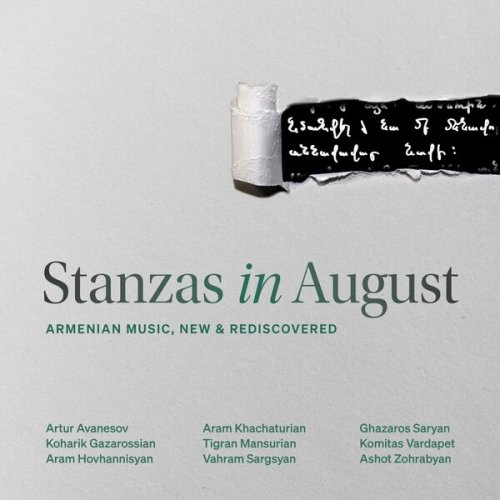
Artist:
Various Artists, Vahram Sargsyan, Nare Karoyan, Anoush Pogossian, VEM String Quartet, Cara Pogossian, Artur Avanesov
Title:
Stanzas in August: Armenian Music, New and Rediscovered
Year Of Release:
2026
Label:
New Focus Recordings
Genre:
Classical
Quality:
FLAC (tracks + booklet) [96kHz/24bit]
Total Time: 4:16:06
Total Size: 4.26 / 1.03 GB
WebSite:
Album Preview
Tracklist:Disc 1
1. Vahram Sargsyan – Vox temporum: I. Im Annmanin (07:34)
2. Vahram Sargsyan – Vox temporum: II. Manook (05:05)
3. Vahram Sargsyan – Vox temporum: III. Calmato e poco allungato - Coda (04:51)
4. Movses Pogossian – String Quartet (13:10)
5. VEM String Quartet – String Quartet No. 2 (1) (10:07)
6. Anoush Pogossian – Unruhig (09:30)
Disc 2
1. Nare Karoyan – Cantique (02:50)
2. Nare Karoyan – 8 Variations sur un thème populaire de Père Komitas: Thème. Vif et délicat (00:31)
3. Nare Karoyan – 8 Variations sur un thème populaire de Père Komitas: Var. I. Modéré et expressif (00:39)
4. Nare Karoyan – 8 Variations sur un thème populaire de Père Komitas: Var. II. Vif et vibrant (00:33)
5. Nare Karoyan – 8 Variations sur un thème populaire de Père Komitas: Var. III. Lent et expressif (01:05)
6. Nare Karoyan – 8 Variations sur un thème populaire de Père Komitas: Var. IV. Lourd, avec humeur (00:47)
7. Nare Karoyan – 8 Variations sur un thème populaire de Père Komitas: Var. V. Lent et douloureux (01:20)
8. Nare Karoyan – 8 Variations sur un thème populaire de Père Komitas: Var. VI. Vif et léger (00:37)
9. Nare Karoyan – 8 Variations sur un thème populaire de Père Komitas: Var. VII. Miserere, andante espressivo (01:29)
10. Nare Karoyan – 8 Variations sur un thème populaire de Père Komitas: Var. VIII. Vif et marqué (01:54)
11. Nare Karoyan – Piano Suite No. 1: I. Prélude (02:38)
12. Nare Karoyan – Piano Suite No. 1: II. L'oiseau à ma fenêtre (01:04)
13. Nare Karoyan – Piano Suite No. 1: III. Paresse (02:26)
14. Nare Karoyan – Piano Suite No. 1: IV. Dansons! (02:16)
15. Nare Karoyan – Préludes: No. 1, Mon enfant, ta mère et morte (02:31)
16. Nare Karoyan – Préludes: No. 2, Chérie, ton nom est Chouchan (02:39)
17. Nare Karoyan – Préludes: No. 3, La lune de la nuit (02:16)
18. Nare Karoyan – Préludes: No. 4, À travers les champs (02:23)
19. Nare Karoyan – Cantiques de Noël: No. 1, Du monde céleste, les voix arrivent (05:03)
20. Nare Karoyan – Cantiques de Noël: No. 2, Réjouissons-nous de ta naissance (02:23)
21. Nare Karoyan – Album bien tempéré: No. 1, Choral (01:17)
22. Nare Karoyan – Album bien tempéré: No. 3, Pièce populaire (01:34)
23. Nare Karoyan – Album bien tempéré: No. 5, Nocturne (02:21)
24. Nare Karoyan – Album bien tempéré: No. 23, Courant d'air (01:08)
25. Nare Karoyan – Piano Suite No. 2: I. Prélude (01:47)
26. Nare Karoyan – Piano Suite No. 2: II. Au son du davoul (01:50)
27. Nare Karoyan – Piano Suite No. 2: III. Nocturne (02:52)
28. Nare Karoyan – Messe arménienne: I. Prélude (03:18)
29. Nare Karoyan – Messe arménienne: II. Fugue (03:32)
30. Nare Karoyan – 3 Cantiques pour la main gauche: No. 2, O Sainte Vierge agenouillons-nous devant Toi (01:18)
Disc 3
1. VEM String Quartet – String Quartet No. 1 (11:37)
2. Artur Avanesov – Piano Sonata (11:07)
3. VEM String Quartet – String Quartet No. 2 (2) (18:42)
4. Edvard Pogossian – Cello Sonata (15:53)
5. Varty Manouelian – String Quartet No. 3 (15:44)
Disc 4
1. Cara Pogossian – Sonata-Song (12:14)
2. Artur Avanesov – Chinar es... (04:53)
3. Edvard Pogossian – Dies ist ein Lied für dich allein (10:24)
4. Artur Avanesov – Chinar es… II (06:47)
5. Cara Pogossian – Ode to the Lotus (09:32)
6. Artur Avanesov – Chinar es (Arr. for Piano by Villi Sargsyan) (03:29)
7. Eva Aronian – Sonata-Monologue (16:01)
8. Artur Avanesov – Suonare (04:26)
9. Movses Pogossian – Cadenza (06:19)
Stanzas in August presents the sixth through ninth volumes, released under one cover, of an ambitious and laudable project spearheaded by Movses Pogossian to document the richness and history of modern Armenian concert music. This lineage is framed by some of the most consequential events of the 20th century, including the Armenian Genocide, Soviet rule, and a period of post-Soviet transition that has seen the country turn towards the West. With a diaspora that is two-thirds of the world’s total Armenian population of 11 million people, the shape of Armenian music has absorbed both the vicissitudes of its recent history as well as global influences as it has evolved. Elements of traditional music, sacred repertoire, and internationalist aesthetic trends have seeped into this collective evolution of an Armenian musical style. Pogossian and his colleagues celebrate this vital and ever growing tradition of composition with this four disc set, shining light on crucial figures from Armenia’s musical past as well as some of its most active and influential contemporary voices.
The first volume focuses on chamber ensemble works in various combinations, presenting music by Vahram Sargsyan, Aram Hovhannisyan, Ghazaros Saryan, and Artur Avanesov. Vahram Sargsyan has cultivated an approach to composing for the voice which merges extended techniques, traditional Armenian musical practices, multi-timbral textures, and microtonality. Vox Temporum is scored for voice (Sargsyan himself performing the unique part), saxophone, and string quartet. The voice and saxophone meld together as a hybrid meta-wind instrument, intertwined in melismatic passages while the string quartet frames the harmony. In “Im Annmanin (To My Matchless One),” throat and overtone singing, bird song imitation, and whistling techniques expands the texture multi-dimensionally. “Manook (Little One)” percolates with furtive pizzicati and short articulations, opening up into a halo of brilliant, luminous sonorities. Sargsyan embeds a stealth element within “Calmato e poso allungato;” several gradual ascending glissandi subtly raise the overall pitch by a semitone. The work closes with a mechanical coda, a temporal suspension over which saxophone multiphonics and vocal whistling float into the ether.
Aram Hovhannisyan’s String Quartet, dedicated to the memory of one of Armenia’s most impactful musical figures, Ashot Zohrabyan, is taut, charged with electricity. The four instruments behave within a heightened state of vigilant anxiety, each new individual gesture triggering the other instruments in a kind of pinball game of musical reactivity. Hovhannisyan contrasts these kinetic passages with music that holds its explosive energy just beneath the surface of swelling chords and angular punctuations. Ghazaros Saryan represents an important lineage in modern Armenian music, a Soviet era generation of composers that followed Aram Khachaturian. Saryan’s String Quartet No. 2, written in 1986, opens with a dense, pathos laden chorale, as accented individual entrances form complex vertical voicings. A contrasting middle section features rhythmic vitality, alternating between driving repeated notes, darting pizzicati, and syncopated figures. The collection’s first volume ends with Artur Avanesov’s 2024 trio Unruhig (translated as “unquiet” from German) for clarinet, cello, and piano. Avanesov explores several different roles for the three instruments as their dialogue unfolds. Initially, short melodic bursts circle around one another in restless anticipation. Later the piano plays off-kilter accented chords that frame punctuations from the other instruments. An extended passage features dramatic, passionate phrases in the cello supported by sweeping keyboard flourishes. The clarinet and keyboard build a fleet, jaunty passage in rhythmic unison, culminating in a dramatic moto perpetuo section in the piano, and a return of the irregularly repeated note gesture, now heard as an alarming texture in the high register.
The second volume is devoted to solo piano works by Koharik Gazarossian, a composer, pianist, and teacher whose early life unfolded amidst the backdrop of the Armenian Genocide in the last years of the Ottoman Empire. Born in Constantinople in 1907, Gazarossian’s family was part of a community of Armenians who were subject to mass arrest, deportation, and subsequent death marches and massacres. Despite this hostile environment, particularly for intellectuals and artists, Gazarossian’s family managed to survive in what would soon be renamed Istanbul, and she was able to continue her music studies there and later in Paris, absorbing wisdom passed down from mentors who had themselves studied with Lizst, Ravel, and others. Despite the global upheaval in the middle of the 20th century, Gazarossian was able to return to live in Istanbul later in life, and also toured throughout the world as a soloist. While her compositional output extends to chamber music, choral music, and concertos, this collection focuses on her solo keyboard music.
Several of the works reflect the incorporation of folk materials and melismatic embellishments into Gazarossian’s writing style for the piano, sometimes virtuosic, other times impressionistic, such as Cantique, Cantiques de Noël, and “O Sainte Vierge agenouillons-nous devant Toi” from Trois cantiques pour la main gauche. Huit Variations sur un thème populaire du Père Komitas affords an opportunity to hear the tools Gazarossian had at her disposal for developing thematic material, mapping it on an approach that spans ruminating melodic over sonorous chordal accompaniment and jocular, characterful textures that showed her prodigious facility on the keyboard. The adaptation of a theme by Komitas, the central turn of the 20th-century figure in Armenian music and indeed a cultural representation of the targets of the genocide itself, reinforces the strong bond Gazarossian maintained with her heritage even as she pursued her studies and career abroad. The two Suites included here demonstrate her unique blend of impressionist and late Romantic tendencies, moving freely between character gems like the hummingbird texture in “L’Oiseau à ma fenêtre,” the rugged “Au son du Davoul,” the Eastern European inflected melancholy of “Nocturne,” and the Lizstian pianism in the two Preludes. Gazarossian imbues the quasi-French overture Prélude and weighty Fugue from Messe arménienne (O mystère profond) with sufficient ornamentation and invention to elevate them beyond their formal strictures and add her individual stamp. The balance between folk and sacred materials, while not being exclusive, is a core component and foundational concern of Gazarossian’s music. Pianist Nare Karoyan has devoted herself to championing the piano oeuvre of Gazarossian, and delivers powerful and sensitive performances on this recording.
Volume 3 is dedicated to the chamber music of Ashot Zohrabyan, one of the most pivotal figures in the lineage of Armenian avant garde composers, beginning with Komitas’ emphasis on traditional music and eschewing of the Romantic mainstream, and extends now to Artur Avanesov, Vahram Sargsyan, and many others. The specter of Soviet aesthetic control loomed over Armenian music for much of the 20th century, requiring composers to walk a fine line in their work to conform to imposed expectations while exploring new directions that they were becoming aware of. Zohrabyan’s music stands in the middle of these tensions, and emerges as a body of work that is focused on economy and formal cohesion, and steers away from extraneous components of virtuosity and filigree. One hears influences of Ligeti and Lutosławski in his music, as he moved away from the neo-tonal aesthetic that took hold both in the late and post-Soviet world as well as in the West. His three String Quartets presented here, written over the course of twenty six years, are all one movement works; the first two were commissioned for the Kronos Quartet, and stand out for their adventurousness. The first Quartet balances material from a charged opening outburst with delicately lyrical melodic fragments passed between the members of the ensemble. These strains of activity alternate throughout the work. String Quartet No. 2 contains a reference to a quintessentially Armenian song by Komitas, Antuni (Exile Song), highlighted at 1:08 in an angular motive on the violin of an ascending major 3rd and ending with a double stop minor 9th. The rest of the ensemble stretches this earthy motive, extending its pitches into an accumulating sound mass. Unsettling, sul ponticello tremolos, sharply accented staccato entrances, and syrupy unison lines harmonized with dissonant intervals create uneasiness that is momentarily soothed by passages of ethereal, luminous harmony. Zohrabyan’s third string quartet (2015) is the newest work in this volume, written for Movses Pogossian’s Dilijan Chamber Music Series and given the subtitle Stanzas in August, which in turn named this collection of recordings. Indeed, Zohrabyan organizes the piece as a series of succinct, self-contained stanzas. He writes, “this work purposely lacks consistent development, and short passages of music are separated with suspended rests... My idea was to create poetic music broken down in 'strophes,' and to shed such a tender August light over each of them.” The individual sections are gems of expressive clarity, opening with a poignant chorale, and moving variously through fluid imitative lines, propulsive rhythmic passagework, wrenching sustains peppered with accented entrances, pointillistic pizzicati accompanying a haunting melody, and intimate moments of expressive directness.
Zohrabyan’s Piano Sonata, written in 1979 and revised in the 1990s, is a three movement work heard here in one track. It unfolds largely as a meditation on a group of thematic elements, led by a dramatic grace note figure featured in the opening passage. Zohrabyan explores a suite of instrumental behaviors that one might understand as coming from traditional performance practice, embedding them within classical contexts, so as to merge characteristics from different styles instead of tokenizing the folkloric material. This grace note idée fixe reappears in many guises throughout the work, highlighting Zohrabyan’s ingenuity in spinning out a musical cell into myriad extrapolations. These motivic ideas seem to spill over into Zohrabyan’s Cello Sonata, written in the same period, now mapped onto his approach to chamber interaction. While the piano articulates similar brilliant flourishes to those in the Piano Sonata, frequently activating the resonance of the high register, the cello plays rhapsodic lines and ferocious double stops. This contrast between roles, pointillistic on one hand and legato and expansive on the other, frames the work, with two moments of repose providing relief to the overall structure.
The final volume on Stanzas in August, “Soliloquy,” features nine works, seven of them solos, that further illustrate the wide net cast by Armenian composers who were responsive both to global trends and allegiance to aesthetics native to their homeland. Aram Khatchaturian is perhaps Armenia’s most famous composer, but was also one of musical figures most widely associated with the Soviet Union in general. His larger orchestral works are his best known pieces, but the last years in his life he produced a series of more introspective solo chamber works, including the Sonata-Song for viola solo (1976) and Sonata-Monologue for violin solo (1975). The Sonata-Song was Khatchaturian’s final significant composition. It opens with a string of arpeggios that outline implied counterpoint and are connected by fluid melodic lines. Later in the piece, idiomatic viola passagework and coloristic pizzicato chords lead the texture through expressive peaks and valleys. The song referenced in the title is one that is in fact claimed by several West Asian cultures besides Armenian, including Iranian, Turkish, and Azerbaijani. The violin Sonata-Monologue loosely adheres to sonata form, often developing material more along the lines of a variations set where several themes are present at once. Khatchaturian emphasizes mournful melodic lines with ornamental embellishments that lend the violin a vocal quality. At the 6:25 mark, we hear an uncharacteristic percussive timbre, sounded by the screw of the bow hitting the chin rest. In these two late solo works, we can observe Khatchaturian going outside the extroverted milieu for which he is best known, reaching for an expressive world that is more reflective, and at times more experimental.
Paired with Khatchaturian’s Sonata-Song is Tigran Mansurian’s Ode to the Lotus for solo viola. Mansurian represents a generation of artists after Khatchaturian that was more grounded in writing a distinctly Armenian music, in opposition to the prevailing southern Soviet style that the ruling party in Moscow aimed to cultivate for many of the southern regions of the USSR. But just as Mansurian was more deeply connected to Armenia itself, living there in his later life in contrast to Khatchaturian, he was initially engaged with avant garde trends that were burgeoning far from Yerevan. Ultimately, he imported these avant garde elements to forge a unique approach to treating traditional materials. Despite the differences in their life trajectories, Ode to the Lotus and Sonata-Song have quite a bit in common, shaped by a similar approach to motivic development, timbral expansion through the use of pizzicati, and shared expressive textures on the viola.
Artur Avanesov’s Dies ist ein Lied für dich allein is scored for singing male cellist, specifically calling for the intimacy of a non-professional vocal approach. The piece sets texts by Stefan George, whose writings had been set by Webern, Adorno, and Egon Wellesz. Avanesov references a Baroque performance practice with an initial theme by Marin Marais, relying on implied counterpoint, accented appoggiaturas, and tonal harmonic progressions to evoke the grandeur of the style. Within that frame, Avanesov subverts expectations with more contemporary instrumental techniques and pitch content, with the inclusion of the voice acting as a kind of ritualistic internal mantra that accompanies the cello.
Chinar es is a traditional Armenian rural folk song that is heard in three treatments. Komitas’ transcription of the folk theme is realized for piano by Villi Sargsyan and captures the serene simplicity of the tune. The other two settings are by Avanesov from his book of piano solos, Feux Follets. On Chinar Es..., we hear a chorale setting with tone clusters and parallel perfect intervals that gives the theme a reverent, sacred quality. Avanesov provides one additional setting of the tune with Chinar Es II, this time in the form of a late Renaissance set of variations, with Dutch composer Jan Pieterszoon Sweelinck’s music as a model.
Suonare is Avanesov’s solo piano homage to Ashot Zohrabyan, incorporating elements of Baroque, Armenian music, and jazz into an improvisatory fantasy. Finally, Stanzas in August closes with Cadenza for solo violin performed by Movses Pogossian, an adapated version of a new cadenza Avanesov wrote for Khatchaturian’s Violin Concerto. Avanesov consciously fused elements of avant gardists Xenakis and Berio with materials from the Khatchaturian concerto, creating a dynamic merging of aesthetics across eras. In this way, Cadenza is a perfect ending for this remarkable contribution to the trajectory of modern Armenian music, a chronicle of a living tradition that has been shaped, but never daunted, by the historically transformative events that have taken place during its evolution.
– Dan Lippel

![DAYNA KURTZ - Postcards From Downtown (25th Anniversary Edition) (2026) [Hi-Res]](https://img.israbox.com/img/2026-08/31/d5yg5b010sblbwep9g2nqr0mn.jpg "DAYNA KURTZ - Postcards From Downtown (25th Anniversary Edition) (2026) [Hi-Res]")
![Alicia Witt - Between Heaven and Earth (2026) [Hi-Res]](https://img.israbox.com/img/2026-08/29/vdfub0as4sebuz9ep06t3j7q4.jpg "Alicia Witt - Between Heaven and Earth (2026) [Hi-Res]")
![Cold Diamond & Mink & Mr. Sophisticated Fingers - Organ-ized (2026) [Hi-Res]](https://img.israbox.com/img/2026-08/28/hrxi6alpe2zivbwviostfgsro.jpg "Cold Diamond & Mink & Mr. Sophisticated Fingers - Organ-ized (2026) [Hi-Res]")
![Spike Wilner - A Set of Originals (2026) [Hi-Res]](https://www.dibpic.com/uploads/posts/2026-08/1787890824_cover.jpg "Spike Wilner - A Set of Originals (2026) [Hi-Res]")
![Jared Schonig - Big Band: Live at Dizzy's (Live) (2026) [Hi-Res]](https://img.israbox.com/img/2026-08/28/v4zdhqwm35azwr9dp57rfb7y1.jpg "Jared Schonig - Big Band: Live at Dizzy's (Live) (2026) [Hi-Res]")