Costantino Mastroprimiano - Beethoven: Sonatas Vol. 5 (2026) [Hi-Res]
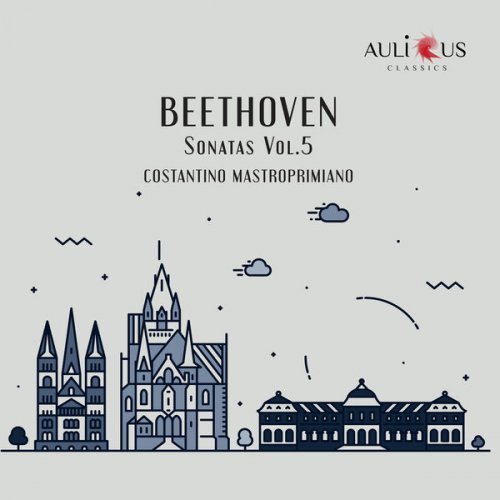
Artist: Costantino Mastroprimiano
Title: Beethoven: Sonatas Vol. 5
Year Of Release: 2026
Label: Aulicus Classics
Genre: Classical Piano
Quality: flac lossless (tracks) / flac 24bits - 48.0kHz +Booklet
Total Time: 00:57:32
Total Size: 253 / 568 mb
WebSite: Album Preview
TracklistTitle: Beethoven: Sonatas Vol. 5
Year Of Release: 2026
Label: Aulicus Classics
Genre: Classical Piano
Quality: flac lossless (tracks) / flac 24bits - 48.0kHz +Booklet
Total Time: 00:57:32
Total Size: 253 / 568 mb
WebSite: Album Preview
01. Rondo in C Major WoO 48: Allegretto
02. Rondo in A Major, WoO 49: Allegretto
03. Sonatina for Piano In F Major, WoO 50: Allegretto
04. Piano Sonata in C Major, WoO 51: I. Allegro
05. Piano Sonata in C Major, WoO 51: II. Adagio
06. 9 Variations on a March by Dressler in C minor, WoO 63
07. 6 Variations on a Swiss Song in F Major, WoO 64
08. 24 Variations on 'Venni Amore' in D Major, WoO 65
Why devote an entire recording to Beethoven’s youthful keyboard works?
These compositions allow us to observe at close range the process through which the young Beethoven, in Bonn and under the guidance of Neefe, became acquainted with the most modern expressive instrument of his time: the fortepiano built by J.A. Stein. Step by step, he explored its technical and expressive possibilities.
Here we encounter a young musician who, thanks to Stein’s new instrument equipped with the Prellzungenmechanik, discovers technical and expressive possibilities unknown to earlier instruments, not only in comparison with the harpsichord and clavichord, but even with earlier generations of pianos:
“I also heard one of the finest keyboard players, the good Bethofen (sic), some of whose compositions were published in Speier’s Blumenlese in 1783 (the Sonatas WoO 47), composed when he was eleven years old. He did not feel inclined to perform in public, probably because the instrument was not to his liking. It was a Späth piano, and in Bonn he is accustomed to playing only on Stein instruments. Nevertheless, I had the great pleasure of hearing him improvise, and I was even invited to give him a theme for variations. […] His manner of playing differs greatly from that of other keyboardists: it seems as though he has opened his own path toward that perfection which he already appears to have attained.”

![Nils Landgren - Nils Landgren 70 - Jazz at Berlin Philharmonic XIX (2026) [Hi-Res]](https://www.dibpic.com/uploads/posts/2026-08/1787665260_folder.jpg "Nils Landgren - Nils Landgren 70 - Jazz at Berlin Philharmonic XIX (2026) [Hi-Res]")
![Jacques Schwarz-Bart - Resistance (2026) [Hi-Res]](https://www.dibpic.com/uploads/posts/2026-08/1787679448_folder.jpg "Jacques Schwarz-Bart - Resistance (2026) [Hi-Res]")