Da Vinci Ensemble - Respighi: Quartetto Dorico, Piano Quintet, Doppio Quartet (2026) [Hi-Res]
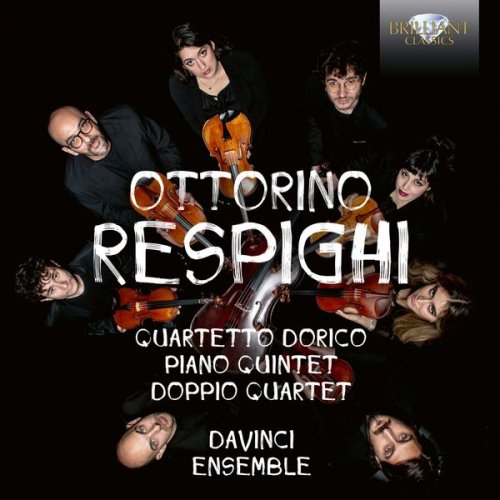
Artist: Da Vinci Ensemble
Title: Respighi: Quartetto Dorico, Piano Quintet, Doppio Quartet
Year Of Release: 2026
Label: Brilliant Classics
Genre: Classical
Quality: flac lossless (tracks) / flac 24bits - 44.1kHz
Total Time: 00:59:40
Total Size: 310 / 596 mb
WebSite: Album Preview
TracklistTitle: Respighi: Quartetto Dorico, Piano Quintet, Doppio Quartet
Year Of Release: 2026
Label: Brilliant Classics
Genre: Classical
Quality: flac lossless (tracks) / flac 24bits - 44.1kHz
Total Time: 00:59:40
Total Size: 310 / 596 mb
WebSite: Album Preview
01. Quartetto dorico, P.144
02. Piano Quintet in F Minor, P.35: I. Allegro
03. Piano Quintet in F Minor, P.35: II. Andante
04. Piano Quintet in F Minor, P.35: III. Vivacissimo
05. Doppio Quartet in D Minor, P.27: I. Allegro
06. Doppio Quartet in D Minor, P.27: II. Adagio non troppo - Quasi andante
07. Doppio Quartet in D Minor, P.27: III. Intermezzo. Allegro vivace ma non troppo
Ottorino Respighi (1879–1936) is best known today for his vividly orchestrated symphonic poems, especially the Roman Trilogy (Fountains of Rome, Pines of Rome, and Roman Festivals). Yet his reputation as a composer rests not only on orchestral color but also on a deep historical awareness and a refined command of chamber music. Trained in Bologna and later influenced by his studies with Rimsky-Korsakov in Russia, Respighi combined Italian lyricism with contrapuntal discipline and a fascination with musical antiquity.
Respighi’s chamber works reveal a more intimate side of his artistry, where structure and thematic development take precedence over orchestral spectacle. Among these, the Piano Quintet (1902) stands as one of his earliest substantial achievements. The quintet shows strong Romantic influences, particularly from Brahms and late German chamber traditions. Its expansive first movement, expressive slow movement, and vigorous finale demonstrate Respighi’s early confidence in handling large forms and dense textures, while hints of his later harmonic individuality already emerge.
The Double Quartet (1904), scored for two string quartets, reflects Respighi’s interest in contrapuntal clarity and ensemble dialogue. Rather than treating the eight instruments as a single mass, he often sets the two quartets in conversation or opposition, creating spatial and textural contrasts. This work illustrates his growing fascination with polyphony and balance, qualities that would later underpin his neoclassical tendencies.
The Doric Quartet (1924) represents Respighi’s mature style and his engagement with ancient musical modes. Inspired by the Doric mode, the work aligns with his broader interest in early music, evident also in pieces like Ancient Airs and Dances. Here, Respighi adopts a restrained, almost austere language, favoring modal harmony, transparent textures, and rhythmic clarity. The quartet avoids overt Romantic excess, instead projecting a timeless, classical serenity.
The DaVinci Ensemble is formed by outstanding Italian musicians, with the aim of making Italian chamber music known throughout the world.
![VA - The Art of HiFi Vol. 3: Percussion (2023) [DSD256]](https://www.dibpic.com/uploads/posts/2026-08/1787844328_oct0043.jpg "VA - The Art of HiFi Vol. 3: Percussion (2023) [DSD256]")

![Joyce Cheung - The Gift (Day Version) (2026) [Hi-Res]](https://www.dibpic.com/uploads/posts/2026-08/1787816531_aq4nucupf4nbw_600.jpg "Joyce Cheung - The Gift (Day Version) (2026) [Hi-Res]")
![matahari sons - Sol en Berlin (2026) [Hi-Res]](https://img.israbox.com/img/2026-08/27/liphdh62asdoa57stjteqmcdz.jpg "matahari sons - Sol en Berlin (2026) [Hi-Res]")
![Jacopo Ferrazza, Sebastian Marino - Apeiron (2026) [Hi-Res]](https://www.dibpic.com/uploads/posts/2026-08/1787747264_bajclticiigao_600.jpg "Jacopo Ferrazza, Sebastian Marino - Apeiron (2026) [Hi-Res]")