Bob Dylan - Bob Dylan (2014) [SACD]
Artist: Bob Dylan
Title: Bob Dylan
Year Of Release: 1962/2014
Label: Mobile Fidelity Sound Lab Inc.
Genre: Folk, Rock
Quality: DSD64 image (*.iso) / 2.0 (2,8 MHz/1 Bit)
Total Time: 37:19
Total Size: 1.5 GB
WebSite: Album Preview
Tracklist:Title: Bob Dylan
Year Of Release: 1962/2014
Label: Mobile Fidelity Sound Lab Inc.
Genre: Folk, Rock
Quality: DSD64 image (*.iso) / 2.0 (2,8 MHz/1 Bit)
Total Time: 37:19
Total Size: 1.5 GB
WebSite: Album Preview
01. You’re No Good 01:43
02. Talkin’ New York 03:22
03. In My Time of Dyin’ 02:42
04. Man of Constant Sorrow 03:10
05. Fixin’ to Die 02:24
06. Pretty Peggy-O 03:27
07. Highway 51 02:53
08. Gospel Plow 01:48
09. Baby, Let Me Follow You Down 02:38
10. House of the Risin’ Sun 05:21
11. Freight Train Blues 02:22
12. Song to Woody 02:45
13. See That My Grave Is Kept Clean 02:44
Bob Dylan is the debut album by American singer-songwriter Bob Dylan. Dylan was 20 years old when the album was released in March 1962. The album features only two songs written by Dylan himself; the rest are folk standards. The album was produced by John Hammond, who signed Dylan to the label.
Dylan met John Hammond at a recording session for Carolyn Hester on September 14, 1961, in Carolyn's apartment. Hester invited Dylan to play harmonica, which Hammond agreed to after listening to and receiving recommendations from his son and renowned Irish folk singer Liam Clancy.
Hammond later admitted that he decided to sign Dylan on the spot and immediately invited him to an official recording session at Columbia Records. This recording was not found in the company's archives, but both Hammond, Dylan, and the director of Columbia Records confirmed its existence.
On September 26, Dylan took part in the two-week folk festival Gerde's Folk City in New York City, performing second, behind The Greenbriar Boys. On September 29, a positive review of his performance appeared in the New York Times. That same day, Dylan recorded harmonica for Hester at Columbia Records' Manhattan studio. After the recording, Hammond invited Dylan to his office and offered him a standard five-year contract for previously unregistered artists, which Dylan signed without hesitation.
The first recording sessions were scheduled for late November, and Dylan immediately began searching for new material, despite already having several songs in his repertoire. Dylan's friend Carla Rotolo said, "He listened to my records day and night, mostly the famous folk collection 'The Anthology of American Folk Music,' songs by Ewan MacColl and A.L. Lloyd, studied Rabbit Brown's guitar, and, of course, Woody Guthrie. We were all waiting to see which songs Bob would choose for the record. I remember discussing this with him very well."
The album was recorded in three short days in the studio from November 20th to 22nd. Hammond later joked that Columbia spent $402 on the recording. Despite the low cost and speed of the recording, Hammond was dissatisfied with Dylan's discipline, who constantly intentionally mispronounced certain letters, sang off the microphone, and refused to correct mistakes.
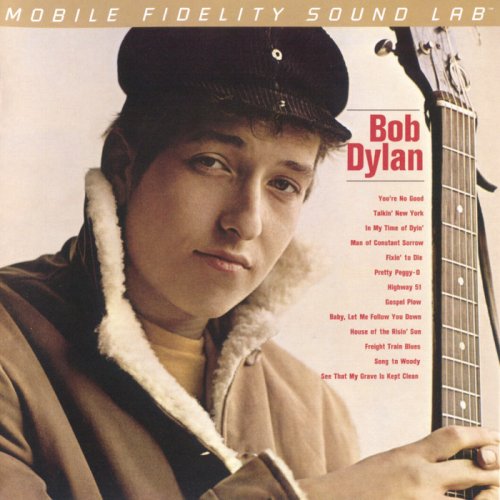
The album cover features a mirrored photo of Dylan; the reason for this remains unknown. Before recording the album, Dylan listened to a huge amount of folk music. He frequented New York clubs and restaurants where his contemporaries were performing, many of whom were close friends, who would invite him to their homes after the concerts and play him their new songs. Dylan also listened to a large number of folk, blues, and country records, some of which were truly rare at the time. In the documentary "No Direction Home," Dylan claims that he only needed to hear a song once or twice to learn it.
On the final version of the album, only two songs were written by Dylan himself; the remaining eleven songs were by other composers, some of which were part of Dylan's club repertoire. In a 2000 interview, Dylan admitted that he didn't want to reveal too much of his original work.
Of the two songs, "Song for Woody" is the more well-known. Dylan's leading biographer, Clinton Heylin, wrote that the song's manuscript is inscribed: "Written by Bob Dylan to Woody Guthrie, at Mills Bar, Bleecker Street, New York City, February 14th." The song's melody is based on Guthrie's "1913 Massacre," but Guthrie, like many folk musicians, including Dylan, may have borrowed the melody from even earlier sources. Woody Guthrie was Dylan's greatest influence at the time of his debut album, and Dylan mimics Guthrie's vocal style on several songs. For example, parallels can be drawn between the song "Talkin' New York" and Guthrie's composition "Pretty Boy Floyd."
![Bob Dylan - Bob Dylan (2014) [SACD]](https://www.dibpic.com/uploads/posts/2026-06/1780496366_disc.jpg)

![Seigen Tokuzawa & Masaki Hayashi - B (2026) [Hi-Res]](https://www.dibpic.com/uploads/posts/2026-08/1787714230_jionhssbrm07c_600.jpg "Seigen Tokuzawa & Masaki Hayashi - B (2026) [Hi-Res]")