Simone Dinnerstein, Baroklyn - Hourglass (2026) [Hi-Res]
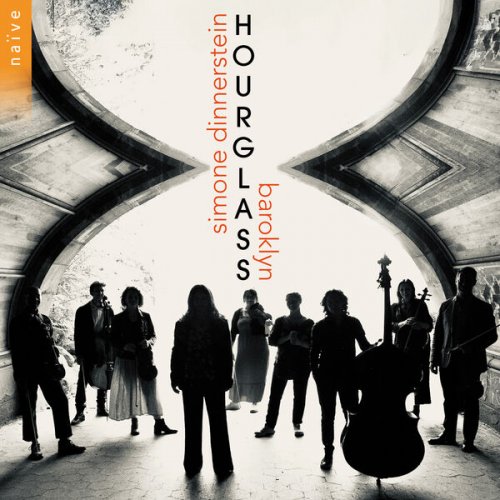
Artist: Simone Dinnerstein, Baroklyn
Title: Hourglass
Year Of Release: 2026
Label: Naive
Genre: Classical
Quality: FLAC (tracks) / 24bit-96kHz FLAC (tracks)
Total Time: 56:51
Total Size: 215 / 754 MB
WebSite: Album Preview
Tracklist:Title: Hourglass
Year Of Release: 2026
Label: Naive
Genre: Classical
Quality: FLAC (tracks) / 24bit-96kHz FLAC (tracks)
Total Time: 56:51
Total Size: 215 / 754 MB
WebSite: Album Preview
1. Suite from "The Hours": I. (Arr. for Piano, Strings, Harp and Celesta by Michael Riesman) (11:17)
2. Suite from "The Hours": II. (Arr. for Piano, Strings, Harp and Celesta by Michael Riesman) (8:59)
3. Suite from "The Hours": III. (Arr. for Piano, Strings, Harp and Celesta by Michael Riesman) (6:57)
4. Tirol Concerto (Piano Concerto No. 1): Movement I (6:28)
5. Tirol Concerto (Piano Concerto No. 1): Movement II (16:40)
6. Tirol Concerto (Piano Concerto No. 1): Movement III (6:33)
Philip Glass, a towering figure in New York’s musical life in the latter half of the Twentieth century and an essential voice of the minimalist movement, crafted soundscapes that seem made for the screen. crafted soundscapes that seem made for the screen.
In 2002, the director Stephen Daldry commissioned Glass to compose the score for his new film, ‘The Hours’, bringing together - in the roles of three women living in three different eras - none other than Nicole Kidman, Julianne Moore and Meryl Streep. For this study on womanhood and the passage of time, the American composer devised a score that then became emblematic of his late style. It is a veritable manifesto of his expressive simplicity, in which layers and motifs are in constant, subtle transformation, giving rise to a richly wrought polyphonic universe that beguiles us with its expansive sonic textures.
The rich score composed for Daldry was later distilled by Michael Riesman - musical director of the Philip Glass Ensemble and a close collaborator of the composer - into a three-movement suite for piano, strings, harp and celesta, which is performed here by pianist Simone Dinnerstein and her New York ensemble, Baroklyn.
During the same recording session in May 2025, Baroklyn’s musicians also immersed themselves in Tirol Concerto (2000), the first concerto that the composer wrote for piano, which is framed solely by strings. Two brief, fleeting movements in neo-Baroque vein enclose a broad elegy - music for an imagined film - threaded with numerous reminiscences of Glass’s Etudes for piano, which he began writing in 1994. for piano, which he began writing in 1994.
Simone Dinnerstein sees a natural affinity between the music of Philip Glass and that of J. S. Bach - one of her most ardent ‘obsessions’ and the main foundation of her work with Baroklyn. In her view, the American composer shares many traits with the Cantor of Leipzig: a deeply polyphonic vision, a quest for the absolute independence of each line, and an abiding concern for the singing quality of musical phrases. Repetitive in essence, Glass’s music here ‘unfolds’ with an extraordinarily generous breadth of spirit, under the capable hands of Simone Dinnerstein and her Baroklyn musicians.
In 2002, the director Stephen Daldry commissioned Glass to compose the score for his new film, ‘The Hours’, bringing together - in the roles of three women living in three different eras - none other than Nicole Kidman, Julianne Moore and Meryl Streep. For this study on womanhood and the passage of time, the American composer devised a score that then became emblematic of his late style. It is a veritable manifesto of his expressive simplicity, in which layers and motifs are in constant, subtle transformation, giving rise to a richly wrought polyphonic universe that beguiles us with its expansive sonic textures.
The rich score composed for Daldry was later distilled by Michael Riesman - musical director of the Philip Glass Ensemble and a close collaborator of the composer - into a three-movement suite for piano, strings, harp and celesta, which is performed here by pianist Simone Dinnerstein and her New York ensemble, Baroklyn.
During the same recording session in May 2025, Baroklyn’s musicians also immersed themselves in Tirol Concerto (2000), the first concerto that the composer wrote for piano, which is framed solely by strings. Two brief, fleeting movements in neo-Baroque vein enclose a broad elegy - music for an imagined film - threaded with numerous reminiscences of Glass’s Etudes for piano, which he began writing in 1994. for piano, which he began writing in 1994.
Simone Dinnerstein sees a natural affinity between the music of Philip Glass and that of J. S. Bach - one of her most ardent ‘obsessions’ and the main foundation of her work with Baroklyn. In her view, the American composer shares many traits with the Cantor of Leipzig: a deeply polyphonic vision, a quest for the absolute independence of each line, and an abiding concern for the singing quality of musical phrases. Repetitive in essence, Glass’s music here ‘unfolds’ with an extraordinarily generous breadth of spirit, under the capable hands of Simone Dinnerstein and her Baroklyn musicians.
![Lalo Schifrin - The Lalo Schifrin Collection, Vol. 2 (Original Motion Picture Soundtrack) (2026) [Hi-Res]](https://img.israbox.com/img/2026-08/25/e6evki0mzwvemyi94ypbkbt5r.jpg "Lalo Schifrin - The Lalo Schifrin Collection, Vol. 2 (Original Motion Picture Soundtrack) (2026) [Hi-Res]")
![Four80East - Barn Sessions Volume One (2025) [CD-Rip]](https://www.dibpic.com/uploads/posts/2026-08/1787663681_h20up3jlj678a_600.jpg "Four80East - Barn Sessions Volume One (2025) [CD-Rip]")
![Morrotrönik - Delaire (2026) [Hi-Res]](https://www.dibpic.com/uploads/posts/2026-08/1787714458_v77vg7agsmnw2_600.jpg "Morrotrönik - Delaire (2026) [Hi-Res]")