Artist:
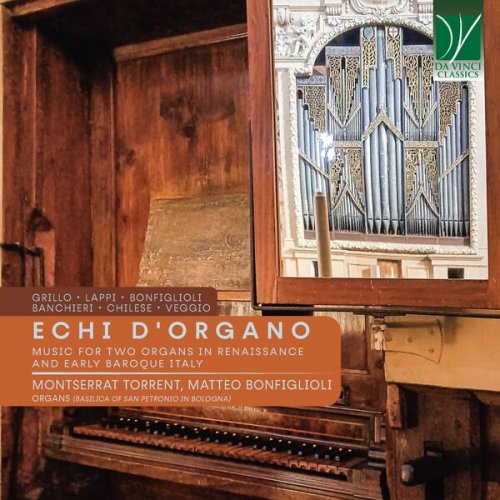
Montserrat Torrent, Matteo Bonfiglioli
Title:
Echi d’Organo: Music for Two Organs in Renaissance and Early Baroque Italy
Year Of Release:
2026
Label:
Da Vinci Classics
Genre:
Classical
Quality:
FLAC (tracks) [96kHz/24bit]
Total Time: 44:55
Total Size: 849 / 195 MB
WebSite:
Album Preview
Tracklist:1. Canzon pian e forte a 8 (03:58)
2. Toccata in Echo per l'Elevatione (02:56)
3. Pavana, Saltarello de la Pavana, La Coda (03:48)
4. Canzon XVII "L’Allé" (04:33)
5. Tiento sopra Ave Maria (05:53)
6. Dialogo Acuto & Sopra'Acuto (02:55)
7. Canzon XXXI "Risposta dell’Eco" (06:05)
8. O gloriosa Domina (Adriano Willaert) (04:32)
9. Ricercada per 8 quadro del primo tono (06:21)
10. Canzon in Echo a 8 (03:49)
During the sixteenth to eighteenth centuries, in the most important churches (such as, for example, S. Maria Gloriosa dei Frari in Venice, the Duomo of Milan, S. Stefano dei Cavalieri in Pisa, Malta Cathedral, etc.), the provision of a second organ developed in parallel with the rise and consolidation of the polychoral repertoire. It is no coincidence that at S. Petronio Baldassarre Malamini’s organ (1596) was placed alongside that of Lorenzo da Prato (1475), «quod possint cum duobus organis fieri concertus et chori ac musica duplex et responsiva ac alternata». Although the formation of a specific repertoire for two organs took place only in the late seventeenth century, the two instruments interacted closely in accompanying polychoral performances, leaving the exercise of an autonomous role, plausibly, to improvisatory practices.
Appearing in the final years of the sixteenth century, the dedicated parts pro organo, with staves following the principle known as the ‘basso seguente’, preferably required an almost faithful rewriting of the vocal texture, a supporting solution regarded – according to theoretical sources, above all Girolamo Diruta’s treatise Seconda parte del Transilvano (1622, Lib. I) – as the most suitable for accompanying polyphony, with the aim of averting approximate results.
In the context of polychoral music a support for the two choirs could be ensured by a single organist who, reading his ‘bass’ part (or simultaneously the two ‘basses’), could arrive at an appropriate synthesis at the keyboard. For ‘a due’ concertation, by contrast, one arrived at a double ‘intavolatura’ of the vocal parts, that is, a reduction for the two keyboards of the respective choirs to which they belonged. It is in view of this complex practice that the present recording offers performances for two organs of ‘a 8’ compositions belonging to the early seventeenth-century instrumental repertoire, by intabulating directly the eight voices from the respective part-books.
One of the most important testimonies to the instrumentalism of this period is the anthology Canzoni per sonare con ogni sorte di stromenti Libro I, published in Venice in 1608 by the printer Alessandro Raveri and containing, as one reads in the dedicatory letter, «Canzoni to be played with the Organ, & other Instruments, collected by me from those most excellent Musicians, who nowadays, together with those of greatest renown, by their works shine most among others». Among the eleven canzoni a 8 voci, out of a total of thirty-six from 4 to 16 voices anthologised by Raveri, the Canzona XXXI Risposta dell’Eco per sonar a 8 [track 7] by Bastiano Chilese stands out: here the echo procedures are understood not so much in a dynamic sense but as in a spatial one, with sonorities of almost equivalent intensity. The print in fact refers to the second organ by means of the simple abbreviation “Risp.” (Risposta). The musical discourse between the instruments is structured in ever closer episodes and concludes with an unexpected and original truncation on descending melodic turns.
A similar conception is revealed in the Canzon XVII l’Allé in Ecco a 8 [track 4] by the Florentine Pietro Lappi, chapel master at S. Maria delle Grazie from 1593, contained in his op. 9, the Canzoni da suonare Libro I (Venice 1616), the only book entirely devoted to instrumental pieces from 4 to 13 voices, alongside other monographic volumes reserved for sacred music, and considered a mature fruit of the Brescian instrumental school. To the solid rhythmic framework of the I Coro the II Coro responds with effective shortenings of the phrase material, establishing different degrees of echo to simulate suggestive distances.
The collection Sacri concentus ac symphoniae (Venice 1618), dedicated to Archduke Ferdinand of Austria, is Giovanni Battista Grillo’s only monograph, in addition to many compositions that appeared in prestigious anthologies, and contains both motets and sonatas and canzoni. Among these, of particular interest are the Canzon in Ecco a 8 [track 10] and the Canzon pian e forte a 8 [track 1], the latter for its evident relationship with Giovanni Gabrieli’s Sonata pian e forte, which appeared in the Symphoniae sacrae of 1597, the first example of dynamic indications explicitly stated in the text. Grillo’s two compositions draw on models from the late sixteenth-century tradition, yet display original traits already fully shaped by the spirit of the concertato style.
The principle of playing in echo may also be a performance choice at the level of concertation for several compositions originally for organ, in which a change of registration already allowed an effective differentiation of sonic planes at the keyboard. The redistribution of the musical discourse here across two organs, in the case of two compositions for a single instrument, pursues the aim of accentuating these effects and of further exploiting the nuances between two different timbral palettes operating at a distance.
The Dialogo Acuto & Sopr’acuto [track 6] was included by Adriano Banchieri in the edition printed in Bologna in 1611 (as op. 25) of his celebrated treatise L’Organo suonarino (ed. 1605, op. 13). It is a short page, not without exemplary intent, written as a score on four staves and consisting of a tightly knit succession of predominantly chordal phrases. The unpublished transcription by Luigi Panzeri (with a small coda added ex novo) is adapted here for two organs and now assumes a new antiphonal dimension, bringing the two instruments together in the final bars in “Pieno & grave”.
The Toccata in Ecco per l’Elevatione [track 2], by an anonymous seventeenth-century author, is contained in a manuscript that forms part of the substantial personal collection of the composer Francesco Spagnoli Rusca (1634-1674) and is currently preserved in the Musical Archive of Como Cathedral. Published by Luigi Picchi in 1956, the Toccata develops, in a calm ternary rhythm, the alternation of two clearly distinct sections, then repeated with minimal adjustments to form a small ABAB design, in a succession of clear symmetries with faint sonorities.
Among Italian keyboard-music collections of the sixteenth century, a not insignificant place is occupied by the ten manuscript fascicles (plus a few detached leaves) preserved in the Archive of the Collegiate Church of S. Maria Assunta in Castell’Arquato, Italy. They transmit a heterogeneous repertoire of compositions (well over a hundred) representing all the musical genres practised at the time: from Masses (alternatim) to motets, madrigals and chansons (intabulated vocal polyphonies), from dances to ricercari. The whole is arranged in a non-systematic order, very probably owing to the different provenance of the fascicles and to the period of their compilation, which scholars place, for some of them, in the decades beyond the middle of the century.
Fascicle VII opens with the Pavana-Saltarello de la pavana-La coda [track 3], a composition based on the ostinato structure of the Romanesca, a harmonic scheme of nine chords whose fundamentals move principally by intervals of a fourth and support a melodic line profiled on a repeated descending tetrachord. This module constitutes the framework upon which the anonymous author elaborates broad ornamental arches entrusted to the right hand, while the left hand limits itself to chordal support. The contrast produced by the shift to the ternary metre of the ensuing Saltarello remoulds the melodic figurae without interruption, while the freer conception of the Coda increases the virtuosity of the cantus part.
Within the heterogeneous content of the various fascicles, many famous vocal polyphonic compositions are also present, undergoing a process of transcription for keyboard; among them O gloriosa domina [track 8] by Adriano Willaert, the celebrated motet that sets for six voices the first three stanzas of one of the best-known Marian hymns for Morning Lauds (a text attributed to Venantius Fortunatus, poet and hagiographer of the sixth century). The keyboard version, of great expressive suggestiveness, confronts the complex vocal counterpoint and reshapes it into a more agile reduction of the texture, without altering its character; indeed, it succeeds in capturing and underlining the solemn aere of the motet as a whole.
The expansive Recercada per b molle del primo tono [track 9] by Claudio Veggio is the most technically demanding piece on this CD. The activity of the author, a native of Piacenza and resident there, is closely connected with the Castell’Arquato manuscripts, which contain his known compositions, instrumental and some vocal. The Recercada in question, the longest in fascicle V, has a tripartite form in duple metre, with the central section in a contrasting tempus perfectum. The first section develops a descending motive that is transformed into a long sequence of rapid scales passing between the two hands and set against held chords. Such a texture, suspended in the central section in favour of a more compact movement with octave chordal responses, returns at times more rarefied in the third section to frame the main motive. While a certain retrospective affinity may be discerned with the rhapsodic ricercari and structurally chordal writing of Marc’Antonio Cavazzoni, Veggio’s style is distinguished by the exuberance of its invention and by the rhythmic impetus of its melodicising, qualities fully conveyed by the sonic vitality of Lorenzo da Prato’s oldest organ.
Antonio Delfino © 2026

![matahari sons - Sol en Berlin (2026) [Hi-Res]](https://img.israbox.com/img/2026-08/27/liphdh62asdoa57stjteqmcdz.jpg "matahari sons - Sol en Berlin (2026) [Hi-Res]")
![The John Payne Band - Bedtime Stories (1976) [Hi-Res]](https://www.dibpic.com/uploads/posts/2026-08/1787861782_cover.jpg "The John Payne Band - Bedtime Stories (1976) [Hi-Res]")
![Marcelo Galter - Marcelo Galter investiga a beleza sem fim de Dorival Caymmi (2026) [Hi-Res]](https://www.dibpic.com/uploads/posts/2026-08/1787803994_dvycawhe2s4gg_600.jpg "Marcelo Galter - Marcelo Galter investiga a beleza sem fim de Dorival Caymmi (2026) [Hi-Res]")
![Ale Núñez - Blue Room (2026) [Hi-Res]](https://img.israbox.com/img/2026-08/27/x7n7owmuquv203irmpuzayub4.jpg "Ale Núñez - Blue Room (2026) [Hi-Res]")
![Joyce Cheung - The Gift (Day Version) (2026) [Hi-Res]](https://www.dibpic.com/uploads/posts/2026-08/1787816531_aq4nucupf4nbw_600.jpg "Joyce Cheung - The Gift (Day Version) (2026) [Hi-Res]")