Artist:
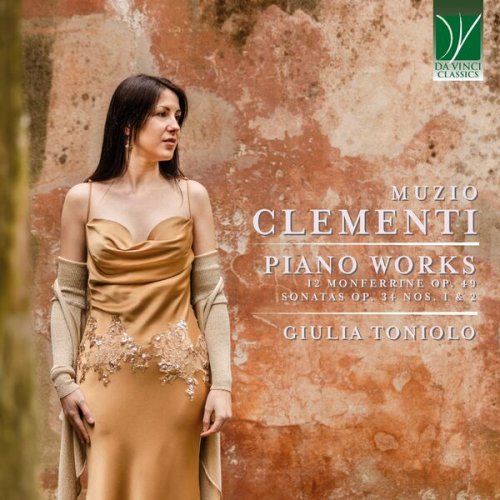
Giulia Toniolo
Title:
Muzio Clementi: Piano Works
Year Of Release:
2026
Label:
Da Vinci Classics
Genre:
Classical
Quality:
FLAC (tracks) [96kHz/24bit]
Total Time: 1:09:51
Total Size: 1.1 GB / 237 MB
WebSite:
Album Preview
Tracklist:1. Sonata in C Major, Op. 34 No. 1: I. Allegro con spirito (10:05)
2. Sonata in C Minor, Op. 34 No. 1: II. Un poco Andante, quasi Allegretto (06:11)
3. Sonata in C Major, Op. 34 No. 1: III. Finale. Allegro (05:04)
4. 12 Monferrine, Op. 49: No. 1 in G Major, Allegro (01:36)
5. 12 Monferrine, Op. 49: No. 2 in C Major, Allegro non troppo (02:04)
6. 12 Monferrine, Op. 49: No. 3 in E Major, Allegretto con espressione (02:07)
7. 12 Monferrine, Op. 49: No. 4 in C Major, Allegretto con moto (02:05)
8. 12 Monferrine, Op. 49: No. 5 in A Major, Allegretto con grazia (02:15)
9. 12 Monferrine, Op. 49: No. 6 in D Minor, Alllegro (01:25)
10. 12 Monferrine, Op. 49: No. 7 in D Major, Allegro vivace (01:47)
11. 12 Monferrine, Op. 49: No. 8 in E-Flat Major, Vivace assai (01:19)
12. 12 Monferrine, Op. 49: No. 9 in G Major, Allegro moderato (02:11)
13. 12 Monferrine, Op. 49: No. 10 in C Major, Allegro moderato (02:25)
14. 12 Monferrine, Op. 49: No. 11 in F Major, Allegro non troppo (02:15)
15. 12 Monferrine, Op. 49: No. 12 in C Major, Allegretto moderato (03:38)
16. Sonata in G Minor, Op. 34 No. 2: I. Largo e sostenuto – Allegro con fuoco (09:37)
17. Sonata in G Minor, Op. 34 No. 2: II. Un poco Adagio (07:05)
18. Sonata in G Minor, Op. 34 No. 2: III. Finale. Molto Allegro (06:34)
The programme brings together two central works within Clementi’s pianistic art, the Sonata in C major op. 34 no. 1 and the Sonata in G minor op. 34 no. 2, together with an entire fascicle of composed dances, the 12 Monferrine op. 49, and in so doing traces an arc that extends from the expansive rhetoric of large-scale form to the choreographic miniature of salon provenance. The co-presence of these two poles is not simply an elegant dramaturgical choice, but casts light on the workshop of a musician who was at once pianist, pedagogue, publisher and piano maker, and who knew how to decant his artisanal knowledge into the very fabric of sound. In Clementi’s trajectory, his native city, Rome, soon gives way to London, where the composer establishes himself as virtuoso, publishing entrepreneur and leading figure of a firm which, under the corporate name Longman & Broderip at first and then Clementi & Co., brings together within a single structure the production, publication and circulation of instruments and repertoires. The transformation of the firm and the managerial role assumed by Clementi speak eloquently of his integrated conception of music, understood as an intelligence of sound and of the object that generates it. This twofold vocation, at once artistic and industrial, is decisive for an understanding of the attention to pianistic gesture, to the mechanics of the keyboard and to editorial legibility that his pages display.
The two Sonate of op. 34 reveal complementary aspects of this poetics. For the Sonata in C major op. 34 no. 1 the sources transmit a curious detail. According to the late testimony of the pupil Ludwig Berger, it originated as a concerto, later reworked for keyboard alone. It is therefore hardly surprising that the Allegro con spirito unfolds figurations of broad span, with passages of virtuosic brilliance entrusted also to the left hand, albeit without the cadential signs typical of soloist-orchestra dialogue. The concerto idea is sublimated rather than flaunted: the thematic discourse is articulated with classical clarity, yet the propulsion of the arpeggiated designs and the skilful handling of transitions and modulatory bridges betray the craft of the keyboard-player-engineer. The Un poco Andante, quasi Allegretto in F major concentrates its lyricism in a line that seems smoothed and rounded by breath: here the shadow of the European salon appears as a foretaste of the cantabile associated with John Field, Clementi’s favourite pupil, poet of the nocturne and of legato playing. This is not a matter of mere stylistic kinship, but of a didactic osmosis in which the master transmits an idea of touch and of phrasing destined to project itself far beyond his own time.
The Sonata in G minor op. 34 no. 2 is regarded by many as one of the highest achievements in Clementi’s output. The opening Largo e sostenuto shapes a short motif, almost a three-beat motto, which thickens into a severe chromatic fugato that is not ornamental but structural; this contrapuntal material is then transfigured in the Allegro con fuoco, where motor energy and polyphonic control coexist with thoroughly modern keyboard figurations. In the recapitulation, the return of the Largo functions as a reminiscence that rereads the formal process from within. The Un poco Adagio unfolds a barcarolle-like song punctuated by a dotted rhythm which at times turns into an angular counter-melody; the concluding Molto Allegro, cast in sonata-form, brings the work to a close, reaffirming its serious and even sombre tone.
Those who wish to grasp Clementi’s originality cannot be content with comparison to his contemporaries; they must look to his pedagogical workshop. Introduction to the Art of Playing on the Pianoforte op. 42 codifies not only elements of notation and fingering, but an idea of the hand and of dynamics that integrates didactic clarity with musical purpose; the monumental Gradus ad Parnassum goes further still, with studies that are also complete pieces, preludes that cultivate a taste for controlled improvisation, fugues that exercise eye and ear alike in polyphony. It is an ethic of work, even before it is a technique, that the Sonate of op. 34 embody in their clarity.
If the Sonate show Clementi in the ‘symphonic’ dimension of the piano, the Monferrine op. 49 reveal him as a refined craftsman of the small form. What, precisely, is a monferrina? A Piedmontese dance of popular character, historically in duple metre – 6/8 – which has migrated from the squares to the ballrooms of early modernity. The composer himself specifies, on the title page, the geographical root of the name, while the Italian tradition underlines its stamp, alive in regional variants and in kindred choreographic vocabularies. Within this framework of social custom, Clementi distils a cycle of twelve pieces of two pages each, almost cameos marked by the unmistakable half-bar anacrusis, with contrasting episodes in closely related keys and a texture often in two parts, transparent and carefully controlled. Formal solidity does not curb a pronounced taste for differentiation. No. 1 in G major (Allegro) opens the fan with a forthright step and sharply profiled dynamics; no. 3 in E major (Allegretto con espressione) focuses on cantabile and embellishments that evoke the art of portamento; no. 8 in E flat major (Vivace assai) bends the writing towards an almost orchestral verve, whereas no. 4 in C major, an exception within the group, thickens the harmonic and chromatic fibres. This is not a matter of mere entertainment: in the Monferrine one can gauge Clementi’s capacity to translate a rhythmic-choreographic profile into a keyboard gesture, exercising hand, ear and a sense of proportion.
The historical context helps to explain why these dances, born at the foot of the Piedmontese hills, enjoyed success in the European capitals and, not least, in the London where Clementi was active as publisher and instrument maker. The attraction to ‘national’ dance pieces is in fact intertwined with the demand for accessible repertories for domestic music-making, a segment that Clementi knew in depth. To such an extent that he returned on several occasions to the monferrina form, leaving also a further group of six pieces which did not find their way into a second fascicle of twelve, a sign of the vitality of a genre that lent itself both to sociability and to the exercise of cultivated taste. Listening to the entire cycle makes it evident how Clementi varies the profiles without betraying the basic identity. The apparent limitation of the means opens on to precious micro-inventions: counter-melodies that emerge and are reabsorbed, small internal cadences, lightning modulations to the subdominant or to the relative key, a palette of dynamics that is restrained yet eloquent. In this craftsmanship one recognises both Clementi the pedagogue and Clementi the publisher, capable of calibrating difficulty, legibility and the pleasure of playing.
Between the two Sonate there runs a common thread: the centrality of the keyboard as an organism. In the C major of op. 34 no. 1 architectural clarity does not exclude virtuosity nor a skilful alternation between registers, almost as if to bring out the mechanics of the modern piano; in the G minor of no. 2 formal restlessness offers the performer a dialectic between cantabile and fugue, weight and lightness, control and abandon. In filigree lies the lesson of Clementi’s treatises and of the Gradus: independence of the fingers, articulation, control of legato and non-legato, judicious use of the pedal, a polyphonic awareness even in the most brilliant discourse. It is a conception of the piano as a synthesis of singer and orchestra, where the skill of the hand is always at the service of a rhetoric of discourse. A further line of interpretation, suggested by the sources, concerns the memory of orchestral forms that lies behind op. 34; that metamorphosis from presumed concerto or symphonic matrices should not be understood as a residue, but rather as a form of latent energy. The rhetoric of the slow introduction that returns in the recapitulation, the contrapuntal density within the sonata-form framework, the ability to make ‘idiomatic’ figurations converse with a thought that is almost symphonic, are all signs of a manner of writing that thinks beyond the keyboard, whilst speaking its language to perfection. In this respect Clementi looks towards a modernity that his heirs would render harsher or more lyrical, but for which he prepared the codes.
This fabric is completed by a brief reference to the editorial and critical sphere: op. 34, at times compared to the early Beethoven cycles for its ambition and quality of writing, occupies a stable place in investigations of late eighteenth-century form and style, whereas the Monferrine op. 49 have been the subject of critical editions and recordings that have specified their metre, their formal layout and their performance practice. The reconstruction of the catalogue and of the composer’s correspondence has in recent years enriched the documentary picture, confirming the vitality of Clementi studies. What the present programme brings out with clarity is the unity of a vision: from the large-scale sonata to the refined dance, Clementi asserts an idea of style as an equilibrium between intellect and hand, measure and invention, tradition and future. In this perspective, the two Sonate and the Monferrine are not parallel worlds but communicating mirrors. In the former, the piano becomes a theatre of passions and of architectures, while in the latter a gymnasium of grace, measure and rhythm, with echoes of European squares and salons. In their dialogue one perceives the hand of the builder, the mind of the pedagogue, the ear of the composer who knows the limits and the virtues of the keyboard. These are pages that speak to those who play and to those who listen, and that, beyond chronology, bring back to the centre what is essential: the capacity to transform a dance step and a three-beat motif into enduring forms of the spirit.
Giuliano Marco Mattioli © 2026

![matahari sons - Sol en Berlin (2026) [Hi-Res]](https://img.israbox.com/img/2026-08/27/liphdh62asdoa57stjteqmcdz.jpg "matahari sons - Sol en Berlin (2026) [Hi-Res]")
![Joyce Cheung - Set Loose (2026) [Hi-Res]](https://www.dibpic.com/uploads/posts/2026-08/1787803966_pbl5fyeuhjjlm_600.jpg "Joyce Cheung - Set Loose (2026) [Hi-Res]")
![Dos Santos - Es Amor (2026) [Hi-Res]](https://img.israbox.com/img/2026-08/27/01zwg61342s1i48xgyhm7u1fv.jpg "Dos Santos - Es Amor (2026) [Hi-Res]")


![101 Strings Orchestra - 60's Style (2014-2026 Remaster from the Original Alshire Tapes) (1976) [Hi-Res]](https://img.israbox.com/img/2026-08/30/0hwcqz4gwqfp1wc4d9hgqm2uf.jpg "101 Strings Orchestra - 60's Style (2014-2026 Remaster from the Original Alshire Tapes) (1976) [Hi-Res]")
![Candice Hoyes - Expecting (2026) [Hi-Res]](https://www.dibpic.com/uploads/posts/2026-08/1787889790_cover.jpg "Candice Hoyes - Expecting (2026) [Hi-Res]")