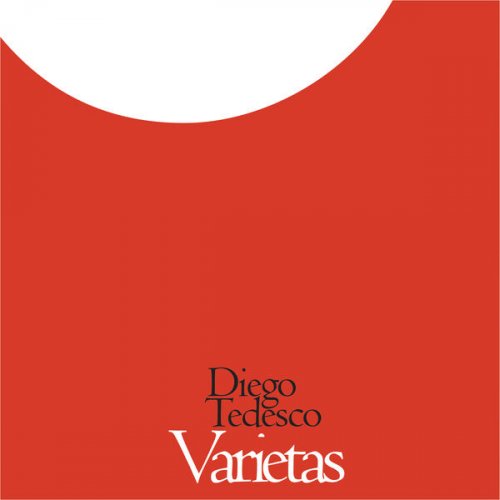
01. Capriccio
02. Portrait #2
03. Scherzo
04. Portrait #1
05. De los sos ojos
06. Varietas: I. Intonazione
07. Varietas: II. Estructuras divergentes
08. Varietas: III. Resonancias
09. Before the World
Argentinean composer Diego Tedesco debut portrait album Varietas highlights his charged, gestural style in works for chamber ensemble, instrument plus electronics, and orchestra. Featuring performances by longtime collaborators violinist Miranda Cuckson, guitarist Daniel Lippel, soprano Natalia Cappa, counter)induction, Orquesta Amigos de la Nueva Música, and the Composers Conference Ensemble, Tedesco carries forward the torch for a rich lineage of Argentinean contemporary music with his clarion expressivity.
Tedesco's debut portrait album chronicles his vivacious, brilliantly hued gestural writing, as well as several of his long term collaborations. A student of the eminent Argentinean composer Mario Davidovsky, Tedesco's participation in Davidovsky's Composers Conference outside of Boston laid the foundation for many of relationships behind the works heard here. While Davidovsky's presence is felt both musically and in terms of shared connections between key figures on this recording, Tedesco's compositional voice is unique and distinctive.
Tedesco met violinist Miranda Cuckson at the Composers Conference in 2014, during which she performed in his Varietas, for fifteen players heard here; he subsequently composed his work for solo violin and ensemble for her, Capriccio to be performed at the 2017 conference. Clarinetist Benjamin Fingland was also a member of the conference ensemble and a performer on both of those Tedesco works, as well as a colleague of Cuckson’s in the New York based ensemble, counter)induction. In 2014, counter)induction artistic directors Douglas Boyce and Kyle Bartlett had curated an 80th birthday concert for Mario Davidovsky and invited guitarist Daniel Lippel to join the group to perform in two of his chamber works. The various threads of connection between members of counter)induction and Tedesco led him to compose the mercurial, character-rich Scherzo for the ensemble in 2019.
Tedesco’s first two Portraits for instrument and electronics grew from there, written for violinist Cuckson and the guitarist Lippel respectively. Moreover, they are the beginning of a series of electroacoustic works that pay homage to Davidovsky’s legacy as an iconic pioneer of electroacoustic music with his Synchronisms works for instrument and electronics. De los sos ojos was written for soprano Natalia Cappa and featured on her 2024 New Focus album Una (FCR391), a compilation of new works for voice and electronics by Argentinean composers. While Tedesco’s orchestral work Before the World is the one piece that eludes the tight web of interconnection, its inclusion here gives welcome context to the trajectory of Tedesco’s music in the last 15 years, as well as how his gift for color and gesture maps itself onto larger ensemble forces.
Among the primary points of focus in Davidovsky’s music is the journey motivic material takes as it is reframed within different character areas in a piece and shifts its role in an ever evolving dramatic dialogue. Diego Tedesco shares this penchant for recasting thematic material; one can hear it most apparently in the migration of similar motivic ideas as they navigate shifting expressive worlds in Scherzo, Capriccio, and Varietas.
In his approach to electronic material, Tedesco shares Davidovsky’s deeply felt skepticism of the technological vanguard, opting to construct his playback part from what he calls “discarded material,” intentionally repurposing sounds that the inexorable wave of progress has chosen to leave behind. In doing so, Tedesco reclaims a purity in his electroacoustic approach that can be obscured by the pervasive use of the newest software or platform, until the next one comes along. With this collection of scraps of sound, he crafts music that is full of expression, jumping between pathos and wry humor with agility. Tedesco cultivates a healthy dose of the absurd in these Portraits, a character that strikes as an expansion of Davidovsky’s own tragicomic impulse that saturates the melodrama in his music. Particularly in Portrait #2, Tedesco engages in a kind of deconstruction of the guitar’s voice, splintering into a distorted collage of its myriad stylistic tropes. He is only slightly more reverent of the violin’s vaunted status; while the prodigious virtuosity in Portrait #1 is a nod to Davidovsky’s Ysaÿe-inspired Synchronisms #6, the raw overpressure figures and stuttering articulations do more than enough to bring the instrument down from its romantic perch to join the dystopian sonic environment which engulfs it.
And yet while Davidovsky’s presence is felt throughout these works, and nowhere more than in the Portraits, Tedesco is decidedly his own composer. Where Davidovsky constructs interdependent dramatic architectural structures whose coherence relies on pristine execution, Tedesco composes in broader strokes, with salient phrases that project clear expression through urgent gestures, decorated with ornamental detail. In this way, Diego Tedesco’s music feels liberated and grounded at once, buoyant with fantasy and embellishment but tethered to larger structural arcs by the clarity of its shapes and expressive content. In a recent conversation, Diego shared one of Mario’s anecdotes about composing — a war metaphor where military airplanes, trains, and infantry all advance at their own pace and the generals need to manage multiple speeds to achieve their objective. Similarly, composing involves balancing many layers of activity progressing at different rates while developing each strand organically and preserving a coherent whole. Davidovsky’s solution to that puzzle is a music of rhetoric, no surprise for those who know how much inspiration he drew from Haydn and Beethoven’s taut management of thematic material. Tedesco manages these layers through a fine calibration of energetic impulses, drawing on a continuum from stasis to dense activity to articulate formal arrivals. He shares Davidovsky's uncanny quality of structural inevitability in their music, but arrives at it through his own powerfully articulated means.
– Dan Lippel



![Morgan Noise - Something built, Something remembered (2026) [Hi-Res]](https://img.israbox.com/img/2026-08/30/zni7k6ltgry3j6mxyts52q2ob.jpg "Morgan Noise - Something built, Something remembered (2026) [Hi-Res]")
![Mika Kallio, Janne Tuomi - Oresme (2026) [Hi-Res]](https://www.dibpic.com/uploads/posts/2026-08/1788070008_se9vnhw6o98no_600.jpg "Mika Kallio, Janne Tuomi - Oresme (2026) [Hi-Res]")