Arturo Toscanini - Giacomo Puccini - La Bohème (1998)
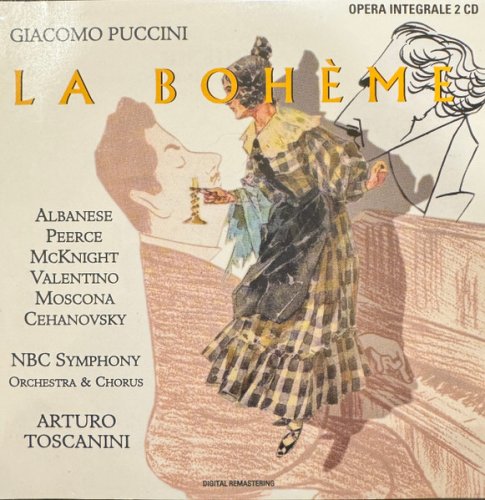
Artist: Arturo Toscanini
Title: Giacomo Puccini - La Bohème
Year Of Release: 1998
Label: Lyrica – LRC 01094-2 / 2 x CD, Reissue
Genre: Classical, Opera
Quality: FLAC (tracks+.cue,log artwork)
Total Time: 1:34:23
Total Size: 431 Mb
WebSite: Album Preview
Tracklist: Title: Giacomo Puccini - La Bohème
Year Of Release: 1998
Label: Lyrica – LRC 01094-2 / 2 x CD, Reissue
Genre: Classical, Opera
Quality: FLAC (tracks+.cue,log artwork)
Total Time: 1:34:23
Total Size: 431 Mb
WebSite: Album Preview
CD 01
01. Questo Mar Rosso (0:51)
02. Nei cieli bigi (2:21)
03. Già dell'Apocalisse (0:54)
04. Pensier profondo! (1:05)
05. Legna! - Sigari! - Bordò (3:37)
06. Si può? - Chi и là? - Benoît! (2:46)
07. Timido in gioventú (3:25)
08. Chi è lá! - Scuci - Una donna! (2:00)
09. Oh! sventata, sventata (1:20)
10. Che gelida manina (4:11)
11. Mi chiamano Mimì (4:18)
12. Ehi! Rodolfo! (0:42)
13. O soave fanciulla (3:48)
14. Aranci, datteri! (3:30)
15. Questa и Mimì (2:33)
16. Una cuffietta a pizzi (1:44)
17. Oh! Musetta! - Essa! (2:57)
18. Quando men vo' (3:10)
19. Gioventù mia (1:07)
20. Caro! - Fuori il danaro! (2:05)
CD 02
01. Ohè, là, le guardie! (1:27)
02. Chi nel ber trovò il piacer (2:22)
03. Sa dirmi, scuci (1:39)
04. O buon Marcello, aiuto! (3:52)
05. Marcello. Finalmente! (1:05)
06. Mimì и una civetta (4:25)
07. Addio, senza rancor (3:15)
08. Che facevi, che dicevi... (3:24)
09. In un coupé (1:12)
10. O mimì, tu più non torni (2:29)
11. Eccoci. - Ebben? (2:37)
12. Vezzosa damigella (0:41)
13. Il duello (0:27)
14. C'и Mimì... (4:51)
15. Vecchia zimarra, senti (1:59)
16. Sono andati? Fingevo di dormire (7:57)
17. Che ha detto il medico? (2:33)
Music is almost as old as humanity, or perhaps even older. It has been present in people’s lives long before the advent of writing, books, or even organized states. Rhythm was probably born before the first melody: a heartbeat, a drumbeat, the rhythm of a collective effort. Since then, music has accompanied human history. It is present at birth and farewell, at celebrations and mourning, in the formation of communities and in individual self-expression. There are few things that are so constant companions to humans.
The uniqueness of music lies in the fact that it speaks to both emotions and reason. It brings joy, sorrow, success, loss, hope, faith, and humor into our lives, while also being able to express feelings that we often cannot even find words for. It is no coincidence that every culture in the world has created its own music, while every culture understands/feels the music of other cultures. The melodies, rhythms and instruments are different, but the need remains the same: to connect with each other and with ourselves.
Music is often called the common language of humanity, and there is more to it than simple poetic imagery. A melody can affect us even if we do not understand the language of the people who created it. At the same time, music is also mathematics. Intervals, proportions, harmonies and disharmonies, frequencies, repeating patterns and systems of rules form the structure on which emotions are built. Perhaps this is what makes it so universal: it speaks simultaneously to the human heart and to the mind that seeks order in the world.
On World Music Day, it is also worth remembering that vibration is not only the property of musical instruments and the human voice. Nature is full of rhythms and repeating patterns. Science is now able to measure and convert the various vibrations of stars, planets and galaxies, or, conversely, atoms, electrons, and quarks, into sounds. Of course, these are not musical works in the traditional sense of the word, but they still remind us of the same thing: our world is made of movement, waves and vibrations. Perhaps this is why music feels so natural to us. It did not come into our lives from outside, but has been part of the world we live in from the beginning.
The uniqueness of music lies in the fact that it speaks to both emotions and reason. It brings joy, sorrow, success, loss, hope, faith, and humor into our lives, while also being able to express feelings that we often cannot even find words for. It is no coincidence that every culture in the world has created its own music, while every culture understands/feels the music of other cultures. The melodies, rhythms and instruments are different, but the need remains the same: to connect with each other and with ourselves.
Music is often called the common language of humanity, and there is more to it than simple poetic imagery. A melody can affect us even if we do not understand the language of the people who created it. At the same time, music is also mathematics. Intervals, proportions, harmonies and disharmonies, frequencies, repeating patterns and systems of rules form the structure on which emotions are built. Perhaps this is what makes it so universal: it speaks simultaneously to the human heart and to the mind that seeks order in the world.
On World Music Day, it is also worth remembering that vibration is not only the property of musical instruments and the human voice. Nature is full of rhythms and repeating patterns. Science is now able to measure and convert the various vibrations of stars, planets and galaxies, or, conversely, atoms, electrons, and quarks, into sounds. Of course, these are not musical works in the traditional sense of the word, but they still remind us of the same thing: our world is made of movement, waves and vibrations. Perhaps this is why music feels so natural to us. It did not come into our lives from outside, but has been part of the world we live in from the beginning.
![Donald Vega - Play It Forward (2026) [Hi-Res]](https://img.israbox.com/img/2026-08/20/uk12t3wt1lrtvw1bhtysafk1g.jpg "Donald Vega - Play It Forward (2026) [Hi-Res]")
![Giraffe - The Towering Inferno With Bongo Drums (2026) [Hi-Res]](https://img.israbox.com/img/2026-08/21/1acile717vyd9fdao3pvgzwrd.jpg "Giraffe - The Towering Inferno With Bongo Drums (2026) [Hi-Res]")
![JariBu Afrobeat Arkestra - M.T.T. (Money Talk Talk or Mad Tyrant T.) (2026) [Hi-Res]](https://img.israbox.com/img/2026-08/20/w4eo8b2fvc27j472ghuekgwla.jpg "JariBu Afrobeat Arkestra - M.T.T. (Money Talk Talk or Mad Tyrant T.) (2026) [Hi-Res]")