Eric Dolphy - Last Date (1964) [2026 SACD]
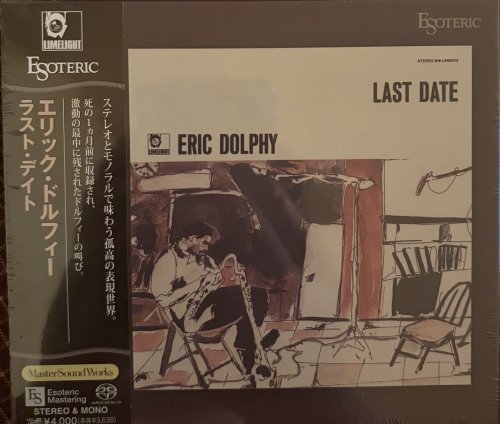
Artist: Eric Dolphy
Title: Last Date
Year Of Release: 1964 [2026]
Label: Esoteric [ESSJ-90325]
Genre: Jazz
Quality: DSD64 image (*.iso) 2.0 > 1-bit/2.8224 MHz
Total Time: 01:31:27
Total Size: 2,4 GB (+3%rec.)
WebSite: Album Preview
Dolphy's final lament, etched into the turbulent and transformative jazz scene of 1964Title: Last Date
Year Of Release: 1964 [2026]
Label: Esoteric [ESSJ-90325]
Genre: Jazz
Quality: DSD64 image (*.iso) 2.0 > 1-bit/2.8224 MHz
Total Time: 01:31:27
Total Size: 2,4 GB (+3%rec.)
WebSite: Album Preview
1964. In Japan, the Shinkansen bullet train opened in October and the Tokyo Olympics were held, but it was also a time of great upheaval not only in Japan but the world, with events such as the Kennedy assassination in November of the previous year. Significant changes were also occurring in the music world. In January, the Beatles dominated the US hit charts, and their subsequent American tour and appearance on the Ed Sullivan Show were reported as global events. At the same time, the jazz world was also undergoing a period of great and diverse change. The previous year, Stan Getz, Antonio Carlos Jobim, and João Gilberto's "The Girl from Ipanema" became a huge hit, sparking a bossa nova boom. At the end of the year, Lee Morgan recorded "The Sidewinder," fusing rock beats with jazz. In 1965, Ramsey Lewis's "The Incrowd" topped the charts, and projects for easy-listening jazz albums with orchestral backing began to emerge, marking the rise of jazz aimed at popular hits. Meanwhile, avant-garde free jazz, considered radical and cutting-edge, also gained momentum. In July 1964, Albert Ayler recorded "Spiritual Unity," and in the fall, avant-garde musicians gathered in New York for what was called the "October Revolution of Jazz," another major event attracting significant attention. Modern jazz, with Eric Dolphy among its leading figures, was also poised for a major leap forward. Miles Davis performed in Japan in the summer of 1964, and in the fall, saxophonist Wayne Shorter joined, completing the golden quintet that would lead the 1960s. John Coltrane recorded his masterpiece, "A Love Supreme," at the end of the year, marking the quartet's most fruitful period. It was during this turbulent and diverse time that Eric Dolphy lost his life in Berlin, approximately one month prior to recording his acclaimed masterpiece, "Last Date," at a Dutch broadcasting station.
A perfect performance and recording, achieved after meticulous rehearsals.
After his April performance with the Mingus Group, Eric Dolphy remained in Europe alone, spending most of May in Paris with Joyce Mortdecai. Then, on the 29th, he headed to the Netherlands. His main purpose was to perform a live public performance for the Dutch broadcasting station VARA. Farrah Radio was located in Hilversum, a town known as the "media capital" for its beautiful green scenery, less than 30 minutes by train from Amsterdam and Utrecht. The members for the broadcast recording were a piano trio arranged by a local promoter.
Pianist Mischa Mengelberg, nephew of the great conductor Willem Mengelberg, was a classically trained musician with a deep understanding of contemporary music, making him the perfect jazz player for Dolphy. Bassist Jack Scholes is a leading Dutch bassist, having collaborated with world-renowned musicians such as singer Ann Burton and pianist Louis van Dyke. Drummer Han Bennink is one of Europe's leading masters, boasting a global reputation and career as a free music drummer.
Thorough meetings and rehearsals with them took place almost daily leading up to the recording. And with everything perfectly prepared, the recording took place on the evening of Tuesday, June 2nd. Several people, including staff and listeners, were present in the studio, creating a kind of live studio performance atmosphere. Entering the studio around 8:30 AM, they performed "Epistle of the World" as a test take. After adjustments were made to the volume balance and microphone placement, Eric Dolphy was satisfied, and recording finally began.
From the explosive intro of "Epistle of the World," Dolphy and his group delivered a passionate performance. The final song, "Miss Anne," finished at 11:00 AM. Dolphy left the studio, saying, "I have to get back to Paris early tomorrow."
The simple yet fresh live sound, characteristic of broadcast recordings, highlights the reality of the performance!
Eric Dolphy died in Berlin on June 29, 1964. This is his last studio session, recorded approximately one month prior. Immediately after this recording, Dolphy traveled alone from Amsterdam to Paris. He went to see his girlfriend, Joyce Mortdecai, who was studying ballet there. The couple, who were reportedly planning to marry in August, spent about a month in Paris. During that time, Dolphy had sessions with Donald Byrd and local musicians, and on June 27, he traveled to Berlin to perform at the club "Tangent." There, his chronic diabetes worsened, and he had to cancel his planned three-set performance at "Tangent" after only two sets. He died at 7 PM on the 29th at Achenbach Hospital.
Tracks:
(Dual-Layer: Stereo)
1. Epistrophy
2. South Street Exit
3. The Madrig Speaks, The Panther Walks
4. Hypochristmutreefuzz
5. You Don’t Know What Love Is
6. Miss Ann
(SACD-Layer only: Mono Versions)
7. Epistrophy
8. South Street Exit
9. The Madrig Speaks, The Panther Walks
10. Hypochristmutreefuzz
11. You Don’t Know What Love Is
12. Miss Ann
Personnel:
Eric Dolphy (bass clarinet, flute, alto sax)
Misja Mengelberg (piano)
Jacques Schols (bass)
Han Bennink (drums)
Recorded at the Hilversum, Netherlands, on June 2, 1964
![Eric Dolphy - Last Date (1964) [2026 SACD]](https://www.dibpic.com/uploads/posts/2026-06/1782153862_02e6003a-1db1-49e5-95eb-3c001616f27a_l0_001.jpg)
![Raphael Jost - Over the Moon (2026) [Hi-Res]](https://www.dibpic.com/uploads/posts/2026-10/1792498812_folder.jpg "Raphael Jost - Over the Moon (2026) [Hi-Res]")
![Papik, Alessandro Pitoni - Dettagli (2026) [Hi-Res]](https://www.dibpic.com/uploads/posts/2026-10/1792257841_folder.jpg "Papik, Alessandro Pitoni - Dettagli (2026) [Hi-Res]")
![Chris Corcoran Band - The Burner (2026) [Hi-Res]](https://www.dibpic.com/uploads/posts/2026-10/1792314157_592x592bb.jpg "Chris Corcoran Band - The Burner (2026) [Hi-Res]")
![Mattia Basilico - On The Edge (2026) [Hi-Res]](https://img.israbox.com/img/2026-10/18/jmh5y9fmkbxue02egykzrfp0z.jpg "Mattia Basilico - On The Edge (2026) [Hi-Res]")