Dieter Flury, Robert Nagy, Ieva Osa - Haydn: Trios for Piano, Flute and Violoncello (2009)
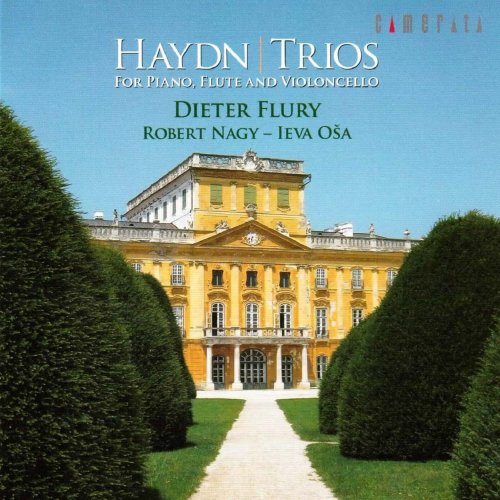
Artist: Dieter Flury, Robert Nagy, Ieva Osa
Title: Haydn: Trios for Piano, Flute and Violoncello
Year Of Release: 2009
Label: Camerata Tokyo
Genre: Classical
Quality: flac lossless (tracks)
Total Time: 00:44:43
Total Size: 165 mb
WebSite: Album Preview
TracklistTitle: Haydn: Trios for Piano, Flute and Violoncello
Year Of Release: 2009
Label: Camerata Tokyo
Genre: Classical
Quality: flac lossless (tracks)
Total Time: 00:44:43
Total Size: 165 mb
WebSite: Album Preview
01. Trio in G Major, Hob. XV:15: I. Allegro
02. Trio in G Major, Hob. XV:15: II. Andante
03. Trio in G Major, Hob. XV:15: III. Finale. Allegro moderato
04. Trio in D Major, Hob. XV:16: I. Allegro
05. Trio in D Major, Hob. XV:16: II. Andantino piùtosto. Allegretto
06. Trio in D Major, Hob. XV:16: III. Vivace assai
07. Trio in F Major, Hob. XV:17: I. Allegro
08. Trio in F Major, Hob. XV:17: II. Finale. Tempo di menuetto
Unlike most of Haydn's small-group chamber music with winds, these trios for flute, cello, and piano are substantial works. Composed in 1789 or 1790 for the London publisher John Bland, they are more genuinely trios than most of the so-called piano trios, where the keyboard is dominant. The flute for the most part has an equal role to the piano in these trios, and the opening sonata-form movements are substantial essays with excursions into remote chromatic territory. Even the concluding Flute Trio No. 30 in F major, Hob. 15/17, which seems to follow an earlier pattern with its two-movement configuration and minuet finale offers in that finale a rather thorny minuet-sonata form hybrid. Smaller dimensions with historical instruments or at least something other than an open Steinway grand are preferable with these works, but they can stand up to the traditional performance mode offered by the Viennese group of flutist Dieter Flury, cellist Robert Nagy, and pianist Ieva Osa. These pieces are underrepresented in the catalog in comparison with Haydn's other late chamber music, and this competent recording is welcome, especially with fine engineering from Japan's Camerata label. Producer Hiroshi Isaka and engineer Yasuhisa Takashima match the spacious, Beethovenian approach of the performers with an expansive acoustic. Notes are in Japanese and English; unlike with the majority of other Camerata releases, they appear to contain the same text rather than completely different material. The program, at under 45 minutes, is a brief one.
![Marty Ehrlich - OPEN AIR: The Complete Saxophone Quartet Compositions of Julius Hemphill (Vol. 1) (2026) [Hi-Res]](https://www.dibpic.com/uploads/posts/2026-08/1787898886_cover.jpg "Marty Ehrlich - OPEN AIR: The Complete Saxophone Quartet Compositions of Julius Hemphill (Vol. 1) (2026) [Hi-Res]")
![Alsogood - 1000 Smiles (2026) [Hi-Res]](https://www.dibpic.com/uploads/posts/2026-08/1787744836_mnujdk1hromc1_600.jpg "Alsogood - 1000 Smiles (2026) [Hi-Res]")
![The John Payne Band - Bedtime Stories (1976) [Hi-Res]](https://www.dibpic.com/uploads/posts/2026-08/1787861782_cover.jpg "The John Payne Band - Bedtime Stories (1976) [Hi-Res]")
![Hoagy Carmichael & Original Off-Broadway Cast of Stardust Road - Stardust Road (Original Off-Broadway Cast Recording) (2026) [Hi-Res]](https://www.dibpic.com/uploads/posts/2026-08/1787841117_e3yhnxmmhuz9w_600.jpg "Hoagy Carmichael & Original Off-Broadway Cast of Stardust Road - Stardust Road (Original Off-Broadway Cast Recording) (2026) [Hi-Res]")
![Tony Lakatos - George in Our Minds (2026) [Hi-Res]](https://www.dibpic.com/uploads/posts/2026-08/1787665605_folder.jpg "Tony Lakatos - George in Our Minds (2026) [Hi-Res]")