Aurea Marston, Cornelia Lenzin - Ullmann: "Wo hast du all die Schönheit hergenommen?" - Lieder (2026) [Hi-Res]
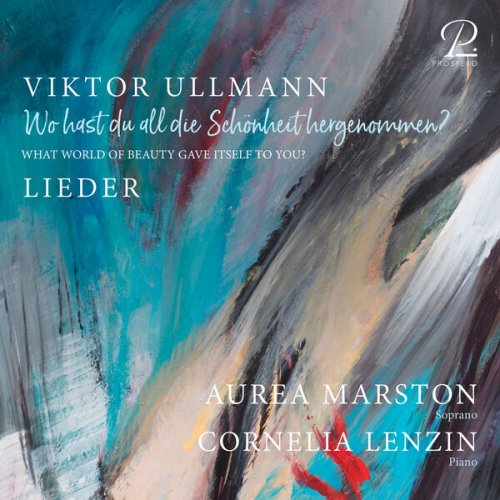
Artist: Aurea Marston, Cornelia Lenzin
Title: Ullmann: "Wo hast du all die Schönheit hergenommen?" - Lieder
Year Of Release: 2026
Label: Prospero Classical
Genre: Classical
Quality: flac lossless (tracks) / flac 24bits - 96.0kHz
Total Time: 00:40:06
Total Size: 158 / 712 mb
WebSite: Album Preview
TracklistTitle: Ullmann: "Wo hast du all die Schönheit hergenommen?" - Lieder
Year Of Release: 2026
Label: Prospero Classical
Genre: Classical
Quality: flac lossless (tracks) / flac 24bits - 96.0kHz
Total Time: 00:40:06
Total Size: 158 / 712 mb
WebSite: Album Preview
01. 7 Elegien nach Gedichten von Albert Steffen, Op. 8: No. 2, Schwer ist's, das Schöne zu lassen
02. 5 Liebeslieder von Ricarda Huch, Op. 26: No. 1, Wo hast du all die Schönheit hergenommen
03. 5 Liebeslieder von Ricarda Huch, Op. 26: No. 2, Am Klavier
04. 5 Liebeslieder von Ricarda Huch, Op. 26: No. 3, Sturmlied
05. 5 Liebeslieder von Ricarda Huch, Op. 26: No. 4, Wenn je ein Schönes mir zu bilden glückte
06. 5 Liebeslieder von Ricarda Huch, Op. 26: No. 5, O schöne Hand, Kelch, dessen Duft Musik
07. 3 Sonette aus dem Portugiesischen, Op. 29: No. 1, Briefe nun mein!
08. 3 Sonette aus dem Portugiesischen, Op. 29: No. 2, Sag immer wieder und noch einmal sag
09. 3 Sonette aus dem Portugiesischen, Op. 29: No. 3, Sein erster Kuss berührte nur die Finger
10. 2 Hölderlin-Lieder: No. 1, Sonnenuntergang
11. 2 Hölderlin-Lieder: No. 2, Der Frühling
12. Brezulinka - 3 Jiddische Lieder, Op. 53: No. 1, Berjoskele
13. Brezulinka - 3 Jiddische Lieder, Op. 53: No. 2, Margaritkelech
Between longing and farewell, memory and transformation, Viktor Ullmann's (1898-1944) song oeuvre unfolds as a cosmos of extraordinary poetic density. The album Wo hast du all die Schönheit hergenommen? paints a multi-layered portrait of a composer whose voice speaks to us today more forcefully than ever: shaped by late Romanticism, sharpened by modernism - and marked by the upheavals of the 20th century.
The soprano Aurea Marston encounters this repertoire with a fine sensitivity to the text and a voice that is as luminous as it is fragile, accompanied by Cornelia Lenzin at the piano. The result is a recording that understands Ullmann's songs not only as historical testimony, but as living art of timeless relevance - as music that seeks to capture the beautiful, precisely in the knowledge of its transience.
![Markos Chaidemenos - Light Beam (2026) [Hi-Res]](https://www.dibpic.com/uploads/posts/2026-08/1788007541_592x592bb.jpg "Markos Chaidemenos - Light Beam (2026) [Hi-Res]")
![Frank London - Touzle Your Kurchy (2026) [Hi-Res]](https://img.israbox.com/img/2026-08/27/nf9uayoqarytzfnp6xv9qz4uk.jpg "Frank London - Touzle Your Kurchy (2026) [Hi-Res]")