Jill Feldman & Kees Boeke - Trecento (2003)
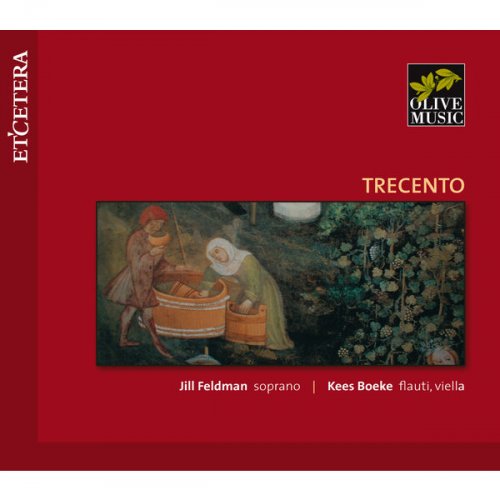
Artist: Jill Feldman, Kees Boeke
Title: Trecento
Year Of Release: 2003
Label: Etcetera
Genre: Classical
Quality: FLAC (tracks)
Total Time: 66:26 min
Total Size: 242 MB
WebSite: Album Preview
Tracklist:Title: Trecento
Year Of Release: 2003
Label: Etcetera
Genre: Classical
Quality: FLAC (tracks)
Total Time: 66:26 min
Total Size: 242 MB
WebSite: Album Preview
01. Virelai: Dame, mon cuer emportes
02. Ballade: Se je me playng
03. Ballade: Dame ne regardés pas
04. Ballade: De desconfort
05. Madrigale: Quando veggio sott'ombra
06. Ballata: La divina giustizia
07. Ballata: Non isperi mercede
08. Ballata: Fuggite, Gianni, Bacco
09. Donna l'altrui mirar
10. Rondeau: Helas! Merci
11. Rondeau: Ne me chaut
12. Rondeau: Plus lies des lies
13. Trotto
14. Ballata: Merçé o morte
15. Ballata: La fiamma del to amor
16. Ballata: Dolçe Fortuna
Things move slowly in the distant corner of the music industry devoted to medieval secular music -- this disc of mostly Italian pieces was recorded in Arezzo, Italy, in 2001 but not released until the end of 2005. The album's title is Trecento (The 1300s), and the performers are soprano Jill Feldman and recorder and vielle player Kees Boeke. It was worth the wait, for this is one of the most accessible introductions to a medieval repertory available outside the classic recordings of Sequentia. The French musical language of the middle and late fourteenth century was a complex, elite one, closely bound up with poetic conventions of courtly love. Poems and songs had elaborate metric and repetition schemes, with a difficult notation system to convey the rhythms. The disc introduces us to these traits with four songs by Guillaume de Machaut and then shows us how they were transferred to Italy in simplified forms. While many of Machaut's songs were in three parts, the Italian composers explored here favored two-part music that's somewhat easier for the modern listener to grasp; all the music on the disc is in two parts. And its appeal becomes still clearer in the performance by Feldman and Boeke. No one is really sure of the combinations of voices and instruments that were originally used to perform this music, but the solution here of voice plus recorder, with a vielle replacing the recorder for variety, is straightforward and sensible. Feldman has an uncanny way of making each piece into something individual: she understands that composers of this era built interest over the length of pieces of music by manipulating the ways in which long notes are subdivided, and, once you adjust your ears to the Pythagorean tuning, her pitch treatment is very sensitive. If you think all music of this era sounds the same, check out tracks 10 and 11 on this album by Italian composer Matteo da Perugia. They differ from one another not so much in the fixed poetic forms they use (one is a rondeau, the other a virelai) but in the rhythmic profiles of the two works; the first is languorous and expansive, taking time to build up complex rhythmic divisions and to accent them with unorthodox vertical sonorities, and the other is a brisk, unified piece, short and sweet. One disappointment here is that English, French, and German translations are printed separately from the original medieval French and Italian, making the reader flip back and forth. There were other ways to solve the problem, like running the texts horizontally. This is nevertheless a very attractive presentation of a still mostly obscure body of music.
![Frank London - Touzle Your Kurchy (2026) [Hi-Res]](https://img.israbox.com/img/2026-08/27/nf9uayoqarytzfnp6xv9qz4uk.jpg "Frank London - Touzle Your Kurchy (2026) [Hi-Res]")
![Cuadra Collective, Christian Cuadra - Väst (2026) [Hi-Res]](https://www.dibpic.com/uploads/posts/2026-08/1787745959_o026jqwpy6vj5_600.jpg "Cuadra Collective, Christian Cuadra - Väst (2026) [Hi-Res]")
![Joyce Cheung - The Gift (Night Version) (2026) [Hi-Res]](https://www.dibpic.com/uploads/posts/2026-08/1787816952_cover.jpg "Joyce Cheung - The Gift (Night Version) (2026) [Hi-Res]")