Maria Agnese Mason - Respighi, Sgambati, Martucci: Italian Nocturnes - For Solo Piano (2026)
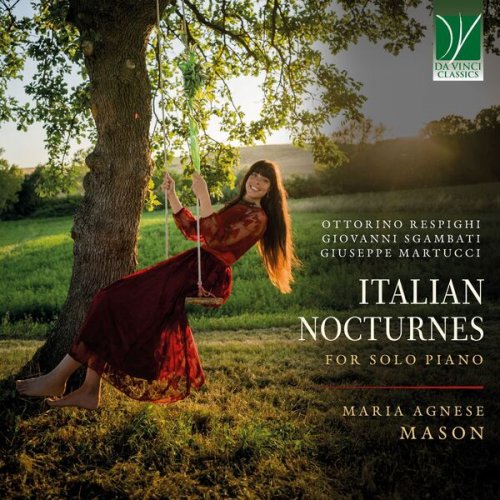
Artist: Maria Agnese Mason
Title: Respighi, Sgambati, Martucci: Italian Nocturnes - For Solo Piano
Year Of Release: 2026
Label: Da Vinci Classics
Genre: Classical Piano
Quality: flac lossless (tracks)
Total Time: 00:45:21
Total Size: 131 mb
WebSite: Album Preview
TracklistTitle: Respighi, Sgambati, Martucci: Italian Nocturnes - For Solo Piano
Year Of Release: 2026
Label: Da Vinci Classics
Genre: Classical Piano
Quality: flac lossless (tracks)
Total Time: 00:45:21
Total Size: 131 mb
WebSite: Album Preview
01. 6 Pezzi, P. 44: No. 6, Intermezzo-Serenata
02. 6 Pezzi, P. 44: No. 3, Notturno
03. Sérénade valsée, Op. posth.
04. Notturno in B Minor, Op. 20 No. 1
05. Notturno in G Major, Op. 20 No. 2
06. Notturno in C Minor, Op. 20 No. 3
07. Notturno in D-Flat Major, Op. 31 No. 5
08. Notturno in E Major, Op. 33 No. 6
09. Notturno in G-Flat Major, Op. 70 No. 1
10. 6 Pezzi, Op. 44: No. 5, Notturno
When I play Respighi’s Intermezzo-Serenata, I often feel cradled by gentle, dreamlike thoughts, scarcely more than whispers, like a swing set in motion by a breath of cool, fragrant air in the familiar stillness of an evening in the Italian countryside.
This opening image seems to me to capture the quiet atmosphere of evening and night-time hours, those privileged moments that invite reflection and inspire pieces such as the nocturnes and serenades gathered on this album. They are pages shaped by intimacy and introspection, by delicacy, elegance and a refined sense of sonority. Through them the musician’s inner life opens and allows emotion to become audible, and it is precisely this manner of expression that I feel to be closest to my own sensibility. It is a language that does not raise its voice or proclaim itself in order to command attention; even in its darkest or most tense moments it deepens pathos without ever declaiming its drama in an ostentatious way. The modern piano nocturne was cultivated above all by composers such as John Field and Chopin, yet its cantabile impulse owes a great deal to the Italian vocal tradition from which it draws so much of its lyricism.
With its delicate and poetic character, the nocturne brings some of the most deeply felt expressions of a dreaming sensibility into relief. Precisely because it is not confined to a single rigid formal scheme, it leaves broad freedom to the composer’s inspiration, so that the musical idea may unfold spontaneously and without the weight of external formal constraint, following instead emotions and states of mind that dwell in the most private part of the self and reveal themselves to the listener in suggestive and often poignant sound-images.
Composers such as Giuseppe Martucci, Giovanni Sgambati and, to a lesser extent, Ottorino Respighi have often been neglected or insufficiently considered. Yet this does not mean that their music is undeserving of recognition. Its value may be appreciated both historically and culturally—since it formed part of Italy’s instrumental reawakening within a musical landscape long dominated by opera—and aesthetically, in the beauty, grace and melodic eloquence of the themes and feelings it conveys.
In reading the lives of Martucci and Sgambati, and the testimony of their contemporaries, I came to realise that, besides being distinguished composers and performers, they also played an important role as teachers, contributing to a widening of the musical and cultural horizons of their time.
On what seems to me the fundamental question of the performer’s role, I should like to stress the importance of musical ideas that do not always speak entirely for themselves, because at times they are only lightly sketched or appear in fragmentary form. Such writing prompts the musician to reflect on how to offer a persuasive performance for a modern audience, and therefore on which interpretative strategies may speak most convincingly to the historical moment in which we live. I believe, then, that the performer must first understand the music in its deepest sense and make it inwardly his or her own, so as to bring it back to life and enable those who hear it—perhaps for the first time—to understand and appreciate it in turn. Through my interpretative choices, I have tried to convey at the piano the emotions, sensations and humanity with which this music is so richly endowed, and of which we still stand in need today, if we are to rediscover, both personally and collectively, the beauty of those small things that soothe the soul like words bearing harmony, beauty and hope. In this spirit, to borrow a phrase attributed to Perracchio, good music belongs to no single time: yesterday’s music is still music for today; nor does it belong to one country alone, for it belongs to everyone.
Ottorino Respighi (Bologna, 1879 – Rome, 1936)
Famous above all for his Roman Trilogy, formed by Fountains of Rome, Pines of Rome and Roman Festivals, Respighi drew on popular, natural and architectural suggestions with melodic spontaneity and elegance. His music is distinguished by refined timbral blends, swift evocative touches and delicate colourings that confer a strongly pictorial value upon his language. One may at times hear, among other strands, a kind of lyrical impressionism shaped in part by the French world, without forgetting that Respighi’s style was in truth an eclectic one, nourished by French, Russian and German influences alike.
The way he develops his compositions reveals a remarkable ability to draw the greatest possible expressive yield even from the most modest thematic cells.
I particularly admire certain suggestive effects of liquid, transparent and almost weightless sonority, in which Respighi is a true master. His search for colour as a personal and evocative language creates rarefied, dreamlike atmospheres that awaken gentle memories.
Giovanni Sgambati (Rome, 1841 – 1914)
Endowed with extraordinary virtuosity, he studied with Liszt, who in a remark often repeated in later literature is said to have observed that ‘Sgambati begins where many others do not even finish’.
He was widely admired not only for his virtuosity but for the seriousness and distinction of his musicianship. The significance of Sgambati the pianist lies above all here: he used technique not as a form of acrobatics for its own sake, but as a means of introducing audiences to the noblest and most elevated works of art, becoming an excellent and austere interpreter in the service of a high ideal of beauty.
Sgambati is a meditative and controlled composer. His nocturnes mark moments of cautious emotional surrender or inward recollection, rendered in clear lines and precise structures through the spontaneity of Italian expression.
His artistic life may be considered under three mutually complementary aspects: pianist, composer and teacher. In each of them one finds what seems to me his fundamental quality: nobility and distinction of feeling, exquisite taste, and a love for the most elevated and austere musical forms.
Giuseppe Martucci (Capua, 1856 – Naples, 1909)
In his creative work one senses the influence of German Romantic composers, yet also an alert awareness of the Italian keyboard tradition, especially that of eighteenth-century Naples. One may observe a tendency towards harmonic fullness and contrapuntal complexity; yet the prevailing inner disposition—particularly in the solo piano pieces—is that of a spirit absorbed in an almost unknowing sweetness, in a kind of innocent unconsciousness, living a life made of imagination and dream, beneath which, nonetheless, a current of pain remains.
In the brief page of the Notturno, the listener is drawn into music that evokes, in refined and sometimes delicately shaded tones, the joys, uneases and anxieties of existence itself. One perceives something that goes straight to the heart: an unmistakably Italian cantabile quality in the musical ideas. The recurrent presence of intimate and pathetic motifs, voiced on a subdued expressive plane, suggests an adherence to small and ordinary things that calls to mind, in literary terms, the atmosphere of crepuscolarismo.
There is, too, a rounding off of the harsher and more angular sonorities through the filter of the Italian melodic tradition and through themes closer to popular culture. What emerges is a duality, or rather a fusion, between northern symphonic thought and a Latin, Mediterranean cantabile—restrained, delicate, and of a subdued beauty.


![Golden Brown - Whisker Fatigue (2025) [Hi-Res]](https://img.israbox.com/img/2026-08/25/2cb03tn8vho9ftlzh3948eldi.jpg "Golden Brown - Whisker Fatigue (2025) [Hi-Res]")
![The Brass Funkeys - BLOW HORN! (2026) [Hi-Res]](https://www.dibpic.com/uploads/posts/2026-08/1787641494_592x592bb.jpg "The Brass Funkeys - BLOW HORN! (2026) [Hi-Res]")