Francesco Stefanelli, Nicola Pantani - Chopin, Enescu: Between Song, Counterpoint and Memory - Cello Sonatas (2026)
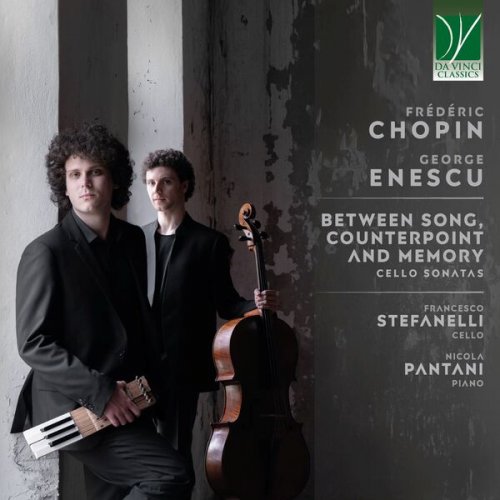
Artist: Francesco Stefanelli, Nicola Pantani
Title: Chopin, Enescu: Between Song, Counterpoint and Memory - Cello Sonatas
Year Of Release: 2026
Label: Da Vinci Classics
Genre: Classical
Quality: flac lossless (tracks)
Total Time: 01:02:22
Total Size: 251 mb
WebSite: Album Preview
TracklistTitle: Chopin, Enescu: Between Song, Counterpoint and Memory - Cello Sonatas
Year Of Release: 2026
Label: Da Vinci Classics
Genre: Classical
Quality: flac lossless (tracks)
Total Time: 01:02:22
Total Size: 251 mb
WebSite: Album Preview
01. Sonata in G Minor, Op. 65: I. Allegro moderato
02. Sonata in G Minor, Op. 65: II. Scherzo. Allegro con brio
03. Sonata in G Minor, Op. 65: III. Largo
04. Sonata in G Minor, Op. 65: IV. Finale. Allegro
05. Sonata in C Major, Op. 26 No. 2: I. Allegro moderato ed amabile
06. Sonata in C Major, Op. 26 No. 2: II. Allegro agitato, non troppo mosso
07. Sonata in C Major, Op. 26 No. 2: III. Andantino cantabile, senza lentezza
08. Sonata in C Major, Op. 26 No. 2: IV. Final à la roumaine. Allegro sciolto
I. The Cello Between Two Centuries
The interval separating Chopin’s Sonata in G minor, Op. 65, and Enescu’s Sonata No. 2 in C major, Op. 26 No. 2, is less a chronological gap than a history of the cello’s redefinition. In Chopin’s Paris the instrument still carried the weight of nineteenth-century notions of gravity, eloquence and noble restraint; by Enescu’s 1930s it could also serve as a vehicle of colouristic modernity, folk memory and structural experimentation. Recent scholarship has underlined how unstable and plural cello practice remained across the long nineteenth century: posture, bow hold, tail-pin usage, fingerings, vibrato and portamento evolved gradually, with older and newer habits coexisting for decades rather than yielding to any tidy narrative of progress. Even the instrument’s cultural identity shifted, from a pedagogy of earnest gravity towards a more fluid expressive field. This is the broader horizon within which these two sonatas are best heard.
Yet the line from Chopin to Enescu is not simply one of emancipation. In both works the cello remains bound to song, to the speaking line, to the illusion that music might at once think and remember. What changes is the nature of that utterance. In Chopin, the cello becomes the privileged partner through whom a composer of the piano tests the possibility of true chamber dialogue; in Enescu, it becomes the bearer of an idiom in which the sonata principle and the remembered inflections of Romanian oral culture are no longer opposites but mutually transformative forces. If Chopin asks how lyric inwardness might sustain a large form, Enescu asks how memory itself might become form.
The contrast between the composers is therefore instructive. Chopin’s non-pianistic output is famously small, and even his earlier chamber works for cello or mixed ensemble largely keep the piano in command. The Cello Sonata, however, occupies a singular place in his oeuvre: it is the last work published during his lifetime and the only major instance in which he grants sustained equality to an instrument other than the piano. Enescu, by contrast, belongs to that rarer species of total musician: composer, violinist, pianist, teacher and conductor. His mature style seeks synthesis rather than purity, and the Second Cello Sonata belongs to the central phase in which Romanian folklore and Western art-music procedures are fused not superficially but at the deepest structural level.
II. Chopin: Late Style and the Chamber Imagination
Written for and dedicated to Auguste Franchomme, Chopin’s Sonata in G minor emerged slowly between 1845 and 1847, under the double pressure of failing health and an increasingly exacting self-criticism. Chopin confessed that he wrote little and crossed out much; he also admitted that he would throw the score aside and later pick it up again. The surviving sketches bear out the point. This was not merely the labour of craftsmanship, but the labour of medium. After earlier works such as the youthful Introduction and Polonaise and the Grand Duo concertant, where the cello remains partly within the orbit of salon brilliance, the sonata confronts the more difficult question of balanced discourse. The genre itself forced Chopin beyond the painstaking perfection of the single medium on which his imagination had largely been built.
The result is late Chopin in an unusually severe and searching aspect. The work moves, at least in part, towards German models, especially Schumann and Mendelssohn, and there is a heightened concern for organic integration. The opening piano prelude, half invocation and half exposed harmonic terrain, does not simply prepare the cello’s entry: it establishes a condition of suspended arrival from which the movement’s thematic life will grow. The first three cello notes act almost as a motto, and the movement proceeds less by rhetorical display than by continuous derivation. Material migrates between both instruments, prefatory gestures harden into themes, cadences are weakened by overlapping melodic continuation, and the reprise famously withholds the expected full return of the first subject. What emerges is not the public narrative of heroic sonata conflict but an autumnal drama of inward pressure: polyphonic, concentrated and restlessly self-aware.
Much of the sonata’s singularity lies precisely in its refusal to treat lyricism and structure as separate orders. The Scherzo keeps dance in reserve rather than on the surface, its rhythmic grain preserving something of Chopin’s native dance imagination without ever lapsing into genre-painting. Its trio offers the nearest thing in the work to unshadowed cantabile, and one understands why writers have lingered over the moment when the cello is allowed simply to sing. The Largo then enters a still more intimate region: part nocturne, part contrapuntal meditation, it unfolds as a single long breath shared between the two instruments. Counterpoint here is never an academic display of learned technique; it is the means by which song acquires depth, as if melodic tenderness could be sustained only by an inner discipline.
The finale releases accumulated tension not by abandoning complexity but by converting it into motion. Rhythmic propulsion becomes structural principle; earlier contrapuntal density is transformed into kinetic drive, and the music closes in a G major whose brilliance is hard won rather than merely jubilant. The public history of the work tells the same story of difficulty and delayed recognition. At the first Paris performance in February 1848, Chopin’s last public concert, only the last three movements were heard, the opening movement having been withheld because some contemporaries found it overburdened or insufficiently clear. Posterity has judged otherwise. What once seemed refractory now appears prophetic: not an aberration within Chopin’s output, but the sign of a late style probing the limits of genre, instrumental partnership and formal thought.
III. Enescu: Folklore, Memory and the Sonata Principle
Enescu’s Second Cello Sonata stands at an altogether different historical threshold. Composed in 1935, dedicated to Pablo Casals, first performed in Paris on 4 March 1936 by Diran Alexanian with the composer at the piano, and curiously paired under the shared opus number 26 with a much earlier sonata from 1898, it belongs to the mature period in which Enescu achieved his most distinctive synthesis of Romanian folklore and Western formal intelligence. The contrast with Chopin is not a contrast between national and cosmopolitan art, still less between instinct and discipline. Enescu’s modernity lies precisely in the way it internalises difference: the folk element is not quoted as local colour but absorbed as a principle of melodic, rhythmic and formal becoming.
The Second Cello Sonata unites apparently divergent worlds: parlando-rubato rhythm, modal thinking, heterophony, doina-like procedures and cellular motivic growth on the one hand; the cyclical principle and the large inheritance of Western sonata thought on the other. That synthesis helps explain why the first movement may sound improvisatory without ever becoming formless. Enescu’s structures often seem fluid or through-composed, yet on closer inspection formal outlines remain legible. The point is not that form disappears, but that it is generated from thematic metamorphosis rather than displayed as architecture in the classical sense. The sonata principle survives, but internalised, loosened and made porous to memory.
This is why Enescu’s extraordinarily detailed performance instructions matter so much. They are not ornamental refinements appended to an already finished text; they are the notation of a musical behaviour that could not otherwise survive translation into the printed score. In this sonata parlando-rubato does not function as a merely local expressive effect but acquires structural force, shaping the very continuity of the musical line. Hence the first movement’s curious temporal poise, at once supple and inexorable, and hence too the sense that the piano is not an accompanying mechanism but a colouristic, harmonic and often heterophonic environment within which the cello’s discourse takes shape. Chopin’s opening movement searches for a chamber dialectic; Enescu’s seems to remember one already dissolved into a more fluid musical consciousness.
The inner movements sharpen the contrast. The second compresses energy into a terser, more abrasive dialogue, while the third, marked Andantino cantabile, senza lentezza, opens onto a region of suspended recollection. That movement may be heard either as a lied-like design or as a succession of variations; it also bears a palpable kinship with the doina, the freely ornamented, continuous-variation type central to Romanian expressive culture. This double perspective is crucial. The movement is neither a simple slow intermezzo nor a static pastoral memory; it is memory organised as variation, nostalgia under compositional pressure. By the time the finale arrives, explicitly marked A la roumaine, Enescu allows folk profiles to emerge more visibly: dance types such as calus and hora are evoked, yet still without raw quotation, as though the music were recollecting collective styles rather than reproducing them.
What gives the finale its exhilaration is the coexistence of asymmetry and control. Rhythmic irregularity, timbral imitation, glissandi, drone-like resonance and the suggestion of traditional instruments all participate in a language that remains rigorously composed. Here lies the sonata’s philosophical core. Enescu does not write ‘folk music’ for the concert room; he writes the memory of folk process within art music. Improvisation is composed, not to neutralise its freedom, but to preserve the conditions under which freedom can still be heard. In this respect the work stands as one of the supreme achievements of the cello repertoire: not because it flatters the instrument, but because it entrusts to it the passage between voice and structure, remembrance and invention.
Heard together, these two sonatas trace one of the great arcs of the modern cello literature. Chopin places the instrument within the space of late Romantic introspection, where chamber music becomes an ethics of listening and of shared utterance. Enescu receives that inheritance after half a century of changed technique, changed sound ideals and changed historical consciousness, and turns it towards memory, folklore and metamorphic form. Between them lies not a simple evolution but a deepening of what the cello can mean: first as interlocutor, then as witness.
![Raymond Roussel - no one asked us yet (2026) [Hi-Res]](https://img.israbox.com/img/2026-08/22/tdf51z389dpo49dojv7nfaj0a.jpg "Raymond Roussel - no one asked us yet (2026) [Hi-Res]")
![Mark Murphy - A Beautiful Friendship: Remembering Shirley Horn (2014) [Hi-Res]](https://www.dibpic.com/uploads/posts/2026-08/1787324201_cover.jpg "Mark Murphy - A Beautiful Friendship: Remembering Shirley Horn (2014) [Hi-Res]")
![Duesund - Under overflaten (2026) [Hi-Res]](https://img.israbox.com/img/2026-08/23/k02uc3gso89jmrqasrcueuwpa.jpg "Duesund - Under overflaten (2026) [Hi-Res]")
![Jaga Jazzist - Live with the Norwegian Radio Orchestra (2026) [Hi-Res]](https://www.dibpic.com/uploads/posts/2026-08/1787597856_cover.jpg "Jaga Jazzist - Live with the Norwegian Radio Orchestra (2026) [Hi-Res]")