Duo Variandi - Toucher les temps - New compositions, recompositions and transcriptions for two guitars (2026)
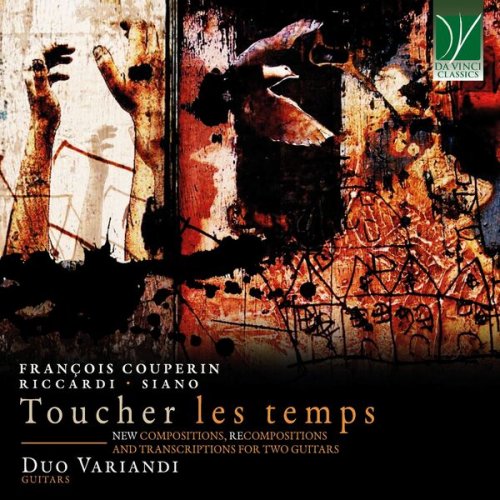
Artist: Duo Variandi
Title: Toucher les temps - New compositions, recompositions and transcriptions for two guitars
Year Of Release: 2026
Label: Da Vinci Classics
Genre: Classical Guitar
Quality: flac lossless (tracks)
Total Time: 00:57:59
Total Size: 210 mb
WebSite: Album Preview
TracklistTitle: Toucher les temps - New compositions, recompositions and transcriptions for two guitars
Year Of Release: 2026
Label: Da Vinci Classics
Genre: Classical Guitar
Quality: flac lossless (tracks)
Total Time: 00:57:59
Total Size: 210 mb
WebSite: Album Preview
01. nun
02. Le Réveille-Matin
03. OpérAtions: OpérAtion 1
04. La Convalescente
05. L'Amazone
06. OpérAtions: OpérAtion 2
07. La Sophie
08. OpérAtions: OpérAtion 3
09. La Monflambert
10. Trois Liaisons La Monflambert: No. 1, Après
11. La Superbe, ou la Forqueray
12. Trois Liaisons Le Trophée: No. 2, Avant
13. Le Trophée
14. L'Évaporée
15. Trois Liaisons L’Évaporée: No. 3, Sur
16. La Tendre Fanchon
17. ADON
The title of this disc articulates, with unusual precision, the very nature of the project. Toucher les temps clearly alludes to the lexicon of touch and, for anyone familiar with François Couperin, almost inevitably calls to mind L’Art de toucher le clavecin, the treatise in which the composer codified not merely a technique, but an entire ethic of performance. Yet here “touching” concerns neither a single instrument nor a single century: it concerns times in the plural—their brushing against one another, their collision, their mutual traversal. In other words, the point is not to transfer Couperin to the guitar as one transfers a design from one surface to another. Rather, it is to make palpable a contact between eras, to turn transcription into a site of friction, memory, and metamorphosis.
Between 1713 and 1730 Couperin published the four books of the Pièces de Clavecin, collections that he organised into ordres rather than suites and that contain more than two hundred pieces. In them, the tradition of the French dance survives, yet is progressively pushed towards a miniaturised theatre of character: no longer merely allemandes, courantes, or sarabandes, but figures, allusions, portraits, objects, moral postures, social shadows. Couperin himself, in the preface to the first book, claimed for these pages a caractère nouveau et diversifié and declared that many of the pieces were, in some sense, portraits. The title, then, is not a simple label: it is already an interpretative threshold. Le Réveille-matin, La Convalescente, L’Amazône, La Sophie, La Monflambert, La Superbe, ou la Forqueray, Le Trophée, L’Evaporée, La Tendre Fanchon: the programme assembled here arranges nine pièces like rooms in a gallery where the social and the affective worlds mirror one another without ever wholly coinciding.
It is precisely at this point that the guitar enters the scene not as a compromise, but as a revelation. Couperin’s writing, though conceived for the harpsichord, preserves a profound memory of the culture of plucked-string instruments. Studies on the so-called style luthé or style brisé have shown clearly how much the French keyboard absorbed from the lute: broken chords, discontinuous resonances, implicit polyphonies, lines that never fully yield themselves to vertical fullness but are intuited over time, through dissemination. In this sense, the transcription for two guitars does not appear as an arbitrary operation, but as the re-emergence of a latent kinship. The two guitars do not imitate the harpsichord; they bring to light an internal memory of it, almost a hidden principle of respiration. Where the harpsichord articulates, the guitar lets the sound decay; where the keyboard proposes a network of simultaneous planes, plucked strings make perceptible their fragility, their exposure, their status as events.
But Toucher les temps does not stop at timbral restitution. The heart of the disc lies precisely in the way Couperin’s material is set back into circulation by two contemporary composers, Graziano Riccardi and Andrea Siano. As the Duo Variandi’s notes make clear, the project began with an initial process of transcription carried out on Couperin’s originals; only at a second stage did some of these transcriptions become the point of departure for a more complex intertwining of variations, rewritings, and recompositions. Riccardi’s OpérAtions and Siano’s Trois Liaisons therefore do not merely comment on Couperin from the outside: they enter into his proximity, approaching him as thresholds, hinges, and reagents. They may function as preludes, postludes, or interludes, but their true function is subtler: they alter the way the listener perceives the historical time of the material that precedes or follows them.
This idea of variation is crucial. It is not variation in the strictly classical sense of the term, that is, a series of ornamental transformations upon a single recognisable theme. Here variation approaches the notion of transmission: what passes from one time to another does not remain intact, but is altered, bent, contaminated. In this sense, the Duo Variandi’s project perhaps encounters, more deeply than it may at first appear, the very material history of the Pièces de Clavecin. Research on the manuscript dissemination of Couperin’s harpsichord music has shown that these pieces did not live solely in the solemn form of the printed book, but also in the more mobile reality of copying, selection, excerpting, domestic and amateur use. To this must be added the fact that Couperin’s writing is anything but neutral: his minute care for agréments, repeat signs, and the formal distribution of reprises and rondeaux makes it clear that every performance is already an act of reading of the highest responsibility. In Couperin there is no inert surface. Every notational detail demands an ethics of touch and intelligence.
Hence an important consequence: transcription, recomposition, even programmatic montage are not betrayals of some presumed original immobility, but conscious continuations of a historical condition. Couperin himself belongs to a moment in which French taste, however strong in its own identity, never ceased to engage with other syntaxes and other models. The very name Les goûts réunis remains one of his highest emblems: not the surrender of one manner to another, but the attempt at a higher reconciliation, a diplomacy of forms. In this disc, such plurality is not invoked as a historiographical formula, but practised: the Baroque past, the lutenistic memory, the contemporary guitar medium, the post-Donatonian lesson of process, writing as a gesture of threshold and grafting, all coexist within a single listening space.
The nine Couperin pièces chosen for the programme therefore do not function as isolated specimens, but as centres of energy. Le Réveille-matin bears in its very title something mechanical and theatrical: a device that awakens, a threshold between sleep and waking. La Convalescente belongs, by contrast, to a more fragile, almost suspended region, where sound seems to measure the distance between debility and return to life. L’Amazône introduces a different gesture, prouder, more sharply profiled. La Sophie and La Monflambert seem to shift the focus towards a domain of character at once more social and more allusive, in which the proper name is at once portrait and mask. Further on, La Superbe, ou la Forqueray and Le Trophée carry with them an almost ostentatious nobility, a density of pose and relief that makes their placement among contemporary pages all the more meaningful. Finally, L’Evaporée and La Tendre Fanchon seem to incline towards a dematerialisation of affect: on the one hand rarefaction, on the other a tenderness that is never sentimentalism, but discreet human intensity.
It is precisely in relation to these nuclei that Riccardi’s and Siano’s interventions acquire their full meaning. Riccardi opens the disc with nun, a page that, as the authors explain, arises from an etymological and symbolic inquiry into the word “nun”: the masculine divinity of the primordial ocean in ancient Egypt, but also a letter associated with flow, resistance, descent, immersion, and transformation. More than a prologue, nun is an originary condition of sound: chaos before figure, matter before naming. At the opposite extreme, Andrea Siano’s ADON—an oblique homage to Franco Donatoni, already signalled by the title—closes the journey not with a reconciled synthesis, but with a process of rarefaction. Here compositional thought displays itself in its nakedness: from incisive, almost percussive material, the music moves towards progressive fluidity, into large temporal spans in which chords dissolve into flows, return as sporadic apparitions, and are filtered until they reach a pure harmonic sound tending towards nothingness. If nun stands before form, ADON places itself almost beyond it: not origin and conclusion, but two cosmological thresholds between which the rest of the disc may occur.
Between these two extremities, the OpérAtions and the Trois Liaisons have nothing of filler about them. The former, already by title, suggest a surgical gesture: intervening in the material, opening it, altering its course. The latter insist on the idea of bond, passage, relation: not separate blocks, but temporal membranes. Thus the programme rejects both museum-like neutrality and the facile opposition between old and new. The past is not an untouchable object, the present is not a marginal commentary: both redefine themselves at the point of their proximity. Here transcription does not reduce distance; it makes it audible.
It is in this sense that Toucher les temps appears as a perfect title. To touch times does not mean to traverse them indifferently, but to recognise that each time bears with it its own material resistance, its own temperature, its own system of traces. Couperin’s music, with its discipline of ornament, its ambiguity of portraiture, its writing at once so minutely marked and so open to allusion, encounters in this disc an environment capable of reactivating it without domesticating it. The two guitars bring out the tactile, lutenistic, breathing component of those pages; Riccardi and Siano, in turn, intensify or deflect their lines of force, showing that the deepest fidelity does not consist in simple preservation, but in the capacity still to hear what in the text remains awaiting transformation.
One might even say that the true object of the disc is neither Couperin, nor the guitar, nor contemporary variation, but the very notion of survival. How does musical writing survive? How does a musical character continue to act when its original instrument is taken away? How is a world of gestures, signs, agréments, resonances transmitted without reducing it to quotation or relic? Toucher les temps answers not with a theory, but with a practice of listening. And it shows that musical time is not a uniform line, but an incised surface, in which the past re-emerges only if someone has the courage truly to touch it.
![Raymond Roussel - no one asked us yet (2026) [Hi-Res]](https://img.israbox.com/img/2026-08/22/tdf51z389dpo49dojv7nfaj0a.jpg "Raymond Roussel - no one asked us yet (2026) [Hi-Res]")


![Duesund - Under overflaten (2026) [Hi-Res]](https://img.israbox.com/img/2026-08/23/k02uc3gso89jmrqasrcueuwpa.jpg "Duesund - Under overflaten (2026) [Hi-Res]")