Paolo Felli, Carlo Geraci - Rare Narrazioni - Paths in 20th- and 21st-Century Music for Solo Guitar (2026)
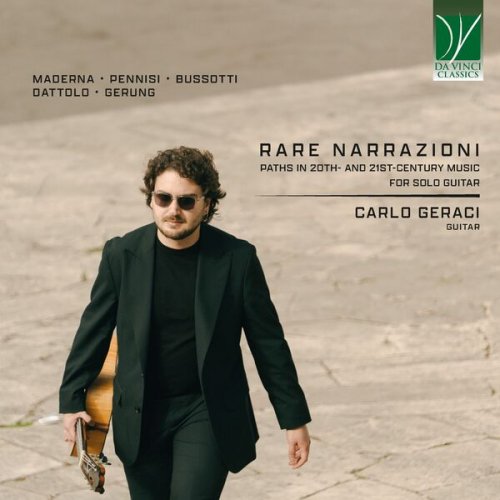
Artist: Paolo Felli, Carlo Geraci
Title: Rare Narrazioni - Paths in 20th- and 21st-Century Music for Solo Guitar
Year Of Release: 2026
Label: Da Vinci Classics
Genre: Classical Guitar
Quality: flac lossless (tracks)
Total Time: 00:51:05
Total Size: 170 mb
WebSite: Album Preview
TracklistTitle: Rare Narrazioni - Paths in 20th- and 21st-Century Music for Solo Guitar
Year Of Release: 2026
Label: Da Vinci Classics
Genre: Classical Guitar
Quality: flac lossless (tracks)
Total Time: 00:51:05
Total Size: 170 mb
WebSite: Album Preview
01. Y Después
02. Intermezzo
03. Ultima Rara
04. Nuvola Barocca
05. Maleditta Vucca
06. 88-97
In the history of the guitar in the later twentieth century, rarity denotes not merely bibliographical exception or executant difficulty. It denotes also a quality of musical utterance, a way of eluding the hierarchies of the established repertory in order to entrust to the instrument the task of narrating obliquely, elliptically, with intense individuality. The programme of this disc, significantly entitled Rare Narrazioni, moves within this horizon with a coherence that extends far beyond the simple anthology. The title itself constitutes a clear declaration of intent, for it points towards the wish to prolong a specifically music-theatrical tradition whose emblematic chapter is Bussotti’s Ultima Rara. Bruno Maderna, Francesco Pennisi, Sylvano Bussotti, Mattia Dattolo and Hans-Jürgen Gerung here delineate an oblique line of modernity, in which the guitar appears by turns as solitary voice, graphic scene, theatre of memory, and meeting place of sound and word. The succession of the works, from the historical late twentieth century to the première of the most recent piece, defines a landscape in which narration assumes the form of a compositional gesture that alludes, evokes, suspends, and allows images and fragments of text to surface within the vibration of the string.
Bruno Maderna occupies, within this itinerary, an inaugural and almost emblematic position. Venetian by birth, formed through rigorous study, precocious instrumental experience, and a vocation to conducting that would make him a central figure of the European post-war avant-garde, Maderna knew how to unite the discipline of the new language with a freedom of imagination nourished always by historical memory. Biographical sources rightly insist upon his rôle as Italy’s initiator of post-Webernism, as a protagonist at Darmstadt, as a pioneer of electronic music and, at the same time, as a passionate interpreter of earlier repertory. Y Después belongs to his final creative period and remains his sole work for solo guitar. It was written for Narciso Yepes and for his ten-string guitar, published by Ricordi, and received its first public performance only a few days after the composer’s death. In it the guitar becomes a tense, nervous, at times abrasive line, within which the Iberian echo suggested by the title and by the horizon of Yepes condenses into an intensely dramatic monody, as though the gesture of the hand were seeking a word prior to discourse.
A different, more secret form of narrativity belongs to Francesco Pennisi. Sicilian by birth and Roman by adoption, painter as well as composer, founder of Nuova Consonanza and a withdrawn figure within the Italian panorama of the later twentieth century, Pennisi elaborated a language which criticism has often described as poised between modernity and classical poise, between miniature and metaphysical vertigo. The testimonies devoted to his work converge in emphasising a writing of rare refinement, nourished by Debussyan fluidity, Webernian economy, and a hidden geometry akin to the late Petrassi. The relationship with Maderna, who conducted one of his scores at the Venice Biennale, renders the presence of Intermezzo beside Y Después all the more persuasive. In Pennisi the guitar assumes the profile of concentrated reflection. The dedication to Vincenzo Saldarelli suggests a direct relationship with the practice of the instrument; yet the page seems to look beyond the idiomatic datum and to construct a small rarefied space, a margin of sound in which every attack, every resonance, every silence weighs like a detail within a drawing. The title itself refers to a poetics of interval and suspension, and in this it summarises something essential of Pennisi’s world.
With Sylvano Bussotti the guitar enters, by contrast, an openly scenic dimension. Few figures of the later twentieth century embodied with equal force the idea of total art. Born in Florence, formed among music, painting, literature and theatre, linked with Dallapiccola, Max Deutsch, Boulez and Cage, Bussotti made of the score a place in which sonic sign, drawing, body and word imply one another reciprocally. His writing, often entrusted to notation of strong visual pregnance, never separates sound from its mode of appearing. Ultima Rara and Nuvola Barocca represent two complementary countenances of this universe. The former, commissioned by the Goethe-Institut in Rome and dedicated to Siegfried Behrend, bears the subtitle Pop Song and from the outset unsettles, with irony, the promise of an ultimate confession. Critical and discographic sources have, in relation to this page, drawn attention to the three-stave notation, the presence of text, the circular nature of phonetics, and the almost ritual gesture required of the performer. Nuvola Barocca, by contrast, appears as a later and more inward distillation, described as a reflection on neoclassicism, a cloud of memory in which the Baroque is not a style to be reconstructed but a remote figure, filtered through an ear that retains its ornaments as motes. Together, the two pieces show how, in Bussotti, the guitar may become at once theatre and reliquary.
The perspectival centre of the disc then shifts towards the present with Mattia Dattolo. His presence carries structural weight. Biographical sources reveal an author who combines composition and conducting, active in contexts strongly oriented towards new music and interested, from his university years onwards, in the relationship between myth, contemporaneity and the construction of sound. Maliditta Vucca, dedicated to Carlo Geraci, on a text by Giusy Bifarella, and here receiving its première, introduces with clarity the element of the poetic word into a programme that had long been implying it. The work is inspired by Colapesce as reimagined by the Sicilian poet Ignazio Buttitta, and from that matrix it draws not only its linguistic and expressive profile but also a sharply contemporary resonance. For beneath its poetic surface lies the reflection of a centuries-old, yet today more than ever urgent, Sicilian condition: the mass emigration of the young, and with it the laceration of departure, the abandonment of family, of place, of the mother herself. In the work this wound is heightened through the figure of a mother who curses the son who leaves, turning lament into malediction and private grief into emblem. The dialect title, the dedication, the relation to a text and the choice of solo guitar outline a threshold of intense orality, almost as though the voice, before becoming explicit sound, inhabited the material of the string as phonetic memory. In this sense Dattolo prolongs from within the lesson of Bussotti and of Pennisi. From the former he receives the theatrical consciousness of the sign, from the latter a miniaturist concentration and a love of the margin. The novelty of the piece does not interrupt the narrative of the disc. It gives it a future.
Still more explicit is the entrance of the voice in Hans-Jürgen Gerung. Composer, guitarist, publisher, promoter of an artistic activity intertwining music, graphic art, literature and the rediscovery of repertories for plucked instruments, Gerung has built around the guitar a veritable intermedial laboratory. His official website itself describes with clarity an aesthetic vision intent upon conducting the past into the present, through original compositions, arrangements and interdisciplinary collaborations. Yet Gerung also enters the deeper fabric of this programme through a more specific historical and artistic lineage: he was a long-standing pupil of Sylvano Bussotti, and the fragmentary, graphic nature of his writing clearly reflects that inheritance. In this sense, his presence within the disc is not episodic, but resonates with particular depth within its broader textual and transcriptive weave. That connection is made still more significant by the fact that Bussotti’s celebrated work for guitar and voice, Ermafrodito, was dedicated to Gerung. 88–97, here entrusted to guitar and speaking voice, occupies the point at which the notion of narration, implicit throughout the programme, manifests itself as concrete fact. The allusive title, almost archival in flavour, suggests a dossier of pages, a sequence of documents, and accords with the idea of a work constructed from fragments and transcriptions. The presence of the narrator alters the very status of listening. The guitar does not accompany a text. It surrounds it, contradicts it, interrupts it, opens spaces of resonance for it. In this perspective, Gerung carries to their furthest consequence the latent trait of the entire disc, the transformation of the guitar into page, dossier, sonic diary.
What holds together such a trajectory is the quality of narration entrusted to the instrument. In Maderna it assumes the form of an ardent and allusive line, close to the memory of a Spanish elsewhere. In Pennisi it withdraws into the most delicate punctuation, almost a margin of light. In Bussotti it expands into theatrical gesture and graphic figure, only to return, with Nuvola Barocca, to a contemplation of the past as suspended image. In Dattolo it is renewed in relation to text and to a new orality. In Gerung it finally declares itself as dialogue with the speaking voice. The title Rare Narrazioni therefore possesses an almost philological precision. These pages are rare because little frequented, eccentric with respect to the canon, often placed at the margins of the great historiography of the guitar. They are rare also because they preserve an uncommon mode of narration, remote from descriptive effect and close to condensation, to fragment, to the sign that alludes more than it expounds. The modern guitar appears here as an instrument of writing. Each work leaves upon its surface a different trace, graphic, poetic, theatrical, memorial. To hear them in sequence is to follow a European history of the solitary string, narrated by composers who, each in his own way, knew how to make of it a form of thought. And it is precisely in this continuity between rarity, memory and invention that the disc finds its most persuasive necessity. The guitar is here revealed as a living archive of the present, capable of transforming the written sign into mental narrative, bodily gesture and listening space, with a lucidity that illumines the entire journey.



![Irene Aranda, Don Malfon & Ami Yamasaki - MAY (2026) [Hi-Res]](https://www.dibpic.com/uploads/posts/2026-08/1787285419_ty00drlg3tqk4_600.jpg "Irene Aranda, Don Malfon & Ami Yamasaki - MAY (2026) [Hi-Res]")
![Mark Murphy - A Beautiful Friendship: Remembering Shirley Horn (2014) [Hi-Res]](https://www.dibpic.com/uploads/posts/2026-08/1787324201_cover.jpg "Mark Murphy - A Beautiful Friendship: Remembering Shirley Horn (2014) [Hi-Res]")


![The Odyssey Cult - Vol. 3 (2026) [Hi-Res]](https://img.israbox.com/img/2026-08/22/24qm3jk3ktqvxtjo970u7u2vp.jpg "The Odyssey Cult - Vol. 3 (2026) [Hi-Res]")