Clélia Iruzun, I Musicanti, Leon Bosch - Treasures from the New World, Vol. 4: Brazilian Piano Quartets (2026) [Hi-Res]
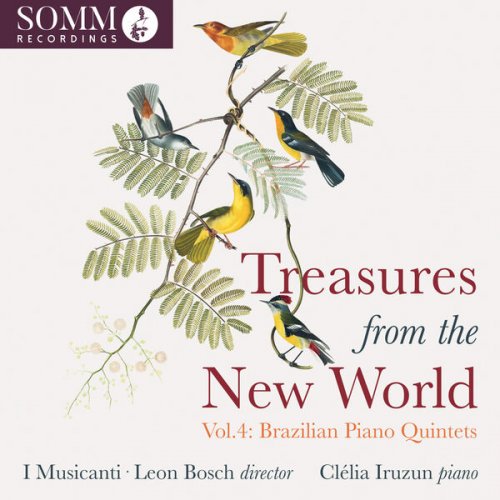
Artist: Clélia Iruzun, I Musicanti, Leon Bosch
Title: Treasures from the New World, Vol. 4: Brazilian Piano Quartets
Year Of Release: 2026
Label: SOMM Recordings
Genre: Classical
Quality: flac lossless (tracks) / flac 24bits - 96.0kHz +Booklet
Total Time: 01:09:09
Total Size: 292 mb / 1.02 gb
WebSite: Album Preview
TracklistTitle: Treasures from the New World, Vol. 4: Brazilian Piano Quartets
Year Of Release: 2026
Label: SOMM Recordings
Genre: Classical
Quality: flac lossless (tracks) / flac 24bits - 96.0kHz +Booklet
Total Time: 01:09:09
Total Size: 292 mb / 1.02 gb
WebSite: Album Preview
01. 5 Miniaturas brasileiras (Version for Piano Quintet): I. Prelúdio
02. 5 Miniaturas brasileiras (Version for Piano Quintet): V. Baião
03. Op. 297: III. Allegro festivo
04. 5 Miniaturas brasileiras (Version for Piano Quintet): II. Toada
05. 5 Miniaturas brasileiras (Version for Piano Quintet): III. Chorinho
06. 5 Miniaturas brasileiras (Version for Piano Quintet): IV. Cantiga de ninar
07. From My Window No. 3: I. Carnival Vertigo
08. From My Window No. 3: II. Antique
09. From My Window No. 3: III. Drums
10. Canção sem palavras (Version for Piano Quintet)
11. Fronteiras, Op. 297: I. Molto lento, espressivo
12. Fronteiras, Op. 297: II. Molto lento
13. Cismas
14. Caratinguê
SOMM Recordings is delighted to collaborate again with I Musicanti, directed by virtuoso double-bass player Leon Bosch and praised by The Strad for their “performances of passion and insight.” This latest release features the Brazilian-born, London-based pianist Clélia Iruzun, whose frequent SOMM collaborations include the International Classical Music Award-nominated Piano Concertos by Albéniz & Mignone with the Royal Philharmonic Orchestra conducted by Jac van Steen.
This release highlights five notable Brazilian composers from generations that succeeded the singular Brazilian composer, Heitor Villa-Lobos. While their names might not be as familiar as their famous compatriot, the musical qualities of their compositions—all scored for the forces of Schubert’s “Trout” Quintet—are revelatory.
The programme opens and closes with works by Edmundo Villani-Côrtes(b. 1930) who acknowledges the early influence of Shostakovich and French Impressionism. He composed his 5 Miniaturas brasileiras in 1978 for flute and piano, and their immediate success led to no fewer than seventeen transcriptions for a variety of instrumental combinations. Caratinguê, a municipality in the Southeast Region of Brazil, lends its name to the work by Villani-Côrtes that closes this programme. It combines art and folk music to conjure the lively rhythms and irresistible musical atmosphere of Brazil.
João Guilherme Ripper (b.1959), who received his D.M.A. in Composition at Catholic University of America, in Washington D.C., later served as composer-in-residence at Kean University in New Jersey, which commissioned From My Window No. 3 in 2011. Ripper describes this three-movement work—heard here in its first recording—as portraying aspects of his native city, from the Carnival in Rio de Janeiro to feelings of nostalgia.
A short Song Without Words, Canção sem palavras, is by Arrigo Barnabé (b. 1951), one of the first and most talented adherents from a movement of urban classically trained musicians in the city of São Paulo who added erudite experimentations to pop music. His varied output also includes soundtracks for around half a dozen Brazilian movies.
The works of pianist-composer José Carlos Amaral Vieira show his ability to write brilliantly for the piano and his intense involvement with the music of Franz Liszt. His Piano Quintet Fronteiras(Frontiers), a reflection on cultural and sonic boundaries, is characterized by Amaral Vieira’s distinctive blend of rigorous technical structure and profound emotion.
Like Amaral Viera, Marisa Rezende (b.1944) began her musical life as a pianist. She started composing when she was a piano student at the University of California, Santa Barbara, where she later returned to complete a doctorate in composition. Cismas (Schisms) lives up to its name, evolving as it does through contrasting segments of gloom, luminosity, and energy.
![Roberto Negro - Pärt & Songs (2026) [Hi-Res]](https://img.israbox.com/img/2026-10/15/q18sovdxgmd2uzlo9hdft3d2e.jpg "Roberto Negro - Pärt & Songs (2026) [Hi-Res]")