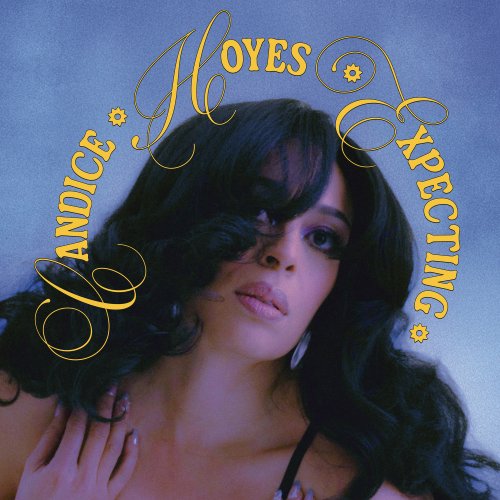
Artist: Candice Hoyes Title: Expecting Year Of Release: 2026 Label: La Reserve Records Genre: Jazz, Soul Quality: FLAC (tracks) [88.2kHz/24bit] Total Time: 47:24 Total Size: 914 / 281 MB WebSite: Album Preview
Tracklist:
01. Zora's Moon 02. Expecting 03. Paradis 04. Making Love 05. Pink Clouds 06. Meant to Be (for Baldwin) 07. Notebook Age Eight 08. Love Over Mind 09. Rain 10. Face Against The Window 11. Winnifred's Barrel 12. Tired (Waiting for the World) 13. Expecting Outro (Gratitude)
I’ve always believed that the record—the real record, the one that spins and breathes—ought to hold more than sound. It ought to hold a lineage, a memory, a future that hums just beneath the grooves. Listening to Candice Hoyes’s Expecting, I hear precisely that kind of intention made audible: a deliberate return, a reaching backward that is also a reaching forward, anchored in what she calls the Black feminine divine. And I recognize the gesture. It is not nostalgia. It is invocation.
Hoyes situates herself within a continuum that includes Maya Angelou and Minnie Riperton—two artists who understood voice not merely as instrument but as vessel. Angelou’s cadence, her poetics of survival and sovereignty; Riperton’s crystalline upper register, her devotional intimacy, these are not references to be borrowed lightly. Yet Hoyes does not imitate. She listens, absorbs, and then transforms, allowing their spirits to inform a language distinctly her own. There is a patience to this record, an unhurried unfolding. In another era, we might have called it spiritual jazz, or simply Black creative music, but those labels feel insufficient here. What Hoyes achieves is closer to a sonic archive: alive, porous, and deeply embodied. She speaks of the album as an “interpolation of the poetic Black femme archive,” and that phrasing resonates. Interpolation, after all, is not extraction. It is dialogue. It is care. The ensemble she gathers is formidable, but more importantly, it is attuned. Drummer Makaya McCraven brings his signature elasticity, shaping time in ways that feel both grounded and open-ended. Vibraphonist Joel Ross adds a luminous shimmer, his lines drifting like light across water. Pianists Sullivan Fortner and Courtney Bryan offer contrasting but complementary textures—Fortner’s touch steeped in tradition yet restless, Bryan’s approach expansive, almost orchestral in its emotional reach. Trumpeter Sean Jones enters with a clarity that feels ceremonial, while harpist Brandee Younger threads the music with a celestial delicacy that recalls Alice Coltrane without ever collapsing into homage. These are not guest appearances in the casual sense. They are partnerships and presences, each musician contributing to a collective act of remembering, recalling, and record-keeping. And at the center, always, is Hoyes’s voice. It does not demand attention; it gathers it tenderly. There is a quiet authority in her phrasing, a refusal to overstate. She understands that intimacy can be radical, that softness can carry weight. In this way, she aligns herself with a lineage of Black women artists who have insisted on complexity in the face of reduction. Her singing feels less like performance and more like offering. Black womxn, constantly laboring under expectation, can rest their head here, and dream in Technicolor. What strikes me most about Expecting is its sense of durability. As she births this work into the world, Hoyes imagines a world where the internet disappears and this vinyl remains as a physical artifact carrying her interpretation of a vast, often under-acknowledged archive. That thought experiment is telling. It speaks to a desire for duration and permanence in a culture that increasingly privileges the accelerated and ephemeral. But it also speaks to faith: faith that these stories, these sounds, will endure because they are rooted in something deeper than whichever trend is driven by the algorithm of zeitgeist. There is an element of anticipation embedded in the title. Expecting as a title, as the word itself, suggests not only gestation but possibility. The music feels as though it is always on the verge of becoming, of revealing another layer. It invites the listener into a process rather than presenting a finished product. In that sense, it resists closure. It lives. As someone who has spent a lifetime thinking about records—their structure, their purpose, their afterlives—I find this deeply moving. Hoyes is not simply adding to the canon; she is reconfiguring the terms by which we understand it. She reminds us that heritage is not static, that it requires continual tending. And she does so with a grace that feels both contemporary and timeless. If this record as a physical object survives—and it will, because we will carry it lovingly with us—it will not be because of nostalgia for a bygone format. It will be because it carries within it a truth and intelligence that resisted pure digitization: that the voices of Black women, in all their multiplicity, are foundational to the story of this music, and therefore the record must play on. Expecting does not argue this point. It embodies it.


![Sbatax + Gross - Lapilli (2026) [Hi-Res]](https://www.dibpic.com/uploads/posts/2026-10/1792302944_cover.jpg "Sbatax + Gross - Lapilli (2026) [Hi-Res]")

![Aria - Rectify (2026) [Hi-Res]](https://www.dibpic.com/uploads/posts/2026-10/1792589967_592x592bb.jpg "Aria - Rectify (2026) [Hi-Res]")