Philipp Rüttgers, Omer Govreen, Sun-Mi Hong - Re: Satie, Picture the Invisible (2026) [Hi-Res]
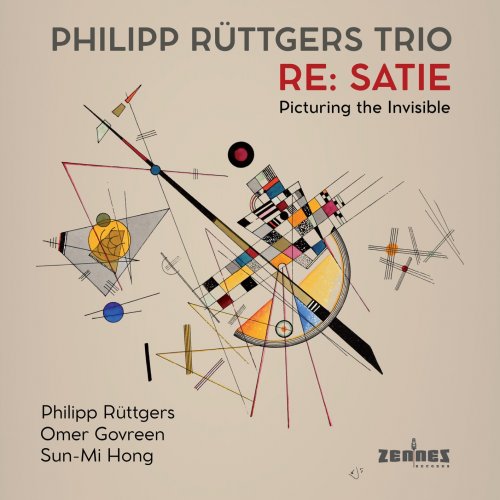
Artist: Philipp Rüttgers, Omer Govreen, Sun-Mi Hong
Title: Re: Satie, Picture the Invisible
Year Of Release: 2026
Label: ZenneZ Records
Genre: Jazz
Quality: FLAC (tracks) / 24bit-44.1kHz FLAC (tracks)
Total Time: 48:28
Total Size: 289 / 534 MB
WebSite: Album Preview
Tracklist:Title: Re: Satie, Picture the Invisible
Year Of Release: 2026
Label: ZenneZ Records
Genre: Jazz
Quality: FLAC (tracks) / 24bit-44.1kHz FLAC (tracks)
Total Time: 48:28
Total Size: 289 / 534 MB
WebSite: Album Preview
1. The Swing (4:22)
2. Gnossienne Interlude 1 (2:04)
3. Patchwork Prelude (5:35)
4. Gymnopedie (6:23)
5. Gnossienne Interlude 2 (1:45)
6. Uspud (6:46)
7. Son of the Stars (6:01)
8. True Flabby Preludes for a Dog (3:27)
9. Gnossienne (4:44)
10. Vexations (1:16)
11. Passacaille (6:09)
Philipp Rüttgers – Piano / Compositions
Omer Govreen – Doublebass
Sun-Mi Hong – Drums
If you think of Erik Satie — keep the characteristic melancholy, enrich it with serenity and a subtle touch of humor, and place it in the context of a contemporary jazz piano trio, you begin to sense what this album is аbout: a quest to picture the invisible in Satie’s music.
For his second trio album, German-born pianist and composer Philipp Rüttgers dives deep into the world of this most eccentric of French composers. Working through the complete volume of Satie’s works (Éditions Salabert), he gathered fragments and motifs. He carefully reordered and reshaped them, the way you might build a new story from existing words. The abstract and enigmatic qualities of Satie remain present, yet the music breathes naturally within a modern piano trio language. Subtle traces of today’s jazz vocabulary may surface, yet the voice is unmistakably Philipp’s own.
His exploration led beyond the well-known Gymnopédies and Gnossiennes to lesser-known works such as Les Fils des étoiles (The Son of the Stars) and Uspud, written during Satie’s Rosicrucian period — before he fell out with the order and founded his own religion, the Église Métropolitaine d’Art de Jésus Conducteur, of which he was famously the sole member.
Satie’s preference for restraint and reduction echoes clearly in Philipp’s playing: more expression through fewer notes when the music calls for it, and layered complexity when it unfolds. In that dynamic space, the interplay with drummer Sun-Mi Hong and bassist Omer Govreen gains remarkable depth. The trio listens closely, shapes balance organically, and allows transparency to become expressive strength.
Every note, pause, and interplay is charged with the music’s obscure architecture: the quiet tensions, the hidden harmonies, the spaces between motifs. The Trio uses that space to picture the invisible that makes the mysteriousness of Satie feel original and thrilling.
Omer Govreen – Doublebass
Sun-Mi Hong – Drums
If you think of Erik Satie — keep the characteristic melancholy, enrich it with serenity and a subtle touch of humor, and place it in the context of a contemporary jazz piano trio, you begin to sense what this album is аbout: a quest to picture the invisible in Satie’s music.
For his second trio album, German-born pianist and composer Philipp Rüttgers dives deep into the world of this most eccentric of French composers. Working through the complete volume of Satie’s works (Éditions Salabert), he gathered fragments and motifs. He carefully reordered and reshaped them, the way you might build a new story from existing words. The abstract and enigmatic qualities of Satie remain present, yet the music breathes naturally within a modern piano trio language. Subtle traces of today’s jazz vocabulary may surface, yet the voice is unmistakably Philipp’s own.
His exploration led beyond the well-known Gymnopédies and Gnossiennes to lesser-known works such as Les Fils des étoiles (The Son of the Stars) and Uspud, written during Satie’s Rosicrucian period — before he fell out with the order and founded his own religion, the Église Métropolitaine d’Art de Jésus Conducteur, of which he was famously the sole member.
Satie’s preference for restraint and reduction echoes clearly in Philipp’s playing: more expression through fewer notes when the music calls for it, and layered complexity when it unfolds. In that dynamic space, the interplay with drummer Sun-Mi Hong and bassist Omer Govreen gains remarkable depth. The trio listens closely, shapes balance organically, and allows transparency to become expressive strength.
Every note, pause, and interplay is charged with the music’s obscure architecture: the quiet tensions, the hidden harmonies, the spaces between motifs. The Trio uses that space to picture the invisible that makes the mysteriousness of Satie feel original and thrilling.

![Big Mama Society - Big Mama Society (2026) [Hi-Res]](https://www.dibpic.com/uploads/posts/2026-10/1792306731_hbmi0wrusz4bj_600.jpg "Big Mama Society - Big Mama Society (2026) [Hi-Res]")