Cristian Măcelaru, Orchestre National de France, Choeur de Radio France - Mahler: Symphony No. 2 "Resurrection" (2026) [Hi-Res]
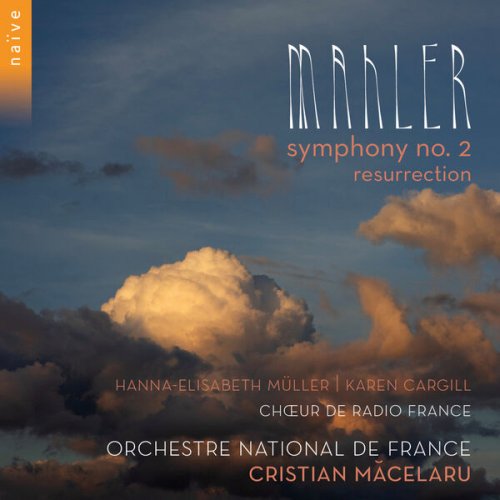
Artist: Cristian Măcelaru, Orchestre National de France, Choeur de Radio France
Title: Mahler: Symphony No. 2 "Resurrection"
Year Of Release: 2026
Label: Naive
Genre: Classical
Quality: FLAC (tracks) / 24bit-96kHz FLAC (tracks)
Total Time: 01:25:28
Total Size: 308 MB / 1.34 GB
WebSite: Album Preview
Tracklist:Title: Mahler: Symphony No. 2 "Resurrection"
Year Of Release: 2026
Label: Naive
Genre: Classical
Quality: FLAC (tracks) / 24bit-96kHz FLAC (tracks)
Total Time: 01:25:28
Total Size: 308 MB / 1.34 GB
WebSite: Album Preview
CD1
1. Symphony No. 2, GMW 30 "Resurrection": Ia. Allegro maestoso. Mit durchaus ernstem und feierlichem Ausdruck (Orchestra) (6:02)
2. Symphony No. 2, GMW 30 "Resurrection": Ib. Sehr mässig und zurückhaltend (Orchestra) (6:07)
3. Symphony No. 2, GMW 30 "Resurrection": Ic. Schnell (Orchestra) (3:46)
4. Symphony No. 2, GMW 30 "Resurrection": Id. Tempo I (Orchestra) (3:59)
5. Symphony No. 2, GMW 30 "Resurrection": Ie. Tempo sostenuto (Orchestra) (3:38)
CD2
1. Symphony No. 2, GMW 30 "Resurrection": IIa. Andante moderato. Sehr gemächlich (Orchestra) (1:23)
2. Symphony No. 2, GMW 30 "Resurrection": IIb. Nicht eilen. Sehr gemächlich (Orchestra) (1:33)
3. Symphony No. 2, GMW 30 "Resurrection": IIc. In Tempo I. zurückkehren (Orchestra) (1:39)
4. Symphony No. 2, GMW 30 "Resurrection": IId. Energisch bewegt (Orchestra) (2:30)
5. Symphony No. 2, GMW 30 "Resurrection": IIe. Wieder ins Tempo zurückgehen (Orchestra) (3:12)
6. Symphony No. 2, GMW 30 "Resurrection": IIIa. In ruhiger fliessender Bewegung (Orchestra) (4:35)
7. Symphony No. 2, GMW 30 "Resurrection": IIIb. Sehr getragen und gesangvoll (Orchestra) (1:24)
8. Symphony No. 2, GMW 30 "Resurrection": IIIc. Zum Tempo I. zurückkehren (Orchestra) (4:46)
9. Symphony No. 2, GMW 30 "Resurrection": IV. Urlicht. Sehr feierlich, aber schlicht. Choralmässig - "O Röschen rot!" (Mezzo-soprano, Orchestra) (5:39)
10. Symphony No. 2, GMW 30 "Resurrection": Va. Im Tempo des Scherzos. Wild herausfahren (Orchestra) (1:46)
11. Symphony No. 2, GMW 30 "Resurrection": Vb. Langsam (Orchestra) (4:06)
12. Symphony No. 2, GMW 30 "Resurrection": Vc. Im Anfang sehr zurückgehalten (Orchestra) (1:14)
13. Symphony No. 2, GMW 30 "Resurrection": Vd. Wieder sehr breit (Orchestra) (3:08)
14. Symphony No. 2, GMW 30 "Resurrection": Ve. Maestoso (Orchestra) (4:01)
15. Symphony No. 2, GMW 30 "Resurrection": Vf. Wieder zurückhaltend (Orchestra) (3:47)
16. Symphony No. 2, GMW 30 "Resurrection": Vg. Sehr langsam und gedehnt (Orchestra) (2:39)
17. Symphony No. 2, GMW 30 "Resurrection": Vh. Langsam. Misterioso - "Aufersteh'n, ja aufersteh'n" (Soprano, Chorus) (3:33)
18. Symphony No. 2, GMW 30 "Resurrection": Vi. Langsam. Nicht schleppen - "Wieder aufzublüh'n, wirst du gesät!" (Soprano, Chorus) (3:46)
19. Symphony No. 2, GMW 30 "Resurrection": Vj. Etwas bewegter - "O glaube, mein Herz, o glaube!" (Mezzo-soprano, Soprano, Chorus, Mezzo-soprano) (3:19)
20. Symphony No. 2, GMW 30 "Resurrection": Vk. vMit Aufschwung, aber nicht eilen - "O Schmerz! Du Alldurchdringer! … Auferstehn, ja auferstehn wirst du" (Mezzo-soprano, Soprano, Chorus) (4:08)
Over two evenings on 24 and 25 October 2024, the Orchestre National de France, under its music director Cristian Măcelaru, immersed themselves in the extraordinary symphonic epic that Gustav Mahler wrote in the 1890s - his utterly unrestrained Symphony No. 2, the Resurrection. What a baptism of fire.
The Romanian conductor, not known for his Mahler until now, boldly takes up, in Paris, the very same score that the legendary Leonard Bernstein conducted at his first great Parisian triumph on 13 November 1958 - which, as it happens, was also with the Orchestre National.
More than 70 years after Bernstein, Cristian Măcelaru offers a vision that is the complete opposite, with a chamber-like approach of delicacy and pastoral warmth, in contrast to his illustrious predecessor’s grandiose and solemn take. The textures are therefore amazingly light - the magnificent transparency of the strings is answered by woodwinds brimming with freshness, discreetly revealing the roots of a composer born not far from Prague who was passionately drawn to new sonorities and unexpected instrumental blends.
Under the Romanian conductor’s direction, joined here by the luminous soprano of Hanna-Elisabeth Müller and the amber-toned mezzo of Karen Cargill, the passionate journey of the Resurrection becomes one of profound serenity. The architecture of the work remains consistently natural and supple, and the symphony finds its unity effortlessly despite the remarkable diversity of soundscapes of which it is made.
The Romanian conductor, not known for his Mahler until now, boldly takes up, in Paris, the very same score that the legendary Leonard Bernstein conducted at his first great Parisian triumph on 13 November 1958 - which, as it happens, was also with the Orchestre National.
More than 70 years after Bernstein, Cristian Măcelaru offers a vision that is the complete opposite, with a chamber-like approach of delicacy and pastoral warmth, in contrast to his illustrious predecessor’s grandiose and solemn take. The textures are therefore amazingly light - the magnificent transparency of the strings is answered by woodwinds brimming with freshness, discreetly revealing the roots of a composer born not far from Prague who was passionately drawn to new sonorities and unexpected instrumental blends.
Under the Romanian conductor’s direction, joined here by the luminous soprano of Hanna-Elisabeth Müller and the amber-toned mezzo of Karen Cargill, the passionate journey of the Resurrection becomes one of profound serenity. The architecture of the work remains consistently natural and supple, and the symphony finds its unity effortlessly despite the remarkable diversity of soundscapes of which it is made.
![The Miles Davis Quintet - Relaxin' With The Miles Davis Quintet (Remastered 2026) (1958) [Hi-Res]](https://www.dibpic.com/uploads/posts/2026-10/1791472956_cover.jpg "The Miles Davis Quintet - Relaxin' With The Miles Davis Quintet (Remastered 2026) (1958) [Hi-Res]")
![Mildlife - Live on Earth (2026) [Hi-Res]](https://www.dibpic.com/uploads/posts/2026-10/1791380861_1.jpg "Mildlife - Live on Earth (2026) [Hi-Res]")
![Magulo - Magulo (2026) [Hi-Res]](https://img.israbox.com/img/2026-10/09/mrnmsxk0jrnxf5r023sj7bm9a.jpg "Magulo - Magulo (2026) [Hi-Res]")
![Wolfgang Mitschke - Behind the Skyline (2026) [Hi-Res]](https://www.dibpic.com/uploads/posts/2026-10/1791293685_folder.jpg "Wolfgang Mitschke - Behind the Skyline (2026) [Hi-Res]")

![Tyler Henderson - The Long Game (2026) [Hi-Res]](https://www.dibpic.com/uploads/posts/2026-10/1791389805_1.jpg "Tyler Henderson - The Long Game (2026) [Hi-Res]")