Oxalis Quartet - Johann Anton André: String Quartets op. 15, 1 & 3 (2026) [Hi-Res]
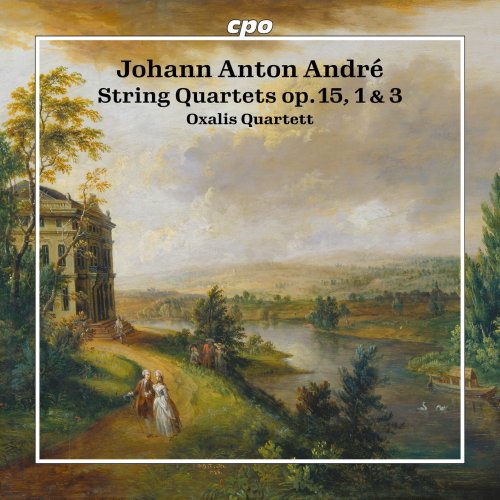
Artist: Oxalis Quartet
Title: Johann Anton André: String Quartets op. 15, 1 & 3
Year Of Release: 2026
Label: CPO
Genre: Classical
Quality: FLAC (tracks) / 24bit-96kHz FLAC (tracks+booklet)
Total Time: 01:00:31
Total Size: 288 MB / 1.09 GB
WebSite: Album Preview
Tracklist:Title: Johann Anton André: String Quartets op. 15, 1 & 3
Year Of Release: 2026
Label: CPO
Genre: Classical
Quality: FLAC (tracks) / 24bit-96kHz FLAC (tracks+booklet)
Total Time: 01:00:31
Total Size: 288 MB / 1.09 GB
WebSite: Album Preview
1. André: String Quartet in E flat major op. 15 No. 1: I. Allegro molto (10:22)
2. André: String Quartet in E flat major op. 15 No. 1: II. Menuetto. Allegretto vivace – Trio (4:26)
3. André: String Quartet in E flat major op. 15 No. 1: III. Adagio con moto quasi andantino (7:01)
4. André: String Quartet in E flat major op. 15 No. 1: IV. Allegretto vivace (3:51)
5. André: Poissons dʼavril en différentes mesures synchrones: No. 1 in A major op. 22: Adagio – Fuga. Moderato (5:23)
6. André: Poissons dʼavril en différentes mesures synchrones: No. 2 in B flat major op. 54: Andante – Fuga. Moderato (4:39)
7. André: String Quartet in D major op. 15 No. 3: I. Poco Adagio e con moto – Allegro vivace (9:39)
8. André: String Quartet in D major op. 15 No. 3: II. Adagio con moto (3:07)
9. André: String Quartet in D major op. 15 No. 3: III. Menuetto. Allegretto vivace – Trio (6:23)
10. André: String Quartet in D major op. 15 No. 3: IV. Finale. Rondo. Allegretto molto vivace (5:48)
“Attention, nostalgia hunters!” is the message at the end of this album, for the refrain of the Allegro molto vivace—with which Johann Anton André concludes his three-part quartet collection, Opus 15—is not far removed from the central theme around which the finale of Ludwig van Beethoven’s last violin sonata revolves. But anyone who might think that the industrious young head of the famous Offenbach publishing house had not shielded himself from outside influences would be mistaken: André’s trilogy appeared a full decade before Beethoven’s Opus 96—honi soit qui mal y pense …
Overall, the encounter with the quartet composer André is a most delightful one. Certainly, he is classically orthodox, writing minuets instead of the emerging scherzos, keeping his developments tightly in check, yet surprising the listener with many small and larger caprices of a harmonic and linear nature that make his scores a considerable pleasure. Even the “filler pieces” are quite something: two Poissons d’Avril (“April Fools’ Jokes”), in which each voice follows its own time signature even when it joins the others to form a full-fledged fugue. That’s no small feat …
Overall, the encounter with the quartet composer André is a most delightful one. Certainly, he is classically orthodox, writing minuets instead of the emerging scherzos, keeping his developments tightly in check, yet surprising the listener with many small and larger caprices of a harmonic and linear nature that make his scores a considerable pleasure. Even the “filler pieces” are quite something: two Poissons d’Avril (“April Fools’ Jokes”), in which each voice follows its own time signature even when it joins the others to form a full-fledged fugue. That’s no small feat …
![Salvatore Bonafede, Eddie Gomez & Billy Hart - Modus Operandi (2026) [Hi-Res]](https://www.dibpic.com/uploads/posts/2026-10/1792077895_cover.jpg "Salvatore Bonafede, Eddie Gomez & Billy Hart - Modus Operandi (2026) [Hi-Res]")
![Kelly Green - Eat Your Greens (Deluxe Edition) (2026) [Hi-Res]](https://www.dibpic.com/uploads/posts/2026-10/1792119522_cover.jpg "Kelly Green - Eat Your Greens (Deluxe Edition) (2026) [Hi-Res]")
![Marla Kether - Luso (2026) [Hi-Res]](https://img.israbox.com/img/2026-10/15/stj850lwmv7giapvdo387au5z.jpg "Marla Kether - Luso (2026) [Hi-Res]")
![Daisy DeVell - UNDERWORLD (2026) [Hi-Res]](https://www.dibpic.com/uploads/posts/2026-10/1791891459_folder.jpg "Daisy DeVell - UNDERWORLD (2026) [Hi-Res]")