Marc André - Mirage (Extended) (2026) [Hi-Res]
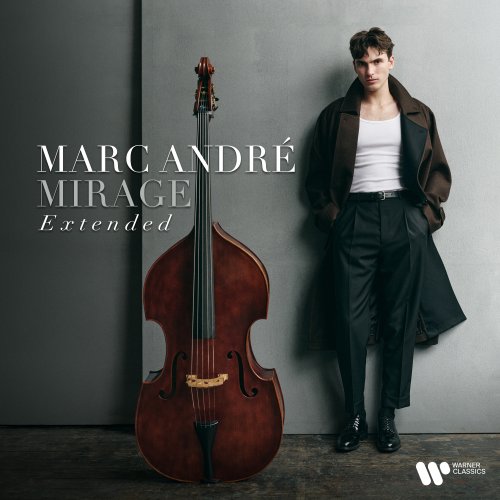
Artist: Marc André
Title: Mirage (Extended)
Year Of Release: 2026
Label: Warner Classics
Genre: Classical
Quality: FLAC (tracks) / 24bit-96kHz FLAC (tracks+booklet)
Total Time: 01:00:27
Total Size: 269 MB / 1.08 GB
Tracklist:Title: Mirage (Extended)
Year Of Release: 2026
Label: Warner Classics
Genre: Classical
Quality: FLAC (tracks) / 24bit-96kHz FLAC (tracks+booklet)
Total Time: 01:00:27
Total Size: 269 MB / 1.08 GB
1. 3 Mélodies, Op. 7: No. 1, Après un rêve (Arr. André. for Double Bass and Piano) (2:57)
2. Gypsy Melodies, Op. 55, B. 104: No. 4, Songs My Mother Taught Me (Arr. Kreisler for Double Bass and Piano) (2:48)
3. Histoire du tango: III. Nightclub 1960 (Perf. by Double Bass and Guitar) (6:20)
4. Beau soir, CD. 84, L. 6 (Perf. by Double Bass and Piano) (2:40)
5. Orfeo ed Euridice, Wq. 30, Act 2: Melody. Dance of the Blessed Spirits (Arr. Kreisler for Double Bass and Piano) (3:11)
6. Andantino quietoso, Op. 6, FWV 5 (Perf. By Double Bass and Piano) (6:07)
7. Cinema Paradiso: Main Theme (Perf. by Double Bass and Piano) (3:10)
8. Melodía sentimental, W556 (Perf. by Double Bass and Piano) (3:17)
9. Suite bergamasque, CD. 82, L. 75: III. Clair de lune (Arr. Roelens for Double Bass and Piano) (4:32)
10. Kinderszenen, Op. 15: No. 7, Träumerei (Perf. by Double Bass and Piano) (2:46)
11. In the Mood for Love: Yumeji's Theme (Perf. by Double Bass and Piano) (2:40)
12. Adagio in G Minor (Perf. by Double Bass and Piano) (5:41)
13. 6 Pieces, Op. 51: No. 6, Valse sentimentale (Perf. by Double Bass and Piano) (2:20)
14. Elegy (Perf. by Double Bass and Piano) (4:35)
15. Song from a Secret Garden (Arr. Astanova for Double Bass and Piano) (3:28)
16. La vida breve: Danza española No. 1 (Arr. André & Bianco for Double Bass and Guitar) (4:03)
This debut album announces a historic milestone, the first exclusive contract between a major classical label and a double bassist. Marc André's mission across these tracks is straightforward: to demonstrate that an instrument typically confined to the orchestral bass section can sing as a genuine solo voice. Playing a modified instrument with five strings rather than the standard four, extending its range and tonal flexibility, André brings a sound closer to the cello's warmth than the double bass's usual orchestral function.
The album opens with Dvořák's Songs My Mother Taught Me in Kreisler's arrangement, immediately establishing André's interpretive priorities. The melody translates onto the double bass with surprising naturalness, the instrument's lower register lending the familiar tune unexpected gravity without sacrificing its essential tenderness. Teruel's piano accompaniment remains attentive throughout, supporting the melodic line without overwhelming the bass's comparatively delicate upper-register work. At the program's center, Piazzolla's "Nightclub 1960" from Histoire du tango introduces guitarist Gabriel Bianco for one of the album's most distinctive pairings. The combination of double bass and guitar suits the tango idiom naturally, both instruments rooted in rhythmic propulsion as much as melody. André navigates the music's sultry, nocturnal character with evident comfort, the duo achieving genuine conversational interplay rather than mere accompaniment. The album closes with de Falla's Danza española from La vida breve, again reuniting André with Bianco. The pairing returns the album to its most rhythmically vivid territory, the Spanish dance's propulsive energy and sharp articulation providing an exuberant conclusion after the more reflective character of the preceding Schumann, Tchaikovsky, and Løvland selections.
The recording presents the instrument with warmth and clarity, capturing the bass's full tonal spectrum without exaggerating its lower frequencies at the expense of nuance. As a calling card establishing a largely unfamiliar solo voice, the album succeeds in its essential purpose, even where individual arrangements lean toward the accessible rather than the adventurous.
© Prince Iwundu /TiVo