Charlie Byrd - Byrdland / More Brazilian Byrd (2000)
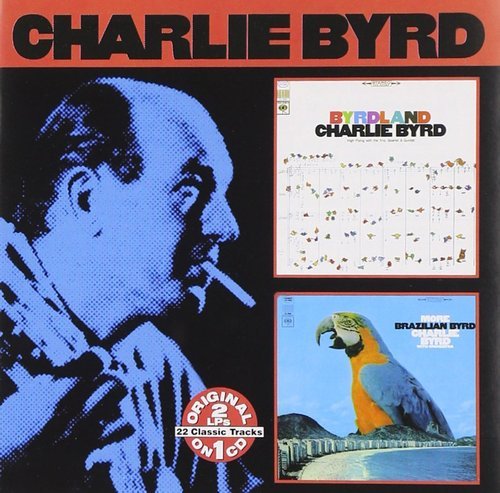
Artist: Charlie Byrd
Title: Byrdland / More Brazilian Byrd
Year Of Release: 2000
Label: Collectables
Genre: Bossa Nova, Bop
Quality: FLAC (tracks+.cue,log)
Total Time: 01:07:38
Total Size: 390 MB
WebSite: Album Preview
Tracklist:Title: Byrdland / More Brazilian Byrd
Year Of Release: 2000
Label: Collectables
Genre: Bossa Nova, Bop
Quality: FLAC (tracks+.cue,log)
Total Time: 01:07:38
Total Size: 390 MB
WebSite: Album Preview
Byrdland (1966)
01. Meditation (3:19)
02. Girl (1:57)
03. Samba de Orpheus (4:47)
04. I'll Be Around (3:49)
05. Work Song (2:54)
06. Blues for China (2:43)
07. Arabesque (2:10)
08. Theme from "Mr. Lucky" (3:04)
09. It's So Peaceful in the Country (1:56)
10. Manha de Carnaval (3:05)
11. Tomorrow Belongs to Me (2:55)
More Brazilian Byrd (1967)
12. One Note Samba (Samba de Uma Nota So) (2:54)
13. Weekend in Guaruja (Fim de Semana em Guaruja) (4:10)
14. Little Boat (O Barquinho) (2:20)
15. Pretty Butterfly (No Balanco do Jequibau) (3:15)
16. Berimbau (3:50)
17. Agua de Beber (3:14)
18. Jequibau (3:32)
19. How Insensitive (Insensatez) (2:44)
20. Esperando o Sol (4:16)
21. Felicidade (2:18)
22. Foi a Saudade (You Can't Go Home Again) (2:26)
Review by Ronnie D. Lankford, Jr.
There is something immediately warm and accessible about Charlie Byrd's acoustic guitar. Byrdland, which was originally released in 1966, and More Brazilian Byrd, released in 1967, find Byrd playing two widely different sets. On the first, he is joined by bassist Joe Byrd, drummer Bill Reichenbach, trumpeter Hal Posey, and saxophonist Teo Macero. When the heat turns up on "Blues for China" and "Work Song," Byrd cuts loose and pulls out all the stops. Both move briskly and are backed by lively Latin percussion. "Meditation" and "It's So Peaceful in the Country" are more tranquil, giving Byrd a chance for more intimate solo work. The overall setting, along with the song choices, offers a relaxed, atmospheric background in which Byrd's acoustic guitar thrives. Even on less than successful pieces like the Beatles' "Girl," it is still enjoyable to hear his guitar wrap itself around a melody. This melodic sense, along with a lovely tone, serves instrumentals like "Samba de Orpheus" and "Theme From 'Mr. Lucky'" well. The second set finds Byrd backed by an orchestra and will probably be a little mellow for most of his fans. It isn't that his guitar work isn't satisfying. Only that the orchestration pours over his playing like syrup, sweetening the overall sound. Still, it isn't a bad album, especially when placed together with Byrdland. This is an enjoyable combination and offers a good place to sample Byrd's mid-'60s work. His fans will welcome this release.
There is something immediately warm and accessible about Charlie Byrd's acoustic guitar. Byrdland, which was originally released in 1966, and More Brazilian Byrd, released in 1967, find Byrd playing two widely different sets. On the first, he is joined by bassist Joe Byrd, drummer Bill Reichenbach, trumpeter Hal Posey, and saxophonist Teo Macero. When the heat turns up on "Blues for China" and "Work Song," Byrd cuts loose and pulls out all the stops. Both move briskly and are backed by lively Latin percussion. "Meditation" and "It's So Peaceful in the Country" are more tranquil, giving Byrd a chance for more intimate solo work. The overall setting, along with the song choices, offers a relaxed, atmospheric background in which Byrd's acoustic guitar thrives. Even on less than successful pieces like the Beatles' "Girl," it is still enjoyable to hear his guitar wrap itself around a melody. This melodic sense, along with a lovely tone, serves instrumentals like "Samba de Orpheus" and "Theme From 'Mr. Lucky'" well. The second set finds Byrd backed by an orchestra and will probably be a little mellow for most of his fans. It isn't that his guitar work isn't satisfying. Only that the orchestration pours over his playing like syrup, sweetening the overall sound. Still, it isn't a bad album, especially when placed together with Byrdland. This is an enjoyable combination and offers a good place to sample Byrd's mid-'60s work. His fans will welcome this release.