Diego Imbert - Guerres (2026) [Hi-Res]
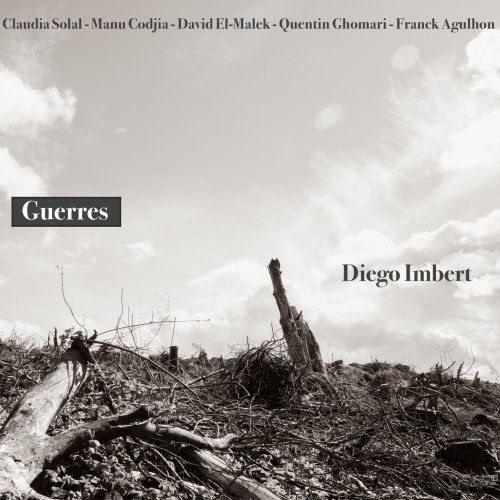
Artist: Diego Imbert
Title: Guerres
Year Of Release: 2026
Label: Trebim Music
Genre: Jazz
Quality: FLAC (tracks) / 24bit-44.1kHz FLAC (tracks)
Total Time: 01:11:58
Total Size: 429 / 846 MB
WebSite: Album Preview
Tracklist:Title: Guerres
Year Of Release: 2026
Label: Trebim Music
Genre: Jazz
Quality: FLAC (tracks) / 24bit-44.1kHz FLAC (tracks)
Total Time: 01:11:58
Total Size: 429 / 846 MB
WebSite: Album Preview
1. Le dormeur du val (6:27)
2. La fleur au fusil (6:04)
3. Morts inquiets (8:50)
4. Guernica (5:45)
5. L'Evadé – Le temps de vivre (9:22)
6. There Will Come Soft Rains (4:55)
7. Carabobo (5:18)
8. My Portion is Defeat - Today (2:40)
9. Le feu (3:41)
10. Désolation (2:42)
11. Prière (5:51)
12. Le crépuscule (3:38)
13. L'Evadé – Le temps de vivre (Short Version) (6:54)
Diego Imbert Sextet, Guerres: Jazz and Poetry Facing the Wars Within and Without
Guerres (“Wars”) is an album born of necessity and which comes from an inner need. The double bassist and composer Diego Imbert has said he wanted to put into music the troubling state of the contemporary world: armed conflicts, social fractures, political and ideological tensions, but also the inner wars that run through individuals. The result, he says, is an unstable and anxious landscape that is often hard to grasp except through emotion. Speaking about the project, he admits that it lets him exorcise some things. He is very worried about the present moment, about the wars under way and about growing populism, and he wonders what world his children will grow up in.
The presentation text written by Pascal Anquetil says the album is neither an abstract manifesto, nor a cry of anger, nor an exercise in style. I like this description, because it names what Guerres avoids. Imbert does not want to describe war in an illustrative way. He wants to question its human, psychological and poetic echoes, with tension running between chaos and balance, violence and fragility, silence and overflowing sound.
For this album, Diego Imbert’s group is a sextet, which Imbert describes as an enlargement of his usual quartet with two decisive presences: Claudia Solal (voice), Quentin Ghomari (trumpet and flugelhorn), David El-Malek (saxophone), Manu Codjia (guitar), Franck Agulhon (drums) and Diego Imbert (double bass).
The quartet at the core, with El-Malek, Ghomari and Agulhon, has been playing his music for years. Imbert has led a quartet since 2008, with three studio albums, À l’ombre du saule pleureur (2009), Next Move (2011) and Colors (2015), so the rapport between these players is not new.
The choice of line-up is at the heart of the writing. The electric guitar of Manu Codjia, who has crossed paths with Imbert sporadically for many years, brings a new textural and harmonic dimension. It can evoke rupture and tearing as readily as light or calm. Claudia Solal’s voice, for her part, is not thought of as a simple melodic vehicle but as a space for narration, breath and poetic speech, sometimes sung, sometimes spoken, sometimes simply a sound presence. She had already worked with Imbert on a project built on poems by Guillaume Apollinaire, so the partnership is a continuation.
The poems are the album’s backbone. Imbert and Solal chose six poets, three men and three women, French and English-language: Arthur Rimbaud, Boris Vian, Antonin Artaud, Renée Vivien, Sara Teasdale and Emily Dickinson.
Claudia Solal: voice
Quentin Ghomari: trumpet and flugelhorn
David El-Malek: saxophone
Manu Codjia: guitar
Franck Agulhon: drums
Diego Imbert: double bass
Download Link Isra.Cloud
Diego Imbert - Guerres Hi-Res.rar - 846.8 MB
Diego Imbert - Guerres FLAC.rar - 429.0 MB
Diego Imbert - Guerres Hi-Res.rar - 846.8 MB
Diego Imbert - Guerres FLAC.rar - 429.0 MB