Lee Wiley - Back Home Again (1994) Lossless
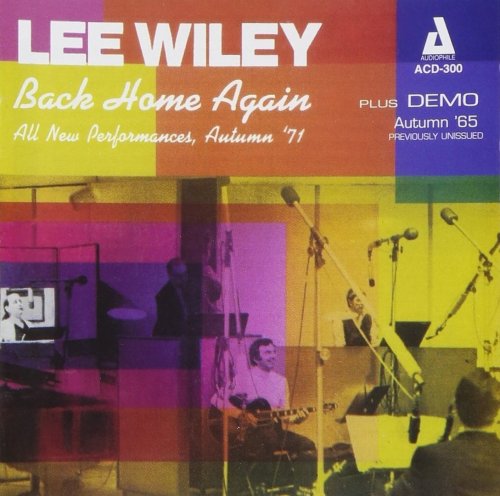
Artist: Lee Wiley
Title: Back Home Again
Year Of Release: 1994
Label: Audiophile Records ACD-300
Genre: Vocal Jazz
Quality: APE (image+.cue,log,scans)
Total Time: 1:14:58
Total Size: 331 MB
WebSite: Album Preview
Tracklist:Title: Back Home Again
Year Of Release: 1994
Label: Audiophile Records ACD-300
Genre: Vocal Jazz
Quality: APE (image+.cue,log,scans)
Total Time: 1:14:58
Total Size: 331 MB
WebSite: Album Preview
01. Moon River (3:34)
02. When I Fall In Love (3:14)
03. You're Lucky To Me (3:41)
04. A Woman's Intuition (2:27)
05. I'll Be Home (3:50)
06. A Love Like This (3:01)
07. A Sleeping Bee (3:50)
08. Indiana (3:39)
09. Spring Will Be A Little Late This Year (3:45)
10. I'm Coming, Virginia (2:53)
11. If I Love Again (4:00)
12. Any Time, Any Day, Anywhere (3:03)
13. When I Leave The World Behind (6) (2:27)
14. Why Shouldn't I (4) (1:39)
15. The Lonesome Road (3) (2:07)
16. Some Day You'll Be Sorry (1) (2:41)
17. I Left My Heart In San Francisco (1) (2:53)
18. Indiana (3) (3:01)
19. When I Leave The World Behind (1) (3:32)
20. When I Leave The World Behind (5) (1:25)
21. Why Shouldn't I (1+2) (2:50)
22. Why Shouldn't I (3) (2:02)
23. The Lonesome Road (1) (3:01)
24. The Lonesome Road (2) (2:11)
25. The Lonesome Road (4) (2:10)
26. The Lonesome Road (6) (2:04)
LEE WILEY
Lee Wiley is back home again, right where we want her in a new album of good songs, all of them favorites of hers, only two of which she has recorded before. These two were included for the sake of old times — A Woman's Intuition, written for Lee by Victor Young and Ned Washington, and Any Time, Any Day, Anywhere, Lee's own song, which she wrote with Victor Young and Ned Washington.
There are two other compositions of Victor Young, the composer-conductor with whom Lee rose to prominence in radio: When I Fall In Love, his definitive ballad, with lyric by Edward Heyman, and A Love Like This, the love theme from Victor's score for the motion picture, "For Whom The Bell Tolls," with lyric by Ned Washington.
Lee is probably best known for her interpretations of songs by Broadway show composers — Gershwin, Porter, Berlin, Rodgers, Arlen — and for her own special renditions of jazz-oriented songs accompanied by top jazz musicians.
This is right enough, but Lee's range is wider, as this collection demonstrates. In addition to the four Victor Young numbers, there are ballads, sensitively interpreted - /f I Love Again, Spring Will Be A Little Late This Year, and A Sleepin' Bee, the latter from Harold Arlen's beautiful "House Of Flowers" score. There is a country-type song, I'll Be Home, there are jazz standards. I'm Coming, Virginia and Indiana, and a nostalgic num¬ber, You're Lucky To Me, introduced by Ethel Waters in "Blackbirds of 1930." And, to seal it all, there is Moon River, the ageless song by Henry Mancini and Johnny Mercer.
Lee's admirers, in addition to musicians and record collectors, include the many of us who know and love her special qualities. Her voice, immediately recognizable, has the sympathetic quality of a viola. She can create a mood, darkly emotional, as in A Love Like This, or tender, as in When I Fall In Love, or she can summon the mood which accompanies communing with a bee who "lies sleepin' in the palm of your hand."
Then there is the way Lee handles a lyric. It is not merely a matter of diction; it is
performance. The words have meaning and the meaning is communicated to the listener, whether it is "When I fall in love, it will be forever..." or "...my huckleberry friend ..or "Back home again — in Indiana...".
Jerome Kern once illustrated this kind of communication with the audience when he referred to Helen Morgan as a "projecteuse". This ability to project and create rapport shines through, particularly in Spring Will Be A Little Late This Year and A Woman's Intuition.
Lee has always been known as a musician's singer. This is because she phrases like a musician and has attracted leading jazz musicians to work with her. This musician-singer relationship is interesting: it works both ways. Singers have always admired musicians, the Tommy Dorsey kind, who play a melody with phrasing that fits the lyric.
This affinity between singer and musician was evident at the recording sessions. Everyone spoke the same language. Bill Borden, Monmoutii-Evergreen producer, and trumpeter Rusty Dedrick assembled an all-star group (see personnel listing).
Rusty Dedrick's arrangements for the ensemble are most effective. In Moon River, when we hear the figure enunciated in the introduction, we are lost in a mood which is sustained throughout. In A Sleepin' Bee, the descending chords in the second eight bars serve to emphasize the mood established in the introduction by piano and guitar.
There is fine solo work by Johnny Mince on alto in I'll Be Home and on clarinet in Any Time, Any Day, Anywhere. Buddy Morrow's trombone is lyrical and eloquent in When I Fall In Love and If I Love Again. Rusty Dedrick's relaxed muted trumpet in A Sleepin'Bee is very much in character and he does an inventive interlude on the flugel- horn in Spring Will Be A Little Late This Year.
Dick Hyman contributes enormously on both piano and organ. The organ provides background for two songs, expansively in When I Fall In Love and with a lilt in Spring Will Be A Little Late This Year. Piano states the idea tenderly in the introduction to If I Love Again and with a touch of stride in I'm Coming, Virginia. Dick's piano accompaniment and George Duvivier's string bass help make Lee's treatment
of A Woman's Intuition altogether enchanting.
Bucky Pizzarelli's use of classic Spanish guitar in A Love Like This is an outstanding moment, evocative of "For Whom The Bell Tolls." With a background of sustained organ, bass, and drumbeats, the guitar provides the right setting for Lee's compassionate performance.
There is real good jazz when Lee and the band launch into Any Time, Any Day, Anywhere, and Indiana. In the studio, when Lee introduced her husband, Nat Tischenkel, she said, "I told Nat how good the band was and he said, 'Well, Bill Borden told you he was going to get the best'."
Lee Wiley is the girl from Oklahoma who came to New York and made it big in radio, sang in jazz clubs and fashionable cafes, and recorded the best with the best. She met every challenge, including a siege of blindness, from which her indestructible spirit rescued her. She went on to make for herself a much-loved niche in the music world.
Lee is still that same girl from Oklahoma. She is one of a few. We are glad she is back home again — and we hope she is with us to stay.
-HERBSANFORD, 1971
Lee Wiley is back home again, right where we want her in a new album of good songs, all of them favorites of hers, only two of which she has recorded before. These two were included for the sake of old times — A Woman's Intuition, written for Lee by Victor Young and Ned Washington, and Any Time, Any Day, Anywhere, Lee's own song, which she wrote with Victor Young and Ned Washington.
There are two other compositions of Victor Young, the composer-conductor with whom Lee rose to prominence in radio: When I Fall In Love, his definitive ballad, with lyric by Edward Heyman, and A Love Like This, the love theme from Victor's score for the motion picture, "For Whom The Bell Tolls," with lyric by Ned Washington.
Lee is probably best known for her interpretations of songs by Broadway show composers — Gershwin, Porter, Berlin, Rodgers, Arlen — and for her own special renditions of jazz-oriented songs accompanied by top jazz musicians.
This is right enough, but Lee's range is wider, as this collection demonstrates. In addition to the four Victor Young numbers, there are ballads, sensitively interpreted - /f I Love Again, Spring Will Be A Little Late This Year, and A Sleepin' Bee, the latter from Harold Arlen's beautiful "House Of Flowers" score. There is a country-type song, I'll Be Home, there are jazz standards. I'm Coming, Virginia and Indiana, and a nostalgic num¬ber, You're Lucky To Me, introduced by Ethel Waters in "Blackbirds of 1930." And, to seal it all, there is Moon River, the ageless song by Henry Mancini and Johnny Mercer.
Lee's admirers, in addition to musicians and record collectors, include the many of us who know and love her special qualities. Her voice, immediately recognizable, has the sympathetic quality of a viola. She can create a mood, darkly emotional, as in A Love Like This, or tender, as in When I Fall In Love, or she can summon the mood which accompanies communing with a bee who "lies sleepin' in the palm of your hand."
Then there is the way Lee handles a lyric. It is not merely a matter of diction; it is
performance. The words have meaning and the meaning is communicated to the listener, whether it is "When I fall in love, it will be forever..." or "...my huckleberry friend ..or "Back home again — in Indiana...".
Jerome Kern once illustrated this kind of communication with the audience when he referred to Helen Morgan as a "projecteuse". This ability to project and create rapport shines through, particularly in Spring Will Be A Little Late This Year and A Woman's Intuition.
Lee has always been known as a musician's singer. This is because she phrases like a musician and has attracted leading jazz musicians to work with her. This musician-singer relationship is interesting: it works both ways. Singers have always admired musicians, the Tommy Dorsey kind, who play a melody with phrasing that fits the lyric.
This affinity between singer and musician was evident at the recording sessions. Everyone spoke the same language. Bill Borden, Monmoutii-Evergreen producer, and trumpeter Rusty Dedrick assembled an all-star group (see personnel listing).
Rusty Dedrick's arrangements for the ensemble are most effective. In Moon River, when we hear the figure enunciated in the introduction, we are lost in a mood which is sustained throughout. In A Sleepin' Bee, the descending chords in the second eight bars serve to emphasize the mood established in the introduction by piano and guitar.
There is fine solo work by Johnny Mince on alto in I'll Be Home and on clarinet in Any Time, Any Day, Anywhere. Buddy Morrow's trombone is lyrical and eloquent in When I Fall In Love and If I Love Again. Rusty Dedrick's relaxed muted trumpet in A Sleepin'Bee is very much in character and he does an inventive interlude on the flugel- horn in Spring Will Be A Little Late This Year.
Dick Hyman contributes enormously on both piano and organ. The organ provides background for two songs, expansively in When I Fall In Love and with a lilt in Spring Will Be A Little Late This Year. Piano states the idea tenderly in the introduction to If I Love Again and with a touch of stride in I'm Coming, Virginia. Dick's piano accompaniment and George Duvivier's string bass help make Lee's treatment
of A Woman's Intuition altogether enchanting.
Bucky Pizzarelli's use of classic Spanish guitar in A Love Like This is an outstanding moment, evocative of "For Whom The Bell Tolls." With a background of sustained organ, bass, and drumbeats, the guitar provides the right setting for Lee's compassionate performance.
There is real good jazz when Lee and the band launch into Any Time, Any Day, Anywhere, and Indiana. In the studio, when Lee introduced her husband, Nat Tischenkel, she said, "I told Nat how good the band was and he said, 'Well, Bill Borden told you he was going to get the best'."
Lee Wiley is the girl from Oklahoma who came to New York and made it big in radio, sang in jazz clubs and fashionable cafes, and recorded the best with the best. She met every challenge, including a siege of blindness, from which her indestructible spirit rescued her. She went on to make for herself a much-loved niche in the music world.
Lee is still that same girl from Oklahoma. She is one of a few. We are glad she is back home again — and we hope she is with us to stay.
-HERBSANFORD, 1971
![James Brandon Lewis, Red Lily - Calling Antonín (2026) [Hi-Res]](https://www.dibpic.com/uploads/posts/2026-10/1792596674_1.jpg "James Brandon Lewis, Red Lily - Calling Antonín (2026) [Hi-Res]")
![Danny Green - Let the Music Happen (2026) [Hi-Res]](https://img.israbox.com/img/2026-10/22/mdm41zc1afaeopu7ne8yr2rf3.jpg "Danny Green - Let the Music Happen (2026) [Hi-Res]")