Trio Mediaeval - Stella Maris (2005) Lossless
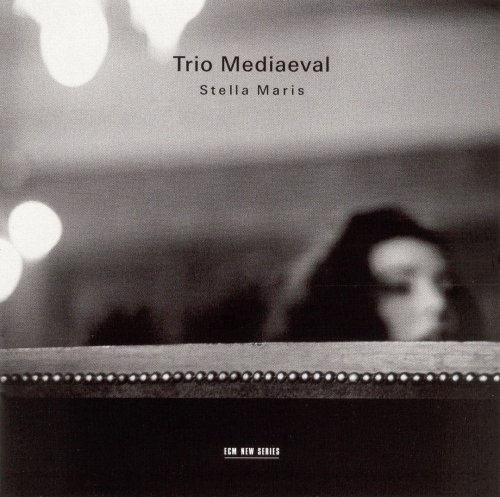
Artist: Trio Mediaeval
Title: Stella Maris
Year Of Release: 2005
Label: ECM New Series
Genre: Classical, Vocal
Quality: FLAC (tracks+.cue,log,scans)
Total Time: 65:43
Total Size: 296 Mb
WebSite: Album Preview
Tracklist: Title: Stella Maris
Year Of Release: 2005
Label: ECM New Series
Genre: Classical, Vocal
Quality: FLAC (tracks+.cue,log,scans)
Total Time: 65:43
Total Size: 296 Mb
WebSite: Album Preview
01. Flos Regalis Virginalis
02. O Maria, Stella Maris
03. Quem Trina Polluit
04. Dou Way Robyn / Sancta Mater
05. Veni Creator Spiritus
06. Dum Sigillum
07. Beata Viscera
08. Missa Lumen De Lumine- Kyrie
09. Missa Lumen De Lumine- Gloria
10. Missa Lumen De Lumine- Credo
11. Missa Lume De Lumine- Sanctus
12. Missa Lume De Lumine- Agnus Dei
Performers:
Anna Maria Friman - vocal
Linn Andrea Fuglseth - vocal
Torunn Østrem Ossum - vocal
Trio Mediaeval is a group of three women from Norway who sing unaccompanied harmonies using medieval polyphony as a point of departure. Even given that we can never really know what 800-year-old music sounded like in its own time, it can be said that they remake medieval pieces according to their own wishes rather than researching their original sound worlds. Their harmony singing is striking. It's highly expressive, with a variety of subtle vocal moves enlivening what is basically an austere musical vocabulary; they apply vibrato at times, and they relax the tempo slightly in order to bring out the pungent dissonances that pass by from time to time in medieval polyphony, with its predominantly linear conception. Stella Maris presents six examples of the freely composed conductus genre that flourished in the twelfth and thirteenth centuries, one unique multitextual English piece (Dou way Robin/Sancta Mater), and Missa Lumen de Lumine, a Mass Ordinary setting by contemporary Korean composer Sungji Hong.
Performances of medieval music, perhaps even more than those of music from later periods, are a matter of taste, with reactions depending partly on what the listener hopes to get out of the music. Those who find a quality of spiritual ecstasy in medieval polyphony and its sense of discovery of new sounds will likely find Trio Mediaeval's performances revelatory. They argue that it makes sense to have women sing this music even though it originated in all-male settings, and they're right -- even if women did not sing these particular pieces, innovative music, some of it polyphonic, originated in medieval convents. Female performers have as much right to the music as anyone else. However, listeners who are really trying to take themselves back to medieval times may feel that Trio Mediaeval has a surfeit of style and a deficit of substance. Such listeners will notice that texts are given only in Latin in the liner notes, and it's hard to begin to understand medieval music unless one knows what is being sung about.
Regardless of one's tastes, the inclusion of Hong's Missa Lumen di Lumine is welcome. Written especially for Trio Mediaeval, the mass is not a neo-medieval piece but includes a variety of references to medieval styles: parallel harmonies, and syncopated rhythms of the sort found in Machaut's mass, for instance. Even within the restrictions imposed by the act of writing for three unaccompanied women's voices, Hong responds to the texts of the Mass Ordinary in amazingly flexible ways. Pictorial effects are present in abundance but are always subtly done; consider the mood of quiet confidence exuded by the music for Christ's resurrection in the Credo, so different from the usual ascending scales attached to the words "Et resurrexit." Hong uses register and spacing among the voices to marvelous effect. Stella Maris thus introduces a major new work that could well be taken up by other female vocal ensembles. ECM's sound engineering shines in this minimal setting.
Performances of medieval music, perhaps even more than those of music from later periods, are a matter of taste, with reactions depending partly on what the listener hopes to get out of the music. Those who find a quality of spiritual ecstasy in medieval polyphony and its sense of discovery of new sounds will likely find Trio Mediaeval's performances revelatory. They argue that it makes sense to have women sing this music even though it originated in all-male settings, and they're right -- even if women did not sing these particular pieces, innovative music, some of it polyphonic, originated in medieval convents. Female performers have as much right to the music as anyone else. However, listeners who are really trying to take themselves back to medieval times may feel that Trio Mediaeval has a surfeit of style and a deficit of substance. Such listeners will notice that texts are given only in Latin in the liner notes, and it's hard to begin to understand medieval music unless one knows what is being sung about.
Regardless of one's tastes, the inclusion of Hong's Missa Lumen di Lumine is welcome. Written especially for Trio Mediaeval, the mass is not a neo-medieval piece but includes a variety of references to medieval styles: parallel harmonies, and syncopated rhythms of the sort found in Machaut's mass, for instance. Even within the restrictions imposed by the act of writing for three unaccompanied women's voices, Hong responds to the texts of the Mass Ordinary in amazingly flexible ways. Pictorial effects are present in abundance but are always subtly done; consider the mood of quiet confidence exuded by the music for Christ's resurrection in the Credo, so different from the usual ascending scales attached to the words "Et resurrexit." Hong uses register and spacing among the voices to marvelous effect. Stella Maris thus introduces a major new work that could well be taken up by other female vocal ensembles. ECM's sound engineering shines in this minimal setting.
![Charles Tolliver - Mosaic Select 20 (2005) [Box Set 3CD]](https://www.dibpic.com/uploads/posts/2021-01/1610661758_folder.jpeg "Charles Tolliver - Mosaic Select 20 (2005) [Box Set 3CD]")
![Sarah Vaughan - Sarah Vaughan à Paris (Remastered, Stereo Version) (2013) [Hi-Res]](https://www.dibpic.com/uploads/posts/2026-10/1792764218_cover.jpg "Sarah Vaughan - Sarah Vaughan à Paris (Remastered, Stereo Version) (2013) [Hi-Res]")
![Brigitte Fontaine - Comme à la radio (Special Edition) (2026) [Hi-Res]](https://img.israbox.com/img/2026-10/22/bza7aw5xi45l2amboa3ugjdgd.jpg "Brigitte Fontaine - Comme à la radio (Special Edition) (2026) [Hi-Res]")
![Projecte Astrolabi - L'Antiga Energia (2026) [Hi-Res]](https://www.dibpic.com/uploads/posts/2026-10/1792488609_cover.jpg "Projecte Astrolabi - L'Antiga Energia (2026) [Hi-Res]")
![Claptrap - Second Guessing (2026) [Hi-Res]](https://img.israbox.com/img/2026-10/19/azhsz7crv134b1keju3jyl9vq.jpg "Claptrap - Second Guessing (2026) [Hi-Res]")