Les Talens Lyriques & Christophe Rousset - Martín Y Soler: La Capricciosa Corretta (2004)
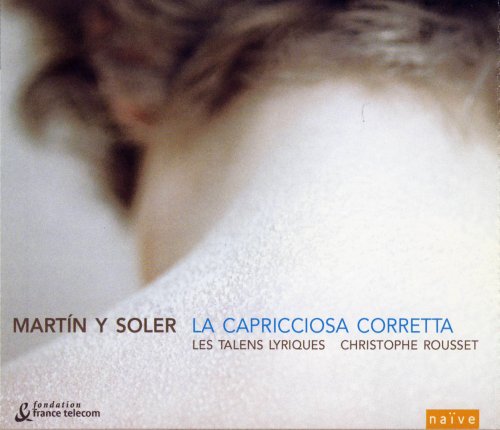
Artist: Christophe Rousset, Les Talens Lyriques
Title: Martín Y Soler: La Capricciosa Corretta
Year Of Release: 2004
Label: Naïve
Genre: Classical
Quality: FLAC (image + .cue, log, artwork)
Total Time: 2:13:15
Total Size: 645 MB
WebSite: Album Preview
Title: Martín Y Soler: La Capricciosa Corretta
Year Of Release: 2004
Label: Naïve
Genre: Classical
Quality: FLAC (image + .cue, log, artwork)
Total Time: 2:13:15
Total Size: 645 MB
WebSite: Album Preview

Think Mozart without “too many notes” (i.e., harmonic complexities) and you’ll have an excellent idea of what this late collaboration between Vicente Martín y Soler and Lorenzo da Ponte is like. It was, of course, a partnership that achieved its greatest fame in Mozart’s Vienna of the 1780s, largely due to the phenomenal successes of Una cosa rara and L’arbore di Diana. But for La capricciosa corretta (“The capricious woman chastised”), or La scuola dei maritati (“The school for married couples”) as it was known at the time of its first production, we move forward into the following decade and a new location — London.
Da Ponte, who had come to London after falling out of favor in Vienna, renewed his collaboration with Martín in 1794, the latter traveling from St. Petersburg, where he was now maestro di cappella, to compose an opera buffa to provide a vehicle for the soprano Anna Bosello Morichelli. The result was La scuola dei maritati, first given with great success at the King’s Theatre on January 27, 1795. La scuola subsequently embarked on a triumphant conquest of European cities, of which Florence (1796) provided the basis for the performing edition (the London score is lost) prepared by Christophe Rousset for the present recording.
Da Ponte’s libretto owes no small debt to Goldoni, or indeed to his own previous librettos. The fast moving sequence of events takes place, like Figaro, over the course of a single day, culminating, again like Mozart’s masterpiece, in a night scene of mystery and confusion in which the day’s crazy happenings are ultimately resolved. To attempt to explain here all the preceding turmoil would involve far too many complexities, but suffice it to say that it revolves around Ciprigna, a capricious young woman married to a well-meaning, if ineffectual old buffer, Bonario. Her behavior has driven everyone in the household to their wits end, it being left to the wily Fiuta, a first cousin of Figaro, to ultimately bring Ciprigna to heel. Resonance with Mozart’s da Ponte operas in particular, and opera buffa in general ring loud and clear. Musically, too, Mozartian echoes abound. The exquisite act I quintet, “Se figli vi siamo,” carries unmistakable reminders of the trio “O soave il vento” from Così, Fiuta’s “Figuriamo che” (act I) of Figaro’s “Se vuol ballare,” where the sentiments are also similar, as indeed they are in Valerio’s militaristic act II aria, “Un fucil un spadon,” which offers itself up for comparison with Figaro’s “Non più andrai.” One could continue finding parallels, but always with the awareness that Martín’s orchestral writing is infinitely less complex, less demanding on the ear than Mozart’s. That is not say it is in any way deficient, and throughout the ear is frequently drawn to the felicitous wind-writing, while the brief introduction to the final night scene is wonderfully evocative. In addition, the Spanish composer was also an undoubted master of dramatic pacing, evidenced in the unusual number of ensembles in La capricciosa. These are by no means limited to the “chain” finales, and all show the keen awareness of pacing that marks out the born dramatist.
The performance by a virtually unknown and mainly young cast is hugely enjoyable. Rousset’s championship of undeservedly neglected operas is becoming as valuable as that of René Jacobs, his belief in the present example everywhere apparent in his witty, sympathetic, and thoroughly assured direction. The orchestral playing is as accomplished as one expects from this band, some less than ingratiating string tone probably at least in part due to the dry recording.
Vocally, it is quite properly Marguerite Krull’s spirited wife-from-hell that dominates. Ciprigna is a soubrette role that could easily become tiresomely brittle in the wrong hands, but here Krull ensures it does not with singing that convincingly characterizes the role without overstating its more shrewish elements. All three baritones (Ramon, Marin, and Baqerizo) are excellent, the only real disappointment coming from tenor Yves Saelens’s Lelio. He is however given two of the most demanding pieces in the opera, serious lyrical arias that find Saelens wanting in technique.
It would be easy, if ultimately futile, to beat Martín y Soler with a big Mozartian stick. Far more satisfying is to take him for what he was, which, on the evidence of Una cosa rara (recorded by Jordi Savall on Astrée) and La capricciosa, amounts to an exceptionally gifted composer with a genuine understanding of stagecraft, and, equally important, one who knew precisely how to entertain his audiences. -- Brian Robins, FANFARE
Da Ponte, who had come to London after falling out of favor in Vienna, renewed his collaboration with Martín in 1794, the latter traveling from St. Petersburg, where he was now maestro di cappella, to compose an opera buffa to provide a vehicle for the soprano Anna Bosello Morichelli. The result was La scuola dei maritati, first given with great success at the King’s Theatre on January 27, 1795. La scuola subsequently embarked on a triumphant conquest of European cities, of which Florence (1796) provided the basis for the performing edition (the London score is lost) prepared by Christophe Rousset for the present recording.
Da Ponte’s libretto owes no small debt to Goldoni, or indeed to his own previous librettos. The fast moving sequence of events takes place, like Figaro, over the course of a single day, culminating, again like Mozart’s masterpiece, in a night scene of mystery and confusion in which the day’s crazy happenings are ultimately resolved. To attempt to explain here all the preceding turmoil would involve far too many complexities, but suffice it to say that it revolves around Ciprigna, a capricious young woman married to a well-meaning, if ineffectual old buffer, Bonario. Her behavior has driven everyone in the household to their wits end, it being left to the wily Fiuta, a first cousin of Figaro, to ultimately bring Ciprigna to heel. Resonance with Mozart’s da Ponte operas in particular, and opera buffa in general ring loud and clear. Musically, too, Mozartian echoes abound. The exquisite act I quintet, “Se figli vi siamo,” carries unmistakable reminders of the trio “O soave il vento” from Così, Fiuta’s “Figuriamo che” (act I) of Figaro’s “Se vuol ballare,” where the sentiments are also similar, as indeed they are in Valerio’s militaristic act II aria, “Un fucil un spadon,” which offers itself up for comparison with Figaro’s “Non più andrai.” One could continue finding parallels, but always with the awareness that Martín’s orchestral writing is infinitely less complex, less demanding on the ear than Mozart’s. That is not say it is in any way deficient, and throughout the ear is frequently drawn to the felicitous wind-writing, while the brief introduction to the final night scene is wonderfully evocative. In addition, the Spanish composer was also an undoubted master of dramatic pacing, evidenced in the unusual number of ensembles in La capricciosa. These are by no means limited to the “chain” finales, and all show the keen awareness of pacing that marks out the born dramatist.
The performance by a virtually unknown and mainly young cast is hugely enjoyable. Rousset’s championship of undeservedly neglected operas is becoming as valuable as that of René Jacobs, his belief in the present example everywhere apparent in his witty, sympathetic, and thoroughly assured direction. The orchestral playing is as accomplished as one expects from this band, some less than ingratiating string tone probably at least in part due to the dry recording.
Vocally, it is quite properly Marguerite Krull’s spirited wife-from-hell that dominates. Ciprigna is a soubrette role that could easily become tiresomely brittle in the wrong hands, but here Krull ensures it does not with singing that convincingly characterizes the role without overstating its more shrewish elements. All three baritones (Ramon, Marin, and Baqerizo) are excellent, the only real disappointment coming from tenor Yves Saelens’s Lelio. He is however given two of the most demanding pieces in the opera, serious lyrical arias that find Saelens wanting in technique.
It would be easy, if ultimately futile, to beat Martín y Soler with a big Mozartian stick. Far more satisfying is to take him for what he was, which, on the evidence of Una cosa rara (recorded by Jordi Savall on Astrée) and La capricciosa, amounts to an exceptionally gifted composer with a genuine understanding of stagecraft, and, equally important, one who knew precisely how to entertain his audiences. -- Brian Robins, FANFARE
Related Releases:
![Thompson Egbo-Egbo - Just A Thought (2026) [Hi-Res]](https://img.israbox.com/img/2026-10/25/vo2lnijn1esegeq6oif5d7jid.jpg "Thompson Egbo-Egbo - Just A Thought (2026) [Hi-Res]")
![Celloman - The Jazz Sessions (2026) [Hi-Res]](https://www.dibpic.com/uploads/posts/2026-10/1792839632_iyhgl2wg0srjs_600.jpg "Celloman - The Jazz Sessions (2026) [Hi-Res]")
![Qü - Revisit on 3rd Avenue (2026) [Hi-Res]](https://www.dibpic.com/uploads/posts/2026-10/1792843717_x3w6bqjatanjp_600.jpg "Qü - Revisit on 3rd Avenue (2026) [Hi-Res]")
![Eyal Maoz, Edom - Blinding (2026) [Hi-Res]](https://img.israbox.com/img/2026-10/24/h5pajkstwf4rm9o56yc49t6zq.jpg "Eyal Maoz, Edom - Blinding (2026) [Hi-Res]")