Orlando Consort - The Call of the Phoenix (2002)
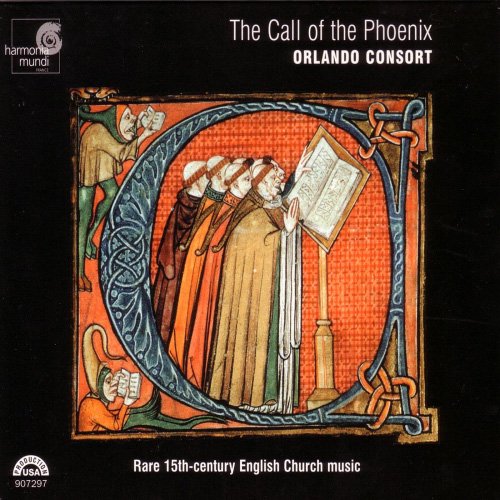
Artist: Orlando Consort, The Orlando Consort
Title: The Call of the Phoenix: Rare 15th Century English Church Music
Year Of Release: 2002
Label: Harmonia Mundi
Genre: Classical
Quality: FLAC (tracks + .cue, log, artwork)
Total Time: 01:10:42
Total Size: 321 MB
WebSite: Album Preview
Tracklist:Title: The Call of the Phoenix: Rare 15th Century English Church Music
Year Of Release: 2002
Label: Harmonia Mundi
Genre: Classical
Quality: FLAC (tracks + .cue, log, artwork)
Total Time: 01:10:42
Total Size: 321 MB
WebSite: Album Preview
01. Stella celi
02. Qual pulcra es
03. Tota pulcra es
04. Gloria
05. Salve scema
06. Credo
07. Tota pulcra es
08. O pulcherrima
09. Sanctus
10. O sanctissime presul
11. Anna mater matris
12. Audivi vocem
13. Ave regina celorum
14. Beata Dei genitrix
15. Ave regina celorum
16. Gaude virgo
17. Nesciens mater
18. Stella celi
The Orlando Consort once again shows its intelligence and educated approach to Renaissance-era music, while not denying the beauty of the pieces. The album is a demonstration, in varied works, of the contenance angloise, the sound that distinguished English music of the fifteenth century from that of the continent. This release pays particular attention to votive antiphons, although there are also a few mass movements included. According to the excellent notes about the works in the accompanying booklet (which also includes lyrics), these were probably written for private chapels or choirs. The more intimate sound of the three- or four-voice works was recorded in a small parish church, so the amount of resonance is appropriate to the original use. There is no huge, hollow-sounding chamber to make the words unintelligible on this recording. The survey begins with works by contemporaries of John Dunstaple and includes a lovely example of Dunstaple's isorhythmic motets in Salve scema. The two upper voices, using two different texts about St. Catherine of Alexandria, wind around the two lower voices, which ground the work with a chant used for her feast day. Another piece from around the same time is the Audivi vocem, a responce that alternates lively, four-voice polyphony with homophonic plainchant, a real contrast of the "old" and the "new." Mixed in with anonymous works of the time are pieces by John Plummer and Walter Frye, representatives of the generation following Dunstaple. Their works show more imitation and passing of melody between voices. The survey ends with Stella Celi by Walter Lambe, from the Eton Choirbook. In all of these pieces, there is clear but complementary independence of lines, sung with grace and a reverence for the music. -- Patsy Morita
![Patricia Moreno - Volver (2026) [DSD]](https://www.dibpic.com/uploads/posts/2026-09/1789311311_as37.jpg "Patricia Moreno - Volver (2026) [DSD]")
![Stochelo Rosenberg, Mozes Rosenberg, Matheus Nicolaiewsky - The Chaplin Project (2026) [Hi-Res]](https://www.dibpic.com/uploads/posts/2026-09/1789481832_folder.jpg "Stochelo Rosenberg, Mozes Rosenberg, Matheus Nicolaiewsky - The Chaplin Project (2026) [Hi-Res]")



![Ayanna Witter-Johnson - New Roots (2026) [Hi-Res]](https://www.dibpic.com/uploads/posts/2026-09/1789484329_folder.jpg "Ayanna Witter-Johnson - New Roots (2026) [Hi-Res]")